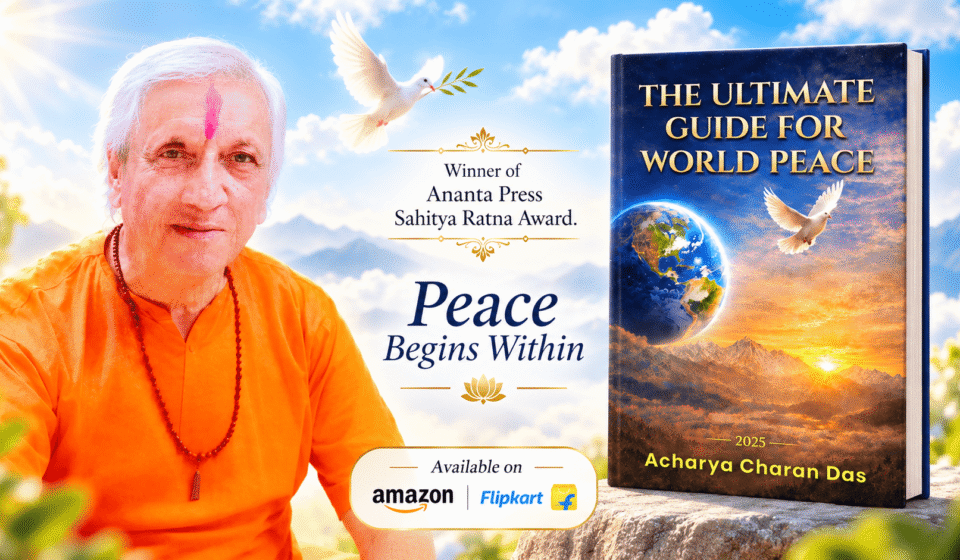

Acharya Charandas’s The Ultimate Guide for World Peace is not a conventional book about diplomacy, international relations, or conflict resolution. It approaches the subject from a more fundamental and spiritual direction: the author asks what kind of human being is capable of creating peace in the first place. His answer is that peace in society cannot be separated from peace in consciousness. Before nations can stop fighting, individuals must learn to govern desire, anger, pride, ego, prejudice, and the restless mind. That starting point gives the book its clearest identity. It is a spiritual manifesto that treats world peace not as a treaty to be signed but as a condition to be cultivated within the self.
The manuscript establishes this perspective from its opening pages. The dedication is addressed to seekers of peace and “absolute truth” who desire coexistence, respect, love for the self, and care for the planet. The introduction then turns to “nature” as a governing principle for life and uses simple analogies to argue that every created thing has characteristics, limits, and responsibilities. The book repeatedly returns to this idea: human beings create disorder when they try to live without understanding the larger laws that connect the self, other living beings, and the natural world. Whether or not every reader accepts the author’s metaphysical conclusions, the structure of the argument is easy to recognize. Inner disorder, in this framework, becomes the seed from which social disorder grows.
This is where the book becomes distinctive. Many books on peace begin at the level of institutions. Charandas begins with consciousness. He asks the reader to consider the quality of the mind that participates in political systems, religious communities, families, economies, and cultural conflicts. A person driven by unlimited desire may speak of peace while acting competitively. A person consumed by pride may speak of brotherhood while insisting on superiority. A person who never examines his own impulses may condemn violence in public and still contribute to cruelty in private. The book’s strongest philosophical contribution lies in making peace a question of personal consistency. It insists that the individual cannot outsource moral responsibility to institutions, leaders, scriptures, or social groups.
The recurring theme of self-realization gives this idea a spiritual vocabulary. Drawing heavily on the Bhagavad Gita and other Vedic sources, the author distinguishes the changing body from the enduring self or soul and argues that a deeper understanding of identity can weaken the impulses that produce rivalry. If people think of themselves only through temporary labels, he suggests, they become trapped in contests over nation, sect, race, possession, status, and bodily pleasure. If they understand themselves as spiritual beings sharing a common origin, the possibility of universal kinship becomes more imaginable. This is the book’s preferred route toward coexistence: not erasing difference, but placing difference below a more basic spiritual unity.
The author’s use of duty is equally important. The text does not present spirituality as withdrawal from ordinary responsibilities. In its discussions of renunciation, it emphasizes working without excessive attachment to personal reward and fulfilling obligations to family and society. That distinction matters because it keeps the book from becoming merely contemplative. Peace, in Charandas’s framework, requires conduct. A peaceful person must work, choose, restrain, serve, and set an example. The book repeatedly stresses that right teaching without right example produces confusion. This concern with example is one of the more memorable threads running through the manuscript. Parents, teachers, spiritual leaders, public figures, and institutions are all measured by the same question: do their actions support what they claim to teach?
Readers will also notice that the book is unusually forceful. It does not adopt the detached tone of academic comparative religion. It is openly committed to a Vedic worldview and frequently challenges religious traditions, historical interpretations, social customs, and modern institutions that the author believes contradict natural or spiritual law. Some passages are polemical and may be uncomfortable, especially for readers whose beliefs are directly criticized. That intensity should be understood as part of the book’s genre and voice. The text is less a neutral survey than an argument made with missionary conviction. Its claims about religion, history, science, and society should therefore be read as the author’s positions, and readers may wish to independently verify factual or historical assertions that matter to them.
Yet the very intensity of the voice also explains why the book is difficult to dismiss as generic. Charandas clearly believes that world peace is too serious a subject for polite vagueness. He wants the reader to compare ideas, question inherited assumptions, and decide whether a teaching produces compassion, restraint, and clarity or produces domination, fear, and division. His method can be confrontational, but his declared destination is consistent: a world in which human beings recognize spiritual kinship, reduce cruelty, protect life, and replace ego-driven competition with a higher sense of responsibility.
The scale of the book reinforces that ambition. The work extends across fifteen chapters, moving from “A Missing Clue for the Right Solution” through comparative religious discussions, population, past Vedic influence, duties and renunciation, “The Missing Pieces of the Puzzle,” a chapter explicitly titled “Solution – The Solutions,” a summary, deeper reflections, things to remember, statements, and suggested readings. This breadth makes the book feel less like a single linear essay and more like a compendium assembled over many years. Quotations, scriptural references, historical anecdotes, images, arguments, and moral questions appear alongside one another. The result is dense, repetitive at times, and deliberately cumulative: the reader is meant to encounter the same central principles from many directions until a pattern emerges.
For a spiritually oriented reader, the most valuable pattern is the link between self-mastery and social peace. The book’s repeated attention to the mind, the senses, desire, karma, compassion, responsibility, and universal spiritual identity gives it a coherent ethical center even when the subject matter ranges widely. Its definition of peace is therefore demanding. Peace is not simply the absence of war. It is a condition in which individuals are less ruled by greed, anger, arrogance, and ignorance; families and communities are guided by example; living beings are treated with greater compassion; and human activity is aligned with what the author understands as the laws of nature.
The Ultimate Guide for World Peace stands out because it refuses to separate the global from the personal. Its world is vast, but its most persistent question is intimate: what kind of consciousness are we cultivating every day? Readers do not have to accept every historical claim, religious judgment, or metaphysical premise to engage with that question. At its best, the book functions as a challenge to examine the distance between the peace we demand from the world and the peace we embody in our own habits. That makes it a substantial, provocative, and deeply committed contribution to spiritual literature on peace.
Amazon Link: https://www.amazon.in/ULTIMATE-GUIDE-WORLD-PEACE-ebook/dp/B0H27JGP8W/