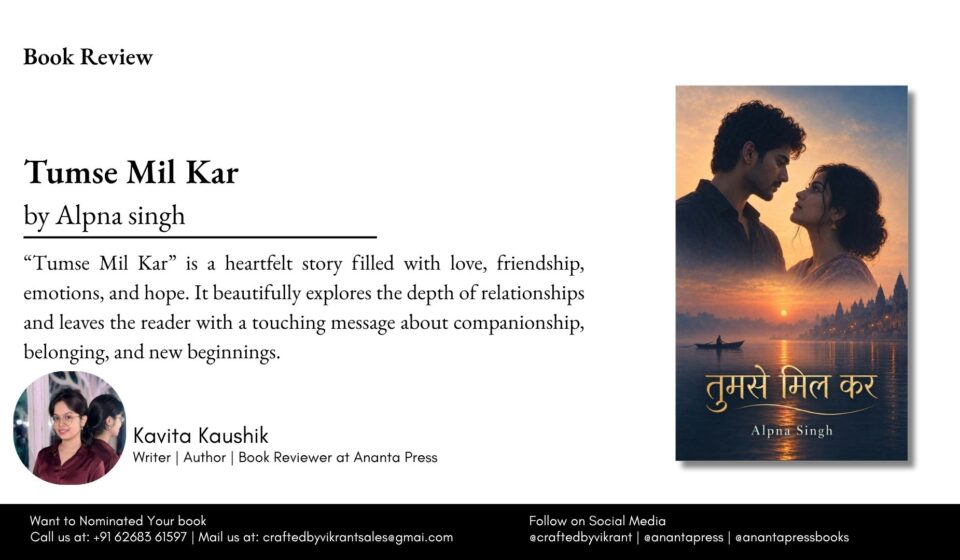

Tumse Mil Kar is an emotionally engaging story that explores love, friendship, longing, memories, relationships, and the complicated choices that people sometimes have to make in life. The story gradually draws the reader into the world of its characters, particularly Yash, whose emotional journey becomes one of the central elements of the narrative. Through conversations, memories, unanswered questions, and moments of silence, the book presents emotions that are often difficult to express in words.
One of the most appealing aspects of the book is the way it portrays human relationships. The characters are not simply connected through ordinary conversations; their relationships are shaped by feelings, expectations, misunderstandings, responsibilities, and the desire to be understood. The story shows that sometimes a person can be physically close to someone yet remain emotionally distant, while at other times even a conversation through a screen can create a deep emotional connection.
Yash’s character carries a strong sense of emotional restlessness. His thoughts, questions, memories, and attachment reveal a person struggling to understand both himself and the people around him. His interactions with others gradually uncover different layers of his personality. At several points, his silence becomes as meaningful as his words, allowing the reader to understand the emotional weight he is carrying.
The presence of friendship adds another important dimension to the story. The conversations between Yash, Vibhu, and Veenoo bring moments of warmth and familiarity to an otherwise emotionally intense narrative. Their friendship provides a sense of companionship and reminds the reader that difficult journeys become easier when there are people willing to stand beside us. Even their lighter conversations create a natural balance within the story.
Another interesting element is the mystery surrounding the woman with whom Yash communicates. His conversations, questions, and curiosity create a sense of anticipation. The reader is encouraged to keep turning the pages to understand who she is, what connects her to Yash, and why certain truths remain hidden. This emotional mystery works alongside the romantic elements of the story and keeps the narrative engaging.
The book also explores the difference between what people show to the world and what they actually experience inside. The characters carry emotions and personal struggles that are not always visible to others. This makes the story relatable because real-life relationships are often shaped by things that remain unspoken. A smile may hide pain, silence may hide longing, and a simple conversation may carry years of emotions.
The emotional descriptions in Tumse Mil Kar are particularly effective. The story uses moments of silence, waiting, memories, messages, and poetry to express feelings. The poetic expressions associated with longing and remembrance give the narrative a softer and more romantic atmosphere. They also help communicate emotions that ordinary dialogue may not be able to capture.
The story’s treatment of waiting is another memorable aspect. Waiting for a message, waiting to meet someone, waiting for an answer, or simply waiting for circumstances to change can become emotionally exhausting. The book captures this feeling through its characters and their experiences. It reminds the reader that sometimes the hardest part of a relationship is not the distance itself, but the uncertainty that comes with it.
At the same time, Tumse Mil Kar is not only a love story. It is also about choices and consequences. The characters have to deal with personal responsibilities, social expectations, past experiences, and emotions that cannot always be followed freely. This creates an emotional conflict between what the heart wants and what life demands.
The character of Manvi adds another important layer to the narrative. Her emotions and decisions demonstrate the complexity of relationships and personal responsibility. Her silence and restraint suggest that people sometimes make difficult choices not because they do not feel deeply, but because they understand the consequences of acting on those feelings. This gives the story an emotional maturity.
The book also succeeds in creating an atmosphere through ordinary settings and everyday moments. Hotel rooms, phone screens, conversations, journeys, and family gatherings become meaningful because of the emotions attached to them. A simple scene can carry the weight of a much larger memory. This approach makes the story feel personal and intimate.
One of the strongest themes running through the narrative is the idea of connection. In a world where communication has become easier through phones and social media, genuine emotional connection can still be difficult to find. The characters communicate through messages and conversations, but behind those words are questions about trust, identity, attachment, and belonging. The story therefore reflects a very contemporary form of relationship while retaining the emotional depth of traditional romance.
The book also shows how the past can continue to influence the present. Memories do not always disappear simply because time has passed. Certain people, conversations, places, and moments remain alive in the mind. For the characters, the past becomes something they must understand before they can truly move forward.
Another notable quality is the emotional contrast within the story. There are moments of sadness, uncertainty, and loneliness, but they are balanced by friendship, humour, affection, and moments of togetherness. This contrast prevents the narrative from becoming emotionally one-dimensional. The lighter interactions between the characters provide relief and make the emotional scenes feel more natural.
The family elements also contribute to the story’s emotional depth. The moments where people come together, talk, eat, smile, or simply share the same space show how important companionship can be. After periods of emotional distance, even an ordinary family moment can feel meaningful. These scenes underline the importance of belonging and human connection.
Overall, Tumse Mil Kar is a story about emotions that are often left unsaid. It explores the space between meeting someone and truly knowing them, between loving someone and being able to stay with them, and between remembering the past and accepting the present. Its characters experience affection, confusion, longing, friendship, responsibility, and emotional conflict in ways that many readers may find familiar.
The narrative is especially likely to appeal to readers who enjoy emotional romance with elements of friendship, mystery, poetry, and personal struggle. Rather than focusing only on romantic attraction, the story gives attention to the emotional consequences of relationships and the choices people make because of them.
What makes the book memorable is its emphasis on feelings rather than grand events. The small moments—the message that is typed and deleted, the question that remains unanswered, the person who waits, the memory that refuses to disappear, or the meeting that happens after years—carry much of the story’s emotional power.
Tumse Mil Kar ultimately leaves the reader with the thought that some meetings change us permanently. Sometimes a person enters our life for a short period but leaves behind emotions that remain for years. Sometimes meeting someone again can bring closure, while at other times it can reopen memories that were carefully hidden away.
The book is therefore not simply about “meeting” someone; it is about what happens emotionally after that meeting. It asks the reader to think about love, attachment, sacrifice, friendship, memories, and the complicated nature of human relationships.
With its emotional characters, relationship-driven narrative, romantic atmosphere, moments of mystery, and poetic expressions, Tumse Mil Kar offers a heartfelt reading experience. It is a story that reminds us that every relationship has its own unanswered questions and that sometimes the deepest emotions are found not in what people say, but in what they choose to leave unsaid.