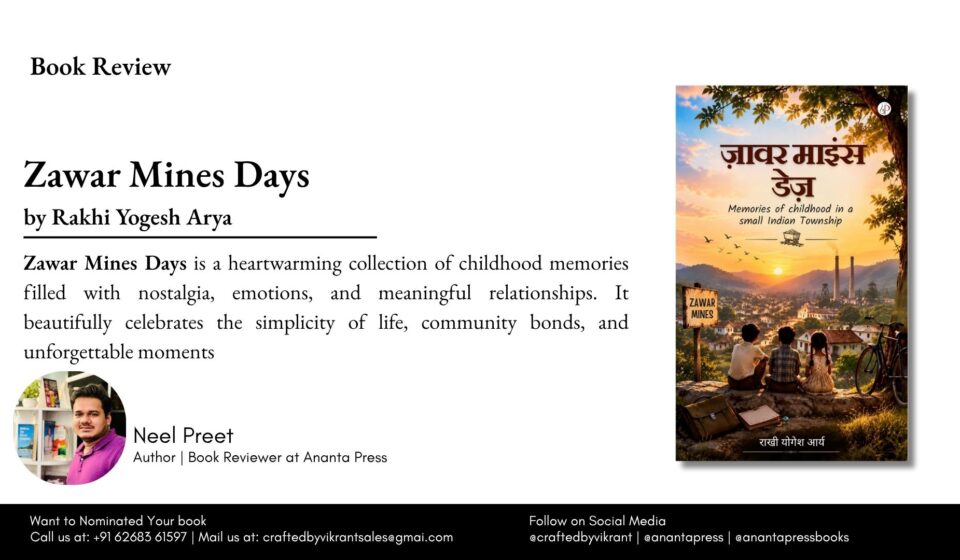

Zawar Mines Days: Memories of Childhood in a Small Indian Township by Rakhi Yogesh Arya is more than a collection of childhood memories; it is an affectionate journey back to a time when relationships were built through everyday conversations, neighbours were treated like family, children found happiness in the simplest things, and an entire township could feel like one large home. Set largely against the backdrop of Zawar Mines, the book brings together memories, experiences, people, traditions, school life and emotionally significant incidents that shaped the author’s childhood and remained alive in her heart long after those years had passed.
What makes the book immediately appealing is the emotional meaning that Zawar holds for the author. Zawar is not presented merely as a geographical location or a mining township. Although the book acknowledges the region’s long association with zinc mining and metallurgy, its real interest lies in the human world that existed around those mines. For the author, Zawar is made memorable by the people who came from different parts of India and created a close-knit community. Different languages, customs, clothes and cuisines existed together, turning the township into a small representation of India itself.
This sense of community forms the emotional foundation of the book. The memories of idli-sambar, dal-baati, rajma-chawal, puran poli, dhokla and other foods are not included simply for nostalgia; they evoke a social environment in which people entered one another’s homes freely and shared food, conversations, celebrations and difficulties. Neighbours were not distant acquaintances. They became extended family. This is one of the strongest qualities of Zawar Mines Days: it preserves not only events but also the atmosphere of a particular kind of community life that many readers may recognise from their own childhoods.
The book’s storytelling is simple, direct and emotionally accessible. Rather than turning childhood into an idealised world without difficulties, Rakhi Yogesh Arya uses incidents from childhood and adolescence to explore questions of compassion, dignity, friendship, equality, misunderstanding and human behaviour. According to the author’s note, most of the episodes are inspired by her childhood memories and experiences, while some incidents, places, characters, names and identities have been altered or supplemented with imagination for literary presentation. The book therefore works as an intimate literary document of memory rather than as a strictly factual historical record.
One of the book’s most memorable threads begins with the story “एक मासूम प्रश्न” (Ek Masoom Prashn). Through the innocence of a child named Pakhi, the narrative raises a difficult moral question surrounding animal sacrifice. Pakhi does not approach the practice through complicated arguments. Instead, she asks a simple question: if an animal’s child is sacrificed, would its mother and father not grieve for it? Her innocent questioning gradually shifts the emphasis from ritual to compassion. The following episodes, including “करुणा का प्रसाद” and “माँ सबकी है,” continue this emotional and ethical exploration. What gives these stories their power is precisely their simplicity. The child does not attempt to lecture adults; she merely asks questions that compel them to reconsider familiar practices.
This technique appears repeatedly throughout the book. Childhood innocence becomes a lens through which adult assumptions are examined. In “नाम में सम्मान,” for example, the issue is something apparently ordinary: the way a teacher addresses children. When insulting or mocking nicknames are treated casually, a child questions why students should accept words that adults themselves would dislike being called. The story ultimately emphasises that a child’s name and identity deserve respect. Through such everyday situations, the author brings attention to the lasting effect that adults’ language can have on young minds.
Another touching story, “मेरा जन्मदिन, मेरी खुशी,” explores disappointment and, eventually, self-worth. A childhood birthday experience leaves an emotional mark that continues into adulthood, but the story does not remain trapped in sadness. Its movement toward self-acceptance transforms the memory into a reflection on learning to create one’s own happiness rather than depending entirely on recognition from others.
The nostalgia becomes especially charming in “दीनू की साइकिल लाइब्रेरी.” The image of books arriving on a bicycle opens a window into an era when reading itself was an adventure. Magazines and books such as Champak, Lotpot, Vikram-Betal and Amar Chitra Katha become part of a childhood ritual of anticipation and discovery. The story contrasts that experience with a present increasingly dominated by mobile screens and suggests that books nurture vocabulary, imagination, thought and emotional depth. Here again, the author takes an ordinary memory and allows it to carry a larger message.
Importantly, however, Zawar Mines Days is not limited to cheerful recollections. The table of contents itself indicates a wide emotional range, moving through stories connected with festivals, school life, personal identity, community gatherings, difficult situations and adolescence. Chapters such as “दुर्गा पूजा,” “होली स्नेह मिलन,” “और पहाड़ धस गया,” “पहचान,” “दोषी कौन?,” “कुलवंत आंटी,” “बाल मेला,” and “ओपन एयर थिएटर” collectively suggest how many different aspects of township life have been preserved in the book.
The multi-part “दोषी कौन?” is particularly significant because it moves into the emotionally complicated world of adolescence. Rather than reducing a difficult situation to a single person’s fault, the narrative ultimately points toward a lack of communication, insufficient understanding of emotions and the absence of timely guidance for young minds. The book recognises adolescence as a sensitive stage in which attraction, confusion, loneliness, stress and misunderstandings can feel overwhelmingly intense. This gives the collection a dimension beyond nostalgia: the past becomes a way of thinking about how children and teenagers need to be heard and understood.
Relationships remain the book’s greatest strength. This is beautifully evident in the chapters devoted to Kulwant Aunty. She emerges not simply as another person from the author’s childhood but as the kind of neighbour who becomes permanently attached to one’s memories. The description of her ability to mix easily with children, adults and elders captures the warmth of community relationships in Zawar. The larger reflection arising from these memories is equally moving: we rarely know when a small act of kindness, a few words of support or an ordinary gesture of affection may later become a source of hope in someone else’s life.
This is perhaps the central idea running through Zawar Mines Days. Small moments matter. A teacher’s words matter. A neighbour’s kindness matters. A child’s question matters. A shared meal matters. A book borrowed for a weekend matters. A festival celebrated together matters. Even seemingly ordinary conversations can survive in memory for decades.
The book is therefore at its strongest when it does not try to make childhood grand. Instead, it shows why apparently insignificant experiences become precious with time.
Another appealing feature is the author’s willingness to acknowledge the people who shaped her life. Her introductory and dedicatory reflections mention parents, family members, teachers, friends, neighbours and even animals whose affection became part of her emotional world. She describes these figures as sources of light in her journey and dedicates the book to those who loved her, believed in her, supported her and helped her become who she is.
That gratitude gives the book its distinctive warmth.
Stylistically, the writing favours emotion and accessibility over literary complexity. The language is conversational, and many scenes are built around dialogue. This makes the stories easy to visualise. Readers can imagine school classrooms, temple bells, colony homes, children waiting eagerly for books, neighbourhood gatherings, kitchens filled with familiar aromas, festival celebrations and the landscapes surrounding Zawar. The emotional lessons generally emerge directly from the incidents, making the book accessible to readers across age groups.
For readers who grew up in industrial townships, government colonies, mining settlements, railway colonies or other close-knit communities, the book may have an additional resonance. Even when the names and places are different, the emotional experiences may feel familiar: neighbours who become relatives without sharing blood, teachers remembered decades later, childhood friendships, festivals celebrated collectively and small incidents that somehow remain clearer in memory than major events.
Yet the book also has value for younger readers who did not experience that period. It offers a glimpse of childhood before smartphones and constant digital entertainment became dominant—a world in which books, playgrounds, neighbours, festivals, conversations and imagination occupied a much larger part of everyday life.
Ultimately, Zawar Mines Days succeeds because it understands that nostalgia is not simply about wishing to return to the past. It is about recognising what the past gave us. Rakhi Yogesh Arya looks back at Zawar not merely because it was where she spent part of her childhood, but because the place gave her relationships, values, stories and memories that continued to shape her.
The book’s spirit can be summed up through the idea expressed in its opening reflections: Zawar had metal in its soil, but there was gold in its relationships.
That sentiment remains with the reader long after individual stories end.
Zawar Mines Days is a warm, nostalgic and emotionally engaging tribute to childhood, community and human connection. Through simple incidents and memorable characters, Rakhi Yogesh Arya reminds us that the richest parts of life are often not extraordinary achievements but ordinary moments shared with people who once made a place feel like home. It is a book about remembering—but even more importantly, it is a book about gratitude, compassion, belonging and the relationships that continue to live within us long after childhood has passed.