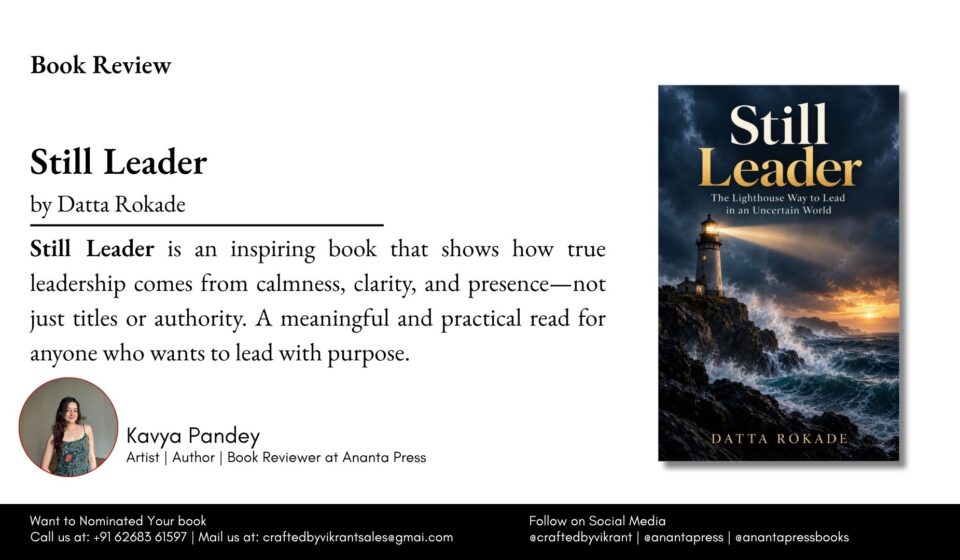

In a world where leadership is often associated with authority, visibility, confidence, and the ability to command attention, Datta Rokade’s Still Leader: The Lighthouse Way to Lead in an Uncertain World offers a refreshingly different perspective. Rather than asking readers to become louder, more dominant, or more influential in the conventional sense, the book invites them to become calmer, clearer, more authentic, and more dependable. At its heart lies a simple but powerful idea: leadership begins not with a title, but with the quality of presence we bring into the lives of others.
The lighthouse metaphor gives the book its emotional and philosophical foundation. A lighthouse does not chase ships, fight storms, or demand attention. It simply remains rooted and continues to shine. Rokade uses this image to describe a form of leadership that is steady rather than forceful. In difficult and uncertain moments, people often need someone who can bring clarity and calm more than someone who merely possesses authority. This metaphor remains meaningful throughout the book because it connects leadership with stability, direction, and service rather than status.
One of the strongest aspects of Still Leader is its challenge to the traditional idea that leadership belongs only to managers, founders, executives, or people in positions of power. The opening chapters argue that leadership can appear in ordinary situations and through people who may hold no formal designation at all. A colleague who remains composed during a crisis, a person who listens when everyone else is reacting, or someone who helps others find clarity can demonstrate genuine leadership without ever being officially called a leader. The book therefore moves the conversation from position to presence and from authority to earned trust.
This approach makes the book accessible beyond the corporate world. Although many examples relate naturally to workplaces and teams, its principles can also be applied to families, relationships, classrooms, communities, and personal life. Leadership, as presented here, is not simply about managing other people. It is first about learning to manage one’s own reactions, fears, intentions, and choices.
The second part of the book develops its central framework through the word STILL: Stillness, Truth, Integrity, Light, and Legacy. These five ideas become the foundations of what Rokade describes as building one’s inner lighthouse.
The first pillar, Stillness, is particularly relevant to modern life. Rokade does not describe stillness as withdrawing from activity or finding a perfectly silent environment. Instead, he defines it as the capacity to remain connected to oneself even while the world around us remains noisy. This distinction is important. Leaders cannot always control circumstances, but they can learn not to become consumed by them. In this sense, stillness becomes a practical leadership skill rather than merely a spiritual concept.
The second pillar, Truth, explores authenticity. The book acknowledges the exhaustion that comes from constantly pretending to have everything under control. Leaders may feel pressure to appear certain, confident, or knowledgeable even when they are struggling internally. Still Leader challenges this performance. Authenticity requires the courage to admit uncertainty, recognise mistakes, speak honestly, and listen to conscience rather than simply seeking approval.
This discussion of truth becomes even more meaningful because the book does not treat honesty as permission to become harsh. Later chapters return to the idea that truth and kindness need to coexist. In difficult conversations, truth without kindness can become aggression, while kindness without truth can turn into avoidance. The balance between the two is presented as an important expression of mature leadership.
Integrity, the third pillar, moves the discussion from what a person believes to how those beliefs appear in everyday behaviour. One of the book’s valuable observations is that integrity is not built only during dramatic ethical decisions. It is revealed through ordinary choices made repeatedly. Goals may tell others where someone is going and talent may reveal what that person can accomplish, but integrity determines whether others can trust them. The book therefore presents integrity as the visible expression of inner intention.
The fourth pillar, Light, focuses on influence through presence. Rokade argues that influence is not necessarily created by speaking more or having stronger arguments. Some of the most influential people are remembered not for everything they said, but for how others felt around them. People remember feeling heard, respected, safe, encouraged, or understood. The book’s lighthouse imagery works especially well here: a lighthouse does not run after ships; its consistency makes it useful. Similarly, meaningful influence can emerge when a person becomes a steady and trustworthy presence for others.
The final pillar, Legacy, expands leadership beyond individual success. Rokade reframes legacy as something more immediate than awards, buildings, achievements, or recognition after death. In the book’s conception, legacy is also what we leave within other people—the confidence, courage, knowledge, values, or hope that continues because we touched their lives. This makes legacy something that can be created every day rather than something reserved for the end of an extraordinary career.
Another strength of Still Leader is that it does not leave these principles at the level of philosophy. The later sections bring still leadership into practical situations involving teams, families, relationships, conflict, failure, fear, self-doubt, and uncertainty. The structure helps readers understand that remaining centred is relatively easy when everything is going well; the real test comes when emotions rise and circumstances become uncomfortable.
The chapter on difficult conversations is particularly relatable. It examines how conflict often becomes more complicated when ego enters the conversation. People may believe they are defending an opinion when, at a deeper level, they are protecting their dignity, identity, respect, or sense of belonging. The book encourages readers to move from blame toward curiosity and to ask questions that create understanding rather than immediately triggering defensiveness.
One especially thoughtful principle is the distinction between trying to win a conversation and trying to understand another person. Rokade does not suggest that understanding requires agreement. Instead, curiosity becomes a way of preserving dignity while still addressing disagreement. This makes the book’s advice useful not only for professional leadership but also for relationships in everyday life.
The discussion of failure, fear, and self-doubt adds another human dimension. Leadership books sometimes focus heavily on confidence and achievement, creating an image of leaders as people who have overcome uncertainty altogether. Still Leader takes a more compassionate approach by acknowledging the private doubts that can exist behind public confidence. Fear and self-questioning are not treated as automatic signs of weakness; instead, the emphasis is placed on how a person responds when their inner light feels less certain.
Perhaps the book’s most useful quality is its reflective nature. Readers are repeatedly encouraged to pause and examine themselves instead of merely collecting leadership concepts. This becomes especially clear in the STILL Quotient Assessment, which functions less like a conventional examination and more like a mirror. The questions invite readers to examine their stillness, authenticity, values, influence, and contribution.
For example, the assessment asks readers to consider whether their words and actions are aligned, whether they can admit mistakes, whether they make decisions according to values rather than pressure, whether they create emotional safety for others, and whether they help people grow without needing recognition. These questions translate abstract leadership qualities into observable behaviour.
The book then extends reflection into action through its 90-Day Still Leader Journey. This is an important addition because personal growth rarely happens through insight alone. The practices encourage readers to bring intention into conversations, listen before responding, speak with truth and kindness, release unnecessary emotional burdens, apologise when necessary, and make integrity visible through ordinary choices.
Stylistically, Still Leader is written in an accessible and reflective voice. The ideas are presented through stories, metaphors, questions, practical exercises, and brief moments of contemplation. The recurring lighthouse imagery gives the different chapters a common identity and prevents the leadership principles from feeling disconnected. Rather than presenting leadership as a complicated collection of techniques, the book continually returns to a fundamental question: Who are you becoming, and what do people experience in your presence?
That question captures much of the book’s value. Still Leader is ultimately less concerned with teaching readers how to look like leaders and more concerned with helping them become people whom others can trust during uncertainty. Its message is especially relevant in a time characterised by rapid technological change, constant communication, information overload, professional uncertainty, and emotional pressure.
Datta Rokade has created a leadership book that combines reflection with application and personal growth with responsibility toward others. Its central message is both simple and demanding: before trying to control the storm outside, learn to steady the world within.
Still Leader therefore stands out as more than a conventional leadership guide. It is an invitation to cultivate stillness without passivity, truth without harshness, integrity without performance, influence without force, and legacy without the need for recognition. For readers seeking a calmer, more human, and purpose-driven approach to leadership, this book offers not merely instructions on how to lead others, but a thoughtful path toward becoming the kind of person whose presence itself can become a source of direction.