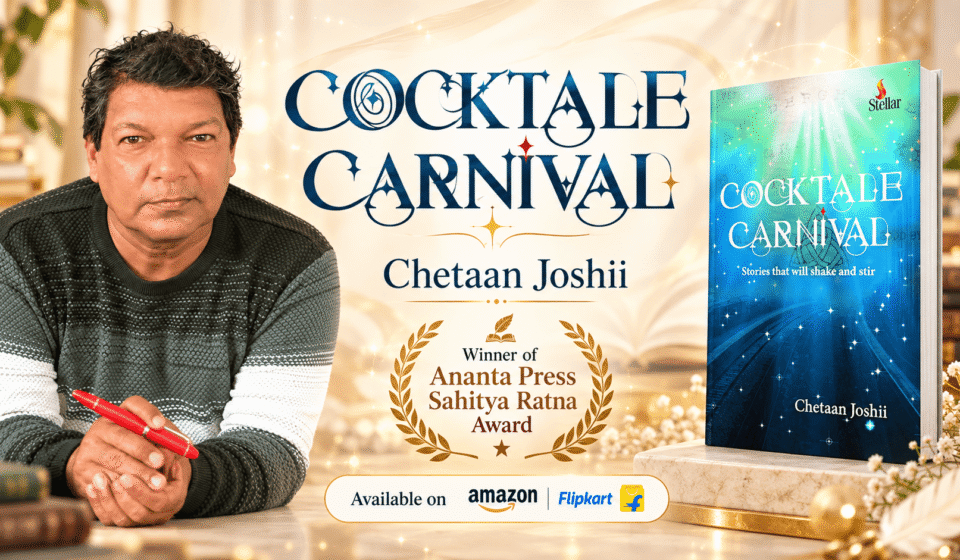

CockTale Carnival by Chetaan Joshii is the kind of book that immediately announces its personality through its title. It is playful, curious, slightly mysterious, and openly inviting. The word “carnival” suggests colour, movement, unpredictability, and variety; the word “cocktale” hints at a spirited mix of stories, flavours, moods, and ideas. Once a reader enters the book, that promise is fulfilled in a rich and engaging way. This short story collection does not remain tied to one emotional tone, one literary mood, or one conventional genre. Instead, it offers a literary feast that moves through fantasy, surrealism, horror, humour, science fiction, realism, satire, and modern fables with remarkable ease. It is a book created for readers who enjoy being surprised and who do not want fiction to feel repetitive or limited.
One of the most attractive qualities of this collection is its range. Many short story collections stay inside a familiar emotional or thematic space. CockTale Carnival does the opposite. It keeps opening new doors. One story may begin with a bizarre yet fascinating premise, another may unfold like a satire, and the next may carry the tone of mystery, wonder, absurdity, or emotional tenderness. This constant shifting gives the collection tremendous energy. Rather than feeling scattered, however, the variety becomes its strength because the author’s imagination provides a clear connecting thread. Every story emerges from an unusual idea, and every idea feels shaped by a writer who genuinely loves storytelling as an act of invention.
The synopsis itself reveals how delightfully imaginative this collection is. The reader encounters a man who travels daily on the same train in search of a place that appears only now and then, a composer who makes a music note vanish, an actor willing to kill for a role, a writer entering his own story to destroy his writer’s block, a detective hunting for a stolen heart, and a scientist who discovers that love is a radioactive element. These are not ordinary concepts, nor are they designed merely to appear strange for the sake of being strange. What makes them compelling is that each premise carries the possibility of metaphor, irony, emotion, and layered interpretation. The stories seem to begin in curiosity but extend into reflection. That is where the book becomes more than entertaining. It becomes memorable.
Chetaan Joshii’s strength lies in his willingness to trust the originality of an idea. In an age where a great deal of writing risks becoming formulaic, CockTale Carnival stands out by refusing to settle for predictability. The stories are built on creative leaps, but they are not careless leaps. They show a writer who understands how to turn imagination into narrative. The result is fiction that stimulates the mind while keeping the reader emotionally involved. That balance is not easy to achieve. Some experimental stories become too abstract; some entertaining stories remain superficial. Joshii manages to create a space where wit, invention, and reader engagement coexist.
Another commendable feature of the collection is its accessibility. The book contains literary sophistication in its ideas, but it does not alienate the reader. Even when the stories move into surreal or fantastical territory, they remain inviting. The reader is not asked to decode them with academic seriousness before enjoying them. Instead, the pleasure of reading comes first. This is important because it reflects one of the best traditions of storytelling: literature that is imaginative and thoughtful, yet still enjoyable. The author seems aware that a story must first hold the reader’s attention before it can leave a deeper impression. That awareness gives the collection a readable, lively quality.
The emotional span of the book is another reason for its success. The description promises a full gamut of responses, from amusement to intrigue, from pathos to surprise, and even to arousal. This broad emotional palette is one of the marks of a well-designed short story collection. A reader does not finish one story and feel that the next will simply repeat the same effect. Instead, every new tale can alter the emotional climate. Such variation keeps the reading experience fresh. It also reflects the complexity of human imagination and human life. After all, reality itself contains comedy, fear, tenderness, absurdity, longing, and irony. By placing these emotions beside one another, the book becomes truer to life even when its premises are wildly inventive.
The presence of animal-centered modern fables adds yet another layer of richness. A duckling convinced he is not truly ugly, a peacock learning why he must strut, and a mouse redefining the meaning of a mousetrap suggest that the book is not confined to adult urban irony or conceptual cleverness alone. It also touches the fable tradition, where animals become mirrors to human vanity, insecurity, wisdom, and error. These stories expand the tonal landscape of the collection and give it a timeless dimension. They remind readers that storytelling can be playful while still containing insight.
Chetaan Joshii’s literary background also contributes to the depth of this work. As an author of multiple books across forms, including short story collections, a graphic book, a novella, and novels rooted in tribal life, he brings a seasoned sensibility to the page. His experience as a creative writing mentor, certified by the British Council, and his long involvement with literature clearly support his craftsmanship. Yet the book does not read like the work of a writer burdened by self-conscious technique. On the contrary, it feels alive, curious, and liberated. That is perhaps what makes the collection especially appealing. It has maturity without stiffness.
The author’s belief in the power of HI—Human Imagination—also resonates strongly through this collection. The stories feel like arguments in favour of imagination itself. They suggest that the human mind remains capable of producing wonder through unexpected combinations, absurd turns, emotional reversals, and fresh perspectives. In that sense, CockTale Carnival is not just a collection of stories; it is also a celebration of the storytelling impulse. It honours the reader’s appetite for novelty and the writer’s commitment to originality.
This book will particularly appeal to readers who enjoy dipping into fiction that resists monotony. It is ideal for lovers of short stories, for readers who appreciate genre-crossing literature, and for anyone who wants to encounter fiction that is simultaneously witty, strange, touching, and inventive. It would also be a rewarding choice for aspiring writers, because it demonstrates how bold ideas can be transformed into engaging narratives. Each story seems to carry a lesson in imaginative freedom: do not write only what is expected; write what surprises you.
Ultimately, CockTale Carnival succeeds because it understands that literature can be both playful and substantial. It entertains without becoming shallow, experiments without becoming inaccessible, and varies its moods without losing coherence. The collection delivers precisely what its premise promises: a carnival of tales, each with a distinct flavour, yet all part of the same exuberant celebration of storytelling. In a reading landscape where so much fiction competes for attention through familiar formulas, Chetaan Joshii offers something refreshingly different—a collection built on the joy of ideas, the thrill of surprise, and the enduring charm of narrative invention.
For readers seeking originality, variety, and imagination in one volume, CockTale Carnival is an excellent choice. It proves that short stories can be compact yet expansive, entertaining yet thoughtful, bizarre yet emotionally resonant. Above all, it proves that when a writer trusts the impossible, the reader receives the delight of the unexpected.
Amazon Link:
https://www.amazon.in/dp/9382035176