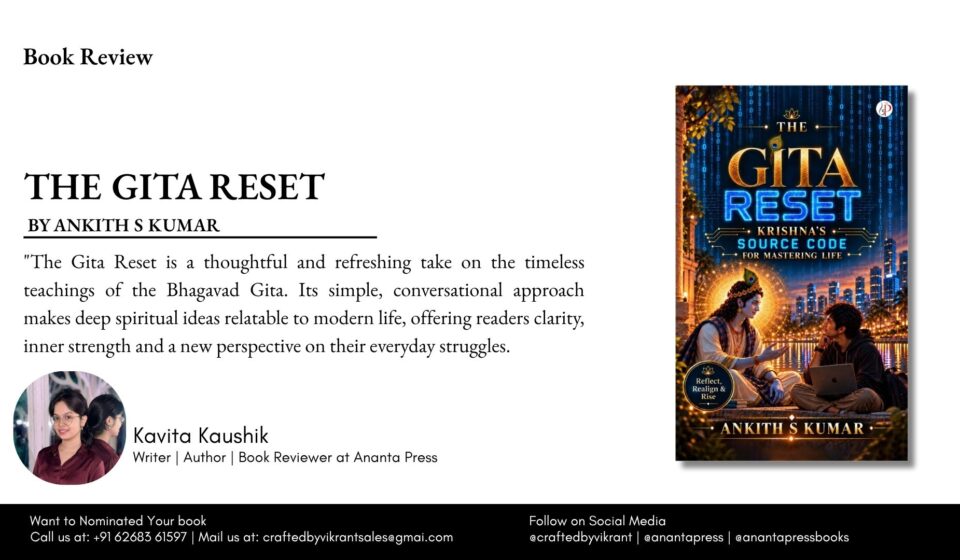

The Gita Reset by Ankith S Kumar is a contemporary and thoughtful exploration of the timeless wisdom of the Bhagavad Gita. The book attempts to bring the ancient dialogue between Lord Krishna and Arjuna closer to the realities of modern life, using a conversational, accessible, and relatable style. Rather than presenting spiritual wisdom only through traditional philosophical language, the author connects it with everyday struggles such as anxiety, overthinking, burnout, confusion, identity, purpose, attachment, fear, and the constant pressure to succeed.
One of the most distinctive aspects of the book is its attempt to make the teachings of the Gita understandable to a contemporary generation. The author describes the book as a modern, conversational adaptation designed to help present-day readers connect with the timeless wisdom of the Bhagavad Gita. It is not intended to replace or diminish the original sacred text, but rather to provide another accessible way for readers to engage with its ideas.
The central idea of The Gita Reset is that the battlefield of Kurukshetra can also be understood as a metaphor for the internal and external struggles that people experience in their own lives. Arjuna’s confusion, hesitation, questions, and search for direction are presented in a way that allows modern readers to recognize aspects of themselves in his situation. The book repeatedly brings the reader back to the idea that every generation has its own challenges and that timeless wisdom can still speak to those challenges when presented in a language people understand.
The book is particularly relevant for readers dealing with the pressures of modern life. Today, people often find themselves surrounded by information but still searching for clarity. There may be professional pressure, personal expectations, fear of judgment, uncertainty about the future, relationship challenges, or a constant desire for achievement. The Gita Reset approaches these concerns through the philosophical framework of the Gita and encourages readers to look beyond immediate circumstances and examine their own thoughts, choices, attachments, and actions.
One of the important themes explored in the book is Karma Yoga, particularly the idea of focusing on one’s actions without becoming excessively attached to the outcome. The book connects this teaching with contemporary problems such as procrastination, endless planning, fear of judgment, the desire for certainty before taking action, and excessive concern about results. The message encourages readers to participate actively in life rather than remaining stuck in hesitation.
This approach gives the philosophical ideas a practical dimension. Instead of presenting spirituality as something separate from ordinary life, the book connects spiritual understanding with work, discipline, decision-making, relationships, and personal responsibility. The reader is encouraged to consider questions such as what action they have been postponing, whether fear of judgment is preventing progress, and whether too much attention is being given to outcomes instead of effort.
Another interesting feature of The Gita Reset is its contemporary vocabulary and presentation. The author occasionally uses modern expressions and technological metaphors to explain spiritual concepts. For example, the discussion of Krishna’s avatar is presented through ideas such as a “spiritual update” and “cosmic tech support.” Such language represents an attempt to bridge the distance between ancient philosophy and the vocabulary familiar to modern readers.
The book also explores the difference between information and wisdom. In a world where knowledge is readily available through technology and the internet, possessing information does not necessarily mean possessing clarity or understanding. The Gita’s teachings are therefore presented not simply as information to be memorized, but as ideas to be reflected upon and applied to life. This distinction is important because the book repeatedly encourages the reader to move from passive reading toward personal reflection.
A significant portion of the book deals with the question of identity. The author explores the distinction between the physical body, the changing circumstances of life, and the deeper concept of the self or soul. One section explains the idea that the individual should not identify completely with the temporary experiences and external structures of life. The modern reader is encouraged to examine attachments, distractions, consumerism, appearances, and the search for temporary security.
This discussion becomes particularly relevant in today’s environment, where success is often associated with external achievements, possessions, social recognition, and appearances. The Gita Reset asks the reader to look inward and consider whether temporary things are being treated as permanent. It also encourages reflection on what attachments prevent a person from experiencing peace and whether one is building a meaningful life or simply accumulating distractions.
The book’s reflective questions are one of its useful elements. Instead of simply explaining philosophical principles, it frequently turns the reader’s attention toward personal experience. Questions encourage readers to examine their fears, habits, attachments, ambitions, and decisions. This makes the reading experience more interactive because the reader is not merely receiving an explanation but is being invited to think about how the teaching relates to their own circumstances.
Another important theme is the movement from ego toward character. In the discussion of divine and demonic qualities, the book presents two contrasting patterns within human behaviour. Rather than treating these ideas only as abstract religious categories, it encourages the reader to consider the qualities and tendencies operating within themselves.
This is consistent with the broader approach of the book: philosophical concepts are repeatedly brought back to everyday human behaviour. The emphasis is not only on understanding what the Gita says, but also on asking how those teachings might influence the way a person thinks, acts, responds to difficulties, and relates to others.
The author’s professional background also provides context for the perspective of the book. Ankith S Kumar is described as a counsellor, behavioural scientist, educator, TEDx speaker, and author whose work focuses on emotional well-being, human behaviour, spirituality, and modern life. His experience includes counselling, psychiatric casework, student support, and therapeutic practice, along with conducting workshops and training programmes.
This background is reflected in the book’s focus on emotional and psychological concerns. The Gita is presented not simply as an ancient philosophical text but as a source through which contemporary questions about anxiety, identity, relationships, purpose, and inner conflict can be explored. The author’s stated aim is to make profound ideas accessible to today’s generation through emotional honesty, modern reflection, and practical insight.
The structure of The Gita Reset also contributes to its accessibility. The chapters use modern headings, short explanations, reflections, questions, and references to the corresponding teachings of the Gita. This creates a reading experience that is different from a conventional academic commentary. Readers who may find traditional philosophical discussions difficult to approach may find the conversational format easier to engage with.
At the same time, the book maintains a clear connection with the traditional text by including Sanskrit shlokas, transliterations, meanings, and references to the teachings associated with different chapters. This combination allows the book to function as a bridge between traditional spiritual wisdom and contemporary interpretation. The author makes it clear that the book is an adaptation rather than a replacement for the original Bhagavad Gita.
One of the strongest ideas running throughout the book is that wisdom becomes meaningful when it enters everyday decisions. The closing section reinforces this approach by encouraging readers not merely to read the book but to live its insights. Krishna’s voice is presented as something that can echo in one’s decisions, while Arjuna’s questions can continue to resonate with the doubts and uncertainties that individuals experience.
The final message of the book returns to the central metaphor of the modern battlefield. The reader is reminded that the “battlefield” is already present in life and that the important question is how one chooses to respond to it. The book therefore moves beyond the idea of spirituality as passive contemplation and emphasizes awareness, action, responsibility, and inner clarity.
Overall, The Gita Reset presents the Bhagavad Gita through a modern lens while retaining its focus on timeless questions of action, identity, attachment, purpose, self-awareness, and spiritual understanding. Its conversational language, reflective questions, contemporary examples, and practical framing make it accessible to readers who may be encountering these ideas for the first time.
The book can particularly appeal to readers interested in spirituality, self-reflection, emotional well-being, philosophy, personal growth, and the relationship between ancient wisdom and modern life. It also offers readers familiar with the Gita an opportunity to consider its teachings from a contemporary perspective.
Perhaps the most meaningful quality of The Gita Reset is its attempt to make the reader pause and look inward. In a world filled with constant activity, information, comparison, and uncertainty, the book invites readers to ask deeper questions: What truly matters? What are we attached to? Why do we hesitate to act? What gives life meaning? How can we remain steady when circumstances are uncertain?
The book ultimately presents the Gita not as wisdom belonging only to the past, but as a continuing conversation about the human condition. Its central message is that the challenges may change across generations, but the fundamental questions of human beings remain remarkably similar.
The Gita Reset is therefore best approached not simply as a book to be read from beginning to end, but as a book to be reflected upon. Its ideas invite readers to return to their own experiences, examine their choices, question their assumptions, and search for greater clarity. As the closing pages suggest, the purpose of wisdom is not merely to provide conclusions, but to help individuals discover their own answers.
In essence, The Gita Reset attempts to create a bridge between an ancient spiritual dialogue and the realities of contemporary life. Through its accessible presentation and emphasis on reflection, action, and inner awareness, it offers readers a modern entry point into the enduring questions addressed by the Bhagavad Gita.