
By Dr. Abha Mishra
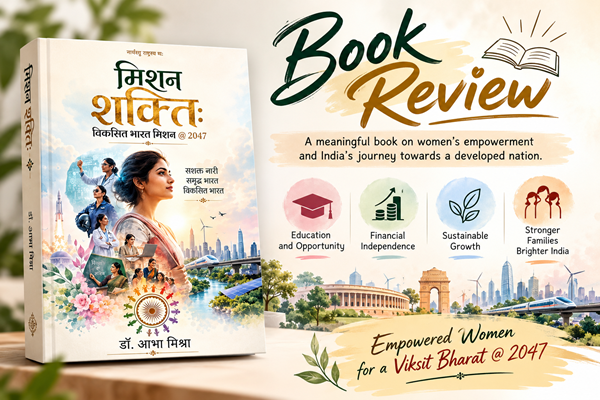
A country cannot truly move forward if half of its population is left behind. This simple thought is at the heart of Naryastu Rashtrasya Shva – Mission Shakti: Viksit Bharat Mission @2047 by Dr. Abha Mishra. The book looks at women not only as people who need support, but as an important force behind India’s economic and social development.
What I found most interesting about this book is its basic question: Can India become a truly developed nation without fully using the talent, skills, knowledge and working ability of its women?
The book makes us think seriously about this question.
For many years, discussions about women have mainly focused on welfare, safety, education and equality. All these issues are important. But this book takes the discussion one step further. It explains that women’s empowerment is also an economic need.
When women study, work, start businesses, manage money and take part in decision-making, the benefits are not limited to women alone. Families become stronger, communities develop and the economy also grows.
This idea connects very well with the vision of Viksit Bharat @2047.
India has a large population, and women form almost half of it. If their abilities are not fully used, a huge amount of human potential remains unused. The book therefore presents women as active partners in nation-building.
I liked that the book does not depend only on emotional arguments. It also discusses data, policies, economic ideas and case studies. This makes it useful for students, researchers, teachers and people interested in public policy.
Another interesting part is its discussion of the Sustainable Development Goals (SDGs) and the challenges related to women. The book connects global concerns with the Indian economy and asks how India can find practical solutions.
This is important because women’s development is connected with many other areas.
Education affects employment. Employment affects income. Income affects financial independence. Financial independence can affect decision-making. Health, safety and social freedom can also influence whether a woman is able to use her full potential. So women’s empowerment cannot be understood as a single issue. One of the most interesting parts of the book is the connection between modern economics and India’s older cultural history. The author discusses economic ideas such as Becker’s theory of time and Amartya Sen’s capability approach while also looking at the role of women in the Vedic period. I found this combination thoughtful.
It reminds us that women’s participation in knowledge, society and economic life is not completely new to India. The book tries to show that inclusion can also be understood through India’s own historical and cultural experience.Another important subject is gender budgeting.At first, this may sound like a difficult economic term. But the basic idea is quite simple. When the government plans how public money will be spent, it should also understand how those decisions affect women and men differently.A budget is not just a collection of numbers. Behind every budget are real people.
Money spent on education, healthcare, transport, employment, rural development or skill training can affect women’s lives in different ways. Looking at public spending through a gender lens can therefore help make policies more useful and inclusive.
The book also connects women with sustainable development and environmental protection. This part is especially interesting in the context of rural India. Women in rural areas are often closely connected with water, land, food, farming and other natural resources in their everyday lives. Their knowledge and experience can be valuable when we talk about environmental protection and climate change.
The book therefore argues for women’s participation in areas such as climate finance and sustainable development. This sends a strong message: women should not only suffer the effects of environmental problems; they should also be part of the decisions and solutions .The discussion on financial inclusion is another useful part of the book. Bank accounts, digital payments, access to loans and financial services can change a person’s life. The book discusses schemes such as PMJDY and MUDRA and looks at how access to banking and digital finance has influenced women. For a woman, having access to her own bank account or financial resources can mean much more than simply keeping money somewhere safely.
It can give her confidence.It can help her start a small business. It can support her family. And most importantly, it can give her a stronger role in financial decisions. The book also raises an issue that is often ignored — unpaid care work. Every day, millions of women spend many hours cooking, cleaning, caring for children, looking after elderly family members and managing homes. Much of this work is unpaid and is not directly counted in GDP. But does that mean this work has no economic value?
Of course not. If all this work suddenly stopped, families and even the wider economy would feel its effect immediately. The book makes us think about this hidden contribution. It also discusses time poverty, where women may have very little time left for education, paid work, rest or personal growth because of their unpaid responsibilities. I think this is one of the most important discussions in the book because it takes something we see every day and asks us to look at it differently. The book also goes beyond the idea of women’s economics alone. It moves towards a wider idea of inclusive or democratic economics, where policies are designed by considering the needs and abilities of different sections of society. This makes the subject relevant not only to women but to the future of the whole country.The reference to economist Claudia Goldin’s work on gender gaps also supports an important idea: gender inequality is not only about fairness. When talented people cannot fully participate in the economy, the country also loses part of its human potential. This is where the book’s connection with India’s future becomes very clear.
Viksit Bharat @2047 is not simply about bigger numbers, taller buildings, more industries or higher income. A developed India should also be an India where people have opportunities to learn, work, create, earn and participate. Women must be a central part of that journey.Overall, I found Naryastu Rashtrasya Shva – Mission Shakti: Viksit Bharat Mission @2047 to be a thoughtful and informative book. It brings together women’s empowerment, economics, public policy, sustainability, financial inclusion, unpaid work, history and India’s development vision.
The subject is academic, but the main message is actually very easy to understand. India cannot use only half of its strength and expect to reach its full potential. For me, the strongest lesson of this book is: Women are not only beneficiaries of development. They are builders of development.
When a woman receives education, opportunity, financial access and the freedom to use her abilities, the result can reach far beyond one individual. A family can change. A village can change. An economy can change. And eventually, a nation can change.
As India looks towards 2047, the question is therefore not simply what the country can do for women. The bigger question is what India can achieve with women as equal partners in its growth. That is what makes this book meaningful. It asks us to imagine a developed India where Nari Shakti is not standing on the side of economic progress, but is standing at its very centre.
Amazon Link – https://www.amazon.in/Naryastu-Rashtrasya-Shva-Mission-Shakti/dp/9379000332/