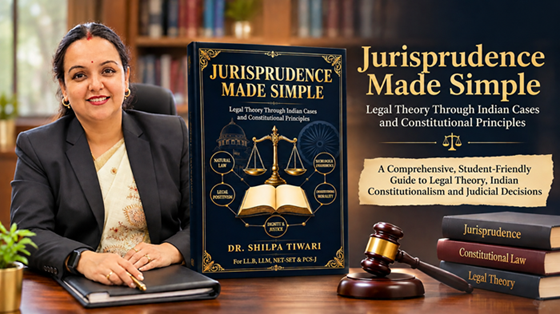
Dr. Shilpa Tiwari Introduces Jurisprudence Made Simple, Connecting Legal Theory with Indian Constitutional Principles and Judicial Decisions

Published by Evincepub Publishing, the book offers a practical and accessible approach to jurisprudence, combining classical legal theories, Indian Supreme Court judgments, constitutional values and examination-oriented learning.
India, November 2026: Jurisprudence is one of the most important subjects in legal education, yet many students find it difficult because of its complex theories, philosophical discussions and technical terminology. Addressing this challenge, legal academician and researcher Dr. Shilpa Tiwari has authored Jurisprudence Made Simple: Legal Theory Through Indian Cases and Constitutional Principles, a comprehensive academic book designed to make legal theory easier to understand and apply.
Published by Evincepub Publishing, the book presents jurisprudence as a practical and relevant subject that influences laws, judicial decisions, constitutional rights and the administration of justice in India.
The publication is intended for LL.B., B.A. LL.B. and LL.M. students, candidates preparing for Judicial Services and PCS-J examinations, and individuals interested in understanding the foundations of Indian law.
Making Complex Legal Concepts Easier to Understand
Jurisprudence examines fundamental questions about law, justice, rights, duties, morality and legal authority. Although these concepts form the foundation of legal education, students often struggle to connect theoretical explanations with actual legal situations.
Jurisprudence Made Simple addresses this difficulty by presenting legal concepts through clear explanations, practical illustrations and relevant Indian judicial decisions.
Instead of focusing only on definitions and theories, the book encourages readers to understand how legal principles operate in real situations.
It explains why laws exist, how courts interpret them, how legal rights are protected and how constitutional principles influence the development of the Indian legal system.
The book also explores the relationship between law and society, helping readers recognise that legal rules are not isolated from social conditions, public welfare and individual freedoms.
A Comprehensive Study of Legal Theories
Organised into 30 chapters, the book provides a systematic introduction to jurisprudence and its major schools of thought.
It begins with the meaning, nature, scope and importance of jurisprudence before examining the relationship between law, justice, morality and Dharma.
Readers are introduced to important subjects such as the State, sovereignty, custom, judicial precedent, legislation, codification and statutory interpretation.
The book discusses major jurisprudential schools, including Natural Law, Analytical Positivism, Historical Jurisprudence, Sociological Jurisprudence, Legal Realism, Feminist Jurisprudence and Critical Legal Studies.
The contributions of influential legal thinkers such as John Austin, Jeremy Bentham, H.L.A. Hart, Hans Kelsen, Friedrich Carl von Savigny, Roscoe Pound, Lon Fuller and John Rawls are explained in accessible language.
By comparing different perspectives, the publication helps students understand how legal thought has developed and how classical theories remain relevant to contemporary legal questions.
Connecting Legal Theory with Indian Constitutional Law
One of the book’s important features is its integration of traditional jurisprudential thought with Indian constitutional principles.
Dr. Tiwari examines concepts such as Dharma, Nyaya, constitutional morality, dignity, equality, liberty and social justice within the framework of Indian law.
The book also discusses significant Supreme Court decisions that have influenced constitutional interpretation.
These include Kesavananda Bharati v. State of Kerala, which established the Basic Structure Doctrine; Maneka Gandhi v. Union of India, which strengthened the understanding of fairness and personal liberty; and Justice K.S. Puttaswamy (Retd.) v. Union of India, which recognised privacy as a fundamental right.
Through such examples, readers can understand how legal philosophy contributes to judicial reasoning and the protection of constitutional rights.
The book demonstrates that jurisprudence is not limited to academic discussion but plays an important role in shaping the relationship between citizens, institutions and the State.
Addressing Modern Legal Challenges
Alongside classical jurisprudential theories, Jurisprudence Made Simple examines contemporary issues that are becoming increasingly important in legal education and professional practice.
Dedicated chapters explore privacy, data protection, cyber jurisprudence, artificial intelligence, environmental justice, climate responsibility, medical ethics and globalisation.
The discussion of artificial intelligence considers legal accountability, equality, explainability and responsibility in technology-driven decision-making.
Environmental jurisprudence examines ecological justice, climate change and the responsibilities of present generations towards future generations.
Similarly, the sections on medical and bio-jurisprudence address questions involving personal autonomy, dignity, health and ethical responsibility.
By including these emerging subjects, the book connects established legal principles with challenges arising from technological developments and changing social conditions.
Designed for Academic Learning and Judicial Examination Preparation
The book has been developed with particular attention to the learning requirements of law students and competitive examination candidates.
Each chapter includes organised explanations, relevant constitutional and statutory provisions, important Supreme Court decisions, practical illustrations and comparison tables.
Chapter summaries help readers revise essential concepts, while expected university examination questions encourage structured academic preparation.
For Judicial Services aspirants, the publication provides PCS-J descriptive questions and preliminary examination practice questions with answer keys.
This examination-oriented structure makes the book useful for classroom study, independent learning, revision and preparation for competitive legal examinations.
It also supports students in developing analytical thinking, understanding legal arguments and connecting theoretical knowledge with practical applications.
About the Author: Dr. Shilpa Tiwari
Dr. Shilpa Tiwari is an experienced legal academician, researcher and institutional leader currently serving as the Principal of Haveli Institute of Legal Studies & Research, Silvassa.
She holds a Ph.D. in Law and an LL.M., for which she received a Gold Medal. Her academic qualifications also include an LL.B., an M.A. in Sociology and a Bachelor of Commerce degree.
With more than a decade of experience in legal education, Dr. Tiwari has served in several academic and administrative positions, including Assistant Professor, Head of Department, Visiting Faculty, Vice-Principal and Principal.
Her areas of academic interest include Constitutional Law, Jurisprudence, Company Law, human rights, gender justice, media freedom, internet governance and social justice.
She has contributed to academic research on constitutional governance, censorship laws, LGBTQ+ representation, child labour, consumer welfare and gender-neutral legislation.
Her dedication to education has been recognised through honours including the Guru Ratna Award (2022) and Women of the Year (2023).
Beyond teaching and research, she has participated in legal-aid initiatives, community outreach, curriculum development and institutional administration.
Her academic philosophy emphasises accessible education, critical thinking and the practical application of legal knowledge.
Encouraging a Deeper Understanding of Law
Through Jurisprudence Made Simple, Dr. Tiwari seeks to encourage students to move beyond memorising legal definitions and develop a deeper understanding of the principles underlying legal systems.
The book presents jurisprudence as a subject that connects legal theory with constitutional governance, individual rights, social responsibilities and judicial decision-making.
Its accessible writing style and structured academic approach make it a valuable educational resource for students, teachers, researchers and aspiring judicial officers.
By bringing together classical legal philosophy, Indian constitutional traditions and contemporary legal developments, the publication offers readers a broader perspective on the role of law in society.
Category: Law, Jurisprudence, Constitutional Law and Legal Education
The book is listed as available through Amazon, Flipkart, Evincepub.com and Kindle.
Jurisprudence Made Simple offers a structured and practical introduction to legal theory, helping readers understand not only what the law provides but also the principles, values and reasoning that shape its interpretation and application in India.