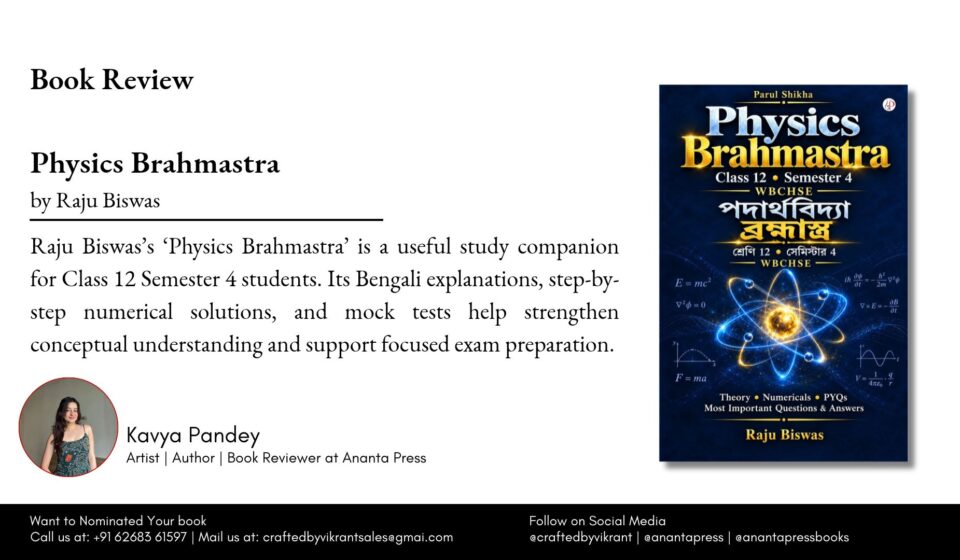
Physics Brahmastra by Raju Biswas: Building Understanding Through Explanation and Practice

Physics can become intimidating when students encounter definitions, mathematical relationships, derivations, and numerical problems together. Understanding an explanation in class does not always translate into solving a question independently. Raju Biswas’s Physics Brahmastra addresses this practical gap by bringing conceptual explanations and examination practice into one study resource. Written primarily in Bengali for Class 12 Semester 4 students, the book approaches learning through familiar language, organised topics, and worked examples. Its central appeal lies in helping readers move from recognising a concept to using it in an answer or calculation.
The preface establishes a worthwhile educational intention: physics should be understood rather than approached only as a collection of formulas to memorise. This idea gives the book a clear purpose. Although its content is strongly oriented towards examinations, the explanations attempt to introduce the meaning behind scientific terms before presenting their applications. For students who feel overwhelmed by technical vocabulary, this can provide a useful starting point. The book recognises that confidence develops through manageable steps, especially when learners can connect a definition, a physical relationship, and a worked solution.
One of its most relevant strengths is its use of Bengali alongside English scientific terminology. Students studying through Bengali often need to understand a topic in their primary classroom language while remaining familiar with English terms used in questions and reference materials. Chapter headings and explanations frequently bring these two forms together. Terms such as reflection, interference, semiconductors, and optical instruments remain identifiable within the Bengali discussion. This approach can help readers establish connections between familiar explanations and the technical vocabulary they encounter elsewhere, without requiring them to navigate an entirely English presentation.
The content covers several major areas of the semester’s physics studies, including optics, quantum theory, atoms, nuclear physics, semiconductors, digital circuits, and communication systems. This range brings related preparation needs into a single volume. The sequence moves from the behaviour of light towards modern physics and electronic applications, giving students opportunities to practise different kinds of reasoning. Some topics require careful verbal explanation, others involve mathematical derivations, and still others demand calculations or an understanding of circuit behaviour. The book’s usefulness comes partly from accommodating these different learning demands within its overall examination focus.
The optics material forms a substantial part of the book. It introduces reflection and refraction before addressing lenses, dispersion, scattering, optical instruments, interference, diffraction, and polarisation. This progression allows students to revisit the behaviour of light through several perspectives. Definitions of incident rays, reflected rays, and relevant angles establish the vocabulary needed for later questions. Discussions of image formation and refractive effects then extend that foundation. For a learner revising optics, having these topics grouped together can make it easier to recognise how individual formulas and explanations belong within a broader subject.
The treatment of optical instruments also gives the material a recognisable connection with everyday experience. The discussion of the human eye introduces components such as the cornea, iris, pupil, lens, and retina. These examples help place optical ideas in a setting students already know, even if they have not previously considered its physics. Such sections are useful because abstract relationships become easier to remember when attached to an identifiable object or process. The book offers opportunities to connect classroom learning with observation, which can make revision more meaningful than simply repeating isolated definitions.
Worked numerical problems are among the book’s most practically valuable features. In the examples reviewed, solutions commonly identify the given quantities, state a relevant relationship, substitute values, and arrive at an answer. This visible sequence matters for students who know a formula but struggle to begin a problem. Instead of presenting only the result, the book shows intermediate reasoning and calculation. Examples involving refraction, photon energy, semiconductor applications, and communication systems illustrate how the same general habit of organised problem solving can be applied across different chapters.
This method also provides a model for presenting answers. Students frequently lose clarity when they move directly from the wording of a question to an unexplained calculation. By separating known values, formulas, and substitutions, worked examples encourage a more readable approach. Readers can observe how physical quantities relate and how units enter the calculation. However, their greatest benefit will come when students attempt similar questions independently. Following a solution can create familiarity, but reproducing its reasoning without assistance is the stronger measure of understanding. The material lends itself to that active form of practice.
The modern physics sections introduce subjects that often require a change from familiar, everyday explanations. Quantum theory, photoelectric emission, and matter waves involve ideas that students may initially find difficult to visualise. The book breaks these subjects into definitions, characteristics, relationships, and questions. Its discussion of photoelectric emission, for example, considers conditions for emission and the roles of frequency and intensity. This approach helps direct attention towards distinctions that are important in conceptual answers. The combination of explanation and calculation gives learners more than one route into a demanding area of physics.
The sections on atoms and nuclear physics extend the book’s scope beyond light and optical devices. These topics require students to handle models, physical quantities, and relationships that may seem unfamiliar at first. Including them within the same study resource supports a connected revision routine rather than requiring a separate guide for each unit. The question-based approach is particularly relevant here because understanding a description does not automatically prepare a student for every application. Repeated engagement with different question forms can help reveal which parts of a topic have been understood and which still need attention.
Semiconductors and electronics add another useful dimension. The material begins with distinctions among conductors, insulators, and semiconductors before moving into related devices and applications. This foundation is helpful because electronic behaviour becomes harder to follow when the underlying categories remain unclear. The practice material also includes questions involving components such as diodes and LEDs. These examples introduce opportunities to connect definitions with calculations and circuit-based reasoning. For students, this combination can make electronics feel more approachable by showing how a general property of a material relates to a particular device or problem.
Digital circuits bring a different style of thinking into the book through binary representation and logic-based questions. Exercises involving number conversion and gates require precision as well as familiarity with terminology. Their inclusion broadens the practice available to readers and reflects the variety of tasks they may need to prepare. Communication systems similarly combine descriptive ideas with quantitative applications. Problems involving antenna length, carrier frequency, modulation, sidebands, and bandwidth show students that this unit also requires careful use of relationships. Together, these sections encourage preparation that goes beyond memorising definitions alone.
The mock tests are an important part of the book’s practical design. They bring questions from different topics into a format that encourages students to work across chapters rather than remaining within one familiar section. The first mock test specifies a two-hour duration and thirty-five marks, providing a concrete framework for timed practice. Questions with different mark allocations also highlight the need to adjust answer length and depth. Used carefully, these tests can help readers assess pacing, identify hesitation, and recognise the difference between knowing material during revision and recalling it under time pressure.
Another useful feature is the inclusion of questions marked with previous examination years. These references allow students to see examples of how topics have been framed in examination-style questions. The combined chapter suggestion section provides further material for focused practice and revision. Its value lies in helping students organise attention and revisit selected concepts. Readers should still study the underlying topics broadly: a collection of familiar questions is most useful when it develops transferable understanding. Preparation becomes stronger when students can respond to a changed wording or unfamiliar numerical value using the same physical principles.
The book is best approached as a study companion that supports classroom teaching and regular independent work. Its concise explanations and substantial question material suit students who want accessible revision and guided practice. Teachers may also find individual examples useful when explaining a calculation or assigning follow-up work. At the same time, reading worked answers should be supplemented by solving questions, checking units, and asking