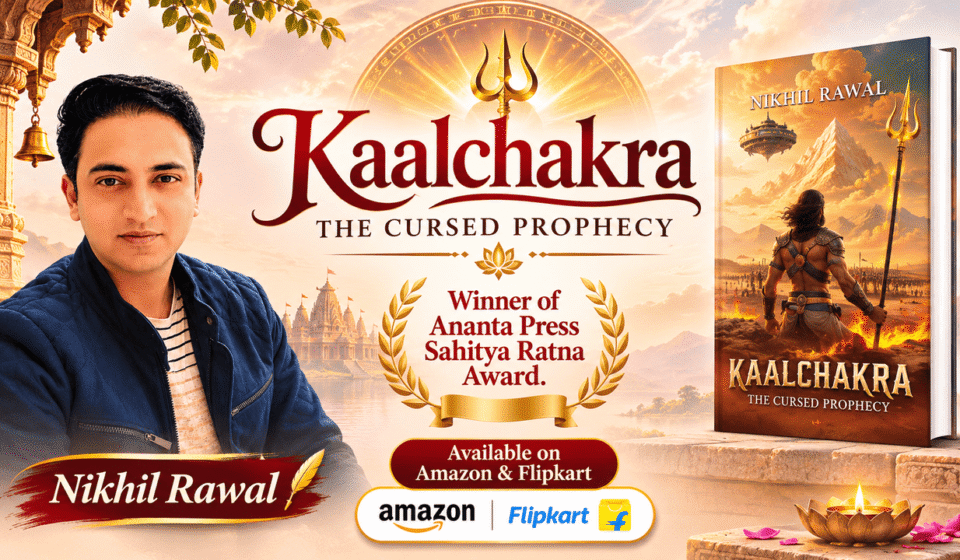

The most affecting doorway into Kaalchakra – The Cursed Prophecy is not its promised cosmic warfare or its extraordinary mythology. It is a recognizably human experience: the moment when a life that seemed secure is broken by loss. Nikhil Rawal’s debut novel introduces Vishwa not as a warrior already trained for divine combat, but as an ordinary businessman. His personal tragedy precedes any revelation of an ancient bloodline. That ordering matters. It gives the mythological premise a human center and suggests that the real beginning of his journey is emotional disorientation rather than heroic ambition. From the supplied synopsis, the novel appears designed to make its reader care about what has happened to one person before asking that reader to imagine the fate of entire realms. For an epic that eventually concerns creation itself, such a beginning can be its most valuable source of intimacy.
Grief makes an especially compelling foundation for mythological fantasy because it brings questions that cannot be answered by strength alone. Someone living with bereavement asks why suffering occurs, whether the past could have taken another course, and whether the future can still contain meaning. These are ordinary questions, but they grow almost impossibly large when placed beside a prophecy that stretches through ages. In Vishwa’s situation, the discovery of an extraordinary inheritance does not simply promise power. It raises the question of whether possessing power would actually relieve the suffering that set his journey in motion. If destiny offers a mission but no easy restoration of what was lost, then the hero must confront an uncomfortable truth: being chosen is not the same as being healed. That tension makes the premise more emotionally interesting than a straightforward tale of an undiscovered savior.
The title Kaalchakra, invoking the wheel or cycle of time, deepens this relationship between private sorrow and immense duration. Human beings measure their days through meetings, celebrations, routines, absences, and remembered voices. Mythic time, by contrast, can contain the rise and disappearance of civilizations. Rawal’s concept brings these two scales together. For a grieving person, a single moment can feel endless; for a cosmic order, even an empire may be brief. That contrast invites the reader to consider whether time truly repairs suffering or merely changes the shape in which it is carried. It is an evocative foundation for fantasy because it converts a familiar phrase—time heals—into a question. What would healing mean to someone whose existence becomes entangled with forces that appear to stand beyond ordinary time?
The author-supplied companion poem, The Wheel of Time, provides a useful interpretive window into this thematic ambition. Its speaker reflects on endless life without treating immortality as an uncomplicated blessing. In the poem, continuance can become an ordeal, and an immortal figure must still make a decisive choice. This is not evidence of how every scene in the full novel unfolds; the complete prose manuscript has not been supplied for this review. It does, however, reveal how the book’s surrounding creative vision links duration with burden, and fate with responsibility. An adventure about divine abilities becomes more distinctive when the central question is not merely what a person can do, but what it costs to continue doing it. Immortality, in this imaginative framework, is as much an ethical and psychological problem as a supernatural condition.
Another attractive feature of the premise is the gradual widening of Vishwa’s world. At first, the crisis belongs to one individual. Then the account expands toward ancestry, a hidden legacy, Kaliyuga, the arrival of Vritra, and the possible collapse of the balance that sustains creation. A movement from the personal to the universal is a familiar epic architecture, yet it becomes compelling when each expansion adds a new burden rather than simply a greater spectacle. The revelation of a bloodline can force a character to reconsider identity; an ancient prophecy can challenge the meaning of choice; a threatened cosmic order can turn private ethics into public duty. Readers who enjoy a layered progression from mystery to revelation are likely to find this structure appealing, particularly because the initial human problem continues to echo within the larger conflict.
Kaliyuga provides more than dramatic atmosphere. In Indian philosophical and mythological traditions, the concept points toward an age associated with the weakening of righteousness and the intensification of moral disorder. Within the supplied description, that setting allows Vishwa’s struggle to stand for more than a clash of weapons. The appearance of Vritra as an embodiment of evil places pressure on the balance of Dharma, giving the adventure a moral language that connects its battles to a broader understanding of responsibility. What matters here is not that every character can be placed neatly into categories of light and darkness, but that the narrative has a vocabulary for asking why one should protect a world filled with suffering. A hero who has already endured deep loss must discover reasons for defending life despite its impermanence.
This is where the theme of sacrifice acquires potential depth. In a less ambitious adventure, sacrifice may function as a spectacular final act, a brief proof of courage. In Kaalchakra’s stated conception, sacrifice is connected to karma, immortality, and free will. Those connections suggest a longer process in which every important decision asks what the protagonist is willing to surrender. The cost may be imagined in terms of comfort, certainty, attachments, or the desire to remain untouched by further pain. To choose responsibility after grief is different from charging into danger without having experienced loss. It requires a person to say that fragility is not a reason to stop caring. Such a position can give the battle for creation a moral significance beyond victory or defeat.
The promised movement across realms and ages also gives the author room to reflect the inward journey through external environments. A change of realm can embody a change of perspective; an encounter with a much older history can make the protagonist feel small; an ancient revelation can complicate his understanding of the present. The supplied synopsis does not describe individual locations or episodes in sufficient detail to judge their execution, so the appeal here lies in the design rather than a claim about scenes not provided. Yet the design is persuasive. Mythological fantasy is often most satisfying when its unfamiliar landscapes are not decorative backdrops but instruments of transformation. Rawal’s narrative premise offers a natural reason for Vishwa to encounter both wondrous phenomena and painful truths about himself.
Vritra’s threatening presence is especially meaningful against the story’s emotional beginnings. A villain described as the embodiment of evil creates a scale of opposition that a merely personal antagonist could not. At the same time, the companion poem raises an intriguing adjacent idea: a fallen guardian sees corruption and attempts to halt the flow of creation, mistaking destruction or stillness for mercy. The poem does not explicitly establish whether this figure and Vritra are identical, and it would be wrong to assume they are. As thematic companions, however, the two descriptions show an interest in the moral danger of rejecting the imperfect world. The hero’s task is not necessarily to demonstrate that existence is painless. It is to decide whether existence remains worth defending in full knowledge of pain.
Rawal’s own background adds an interesting layer to this undertaking. He works in business analysis and has experience in blogging and digital marketing, while describing a lasting fascination with mythology, spirituality, and culturally expansive stories. Such a combination of analytical and imaginative interests seems well suited to an ambitious plot built around interconnected ages, inherited obligations, and far-reaching consequences. Of course, a professional biography cannot prove the quality of a novel’s prose or pacing. What it can show is the deliberate cross-disciplinary interest behind the project. The author is not presenting mythology as an isolated curiosity; he appears drawn to it as a living framework for thinking about contemporary identity and perennial human dilemmas.
For readers deciding whether this book belongs on their shelf, the most helpful expectation is to approach it as an emotionally motivated epic rather than as a narrow action fantasy. Those attracted to Indian mythology can look forward to a mythic framework involving Dharma and Kaliyuga. Readers who enjoy journeys through time and extraordinary worlds may appreciate the ambitious scope. But the premise’s deepest appeal is likely to be for anyone who wants fantasy to ask difficult questions about bereavement, duty, and the limits of control. Not every reader will prefer a story that makes philosophical inquiry central to its adventure, and a full-text assessment would be necessary to judge how seamlessly those modes are woven together. Still, the combination itself is distinctive and promising.
Ultimately, the question at the center of Kaalchakra – The Cursed Prophecy is as poignant as it is immense: after life has taken something irreplaceable, can a person choose to protect life anyway? Vishwa begins as an ordinary man forced into extraordinary awareness, and the implied transformation is therefore more than a discovery of hidden power. It is a possible movement from wounded selfhood toward chosen responsibility. The wheel of time may carry civilizations onward, but the reader’s emotional investment rests on the decisions made within that movement. Based on the synopsis and companion poem, Rawal’s debut offers an imaginative invitation to consider whether courage is not freedom from suffering, but the willingness to answer suffering with a commitment to something larger than oneself.
AMAZON / BOOKSTORE LINK