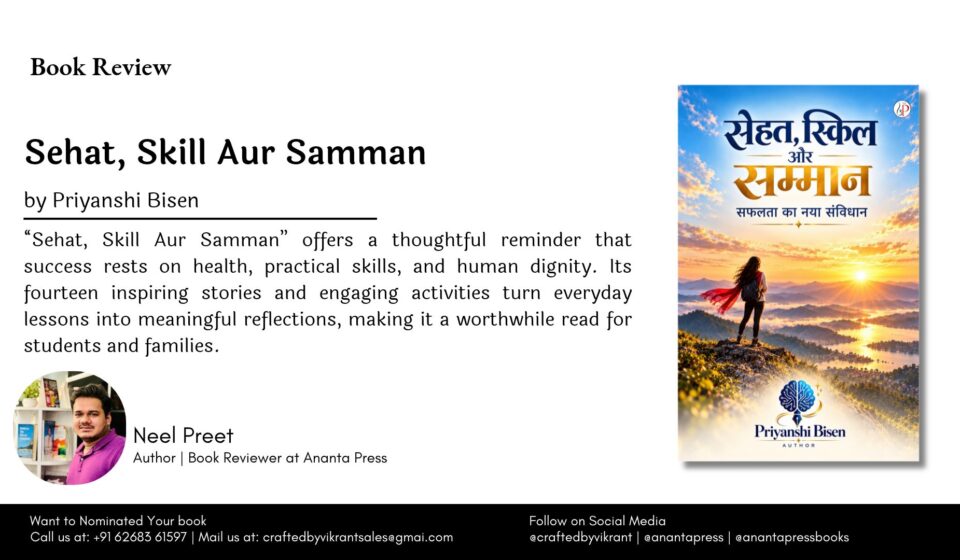
Sehat, Skill Aur Samman: A Thoughtful Guide to Building a Meaningful Life

In a world where success is frequently measured through examination results, professional titles, and financial achievements, Sehat, Skill Aur Samman offers a welcome invitation to reconsider our priorities. Written by Priyanshi Bisen, this Hindi book presents personal growth through three connected foundations: health, skills, and respect. Through fourteen instructive stories, reflections, and practical activities, it encourages readers to think beyond outward accomplishment and consider the habits, relationships, and values that make achievement meaningful and sustainable.
The book’s central strength lies in the connection it establishes between ambition and responsibility. Bisen encourages readers to pursue their potential while examining the foundation supporting that pursuit. Health enables participation in life, skills help people respond to changing circumstances, and respect gives direction to personal and social relationships. Together, these ideas create a broad understanding of success. The result is a book concerned with how people live, learn, treat others, and understand themselves.
The opening story, centred on the ambitious businessman Aarav Sharma, introduces this perspective with dramatic clarity. His professional achievements conceal an increasingly neglected personal life and physical condition. When a serious health crisis interrupts his progress, the distance between apparent success and actual wellbeing becomes painfully visible. The story’s emotional force comes from that reversal: a person accustomed to managing a business suddenly struggles with ordinary activities that previously required little thought or conscious effort.
As a literary device, Aarav’s experience establishes the recurring image of a strong foundation. An impressive building cannot remain secure when its base is weak; similarly, professional achievement becomes fragile when health and balance receive insufficient attention. This metaphor gives the book a consistent thread. Its simplicity makes the underlying argument easy to remember, particularly for younger readers who may understand an image more readily than a lengthy discussion of priorities, discipline, and personal wellbeing.
The discussion of fear adds an emotional dimension to this foundation. Through Ankush’s anxiety about performing before others, the author explores how imagined judgment can become a barrier to participation. His movement towards courage begins with identifying what frightens him. This is an effective choice because it gives fear a recognisable shape. Readers encounter a familiar experience: wanting to do something while worrying about embarrassment, failure, or the reactions of people watching.
The value of this episode lies in its encouragement of reflection. Courage emerges through understanding and taking a step forward despite uncertainty. For students facing classroom presentations, performances, or unfamiliar situations, the story offers an approachable starting point for conversation. Parents and teachers can also use it to ask better questions about hesitation. The chapter encourages adults to look beneath a child’s refusal or nervousness and consider the feelings that may be driving that response.
The book’s attention to originality and practical ability further strengthens its message. Its stories encourage readers to recognise their talents and develop a personal identity through effort. This approach has particular relevance in environments where comparison can overshadow individual interests. By giving skills a central place in its understanding of success, the book creates room for different forms of competence. Learning becomes connected with capability, initiative, and self-confidence, rather than being confined to academic recognition alone.
Time management and financial awareness bring an everyday practicality to these ideas. Their inclusion suggests that character development also involves learning how to handle limited resources. Time, attention, and money require choices, and those choices influence future opportunities. Presented through accessible storytelling, these subjects become less intimidating for young readers. They also give families useful material for discussing responsibility in ordinary situations, where small decisions often reveal more about habits than general statements about ambition ever could.
One of the book’s warmest sections recognises the mother as the household’s chief executive officer. This comparison draws attention to the organisation, planning, and emotional effort involved in domestic life. Work that often remains unnoticed becomes visible through a familiar professional image. The chapter invites readers to recognise competence within caregiving and household management. Its emotional appeal comes from directing attention towards someone whose contribution may be relied upon every day without receiving proportionate appreciation.
The accompanying activities make that appreciation tangible. Thank-you notes, shared responsibilities, and giving a mother time to rest turn a broad lesson about gratitude into specific actions. These suggestions are among the book’s most effective features because they connect reading with behaviour. A family can discuss respect at length, but helping with a task or acknowledging someone’s effort creates a lived experience of it. Here, the book offers a useful bridge between understanding a value and practising it.
Beyond the home, the book addresses civic awareness, women’s empowerment, and social change. These subjects widen its scope and connect personal growth with community life. Their presence is significant: readers are encouraged to see themselves as participants in a larger society. Confidence and capability gain additional meaning when they support informed participation and consideration for others. This broader perspective helps prevent the book’s idea of success from becoming entirely individualistic or focused exclusively on private achievement.
The attention given to lifelong learning and retirement also broadens the intended readership. Although many activities are especially suitable for children and parents, these chapters acknowledge that growth continues through different stages of life. Learning remains valuable after formal education ends, and a change in professional circumstances can open space for renewed purpose. This is an encouraging perspective for families reading together, since it allows adults to consider their own development alongside the aspirations of younger members.
Among the most affecting stories is Kavya’s experience of colour-based prejudice. The cruelty she encounters shows how casual comments can influence a child’s confidence and willingness to be seen. Her later decision to build a beauty business that welcomes different skin tones gives the story a clear social purpose. Personal hurt becomes the starting point for questioning an exclusionary standard. The episode brings particular emotional depth to the book’s discussion of dignity, identity, and self-respect.
An especially thoughtful detail is that Kavya’s early appearance on stage does not result in a prize. The meaningful change is her growing ability to participate with confidence. This distinction supports the book’s larger argument about success: internal progress deserves recognition even when it produces no immediate public reward. For children accustomed to rankings, certificates, and applause, that idea can be reassuring. It gives value to effort, courage, and self-acceptance within the process of development itself.
Structurally, the book works as a combination of story collection and activity-based guide. Narrative episodes introduce a concern, explanatory passages draw out the lesson, and exercises invite readers to engage with it. This arrangement makes the material suitable for reading in manageable sections. It also allows a chapter to become the basis of a family discussion or classroom session. Readers can pause over an idea, relate it to their circumstances, and return to the book later.
The direct involvement of parents is another distinguishing feature. Adults are repeatedly asked to examine the expectations they place on children and the example they provide through their own conduct. This creates a sense of shared responsibility. A child’s confidence is connected with encouragement, patience, and acceptance within the home. The book is strongest when it recognises that developing character requires a supportive environment as well as individual effort, and that adults must participate in the values they teach.
The writing generally favours clarity, explanation, and recognisable situations. Readers seeking accessible moral storytelling will appreciate this straightforward approach. The recurring images of foundations, roots, and buildings help hold the chapters together. At times, however, the repeated explanation of a lesson can feel more extensive than necessary. Some passages might gain impact from greater brevity, allowing the emotional meaning of a story to remain with the reader before another explanation reinforces the same point.
The stories also tend towards clear lessons and encouraging resolutions. This suits the book’s educational purpose, though readers expecting complex character studies or ambiguous literary fiction may find the treatment simplified. Its strongest use is as a starting point for reflection and discussion. The practical guidance is best approached in that spirit, with families and educators adapting activities to their circumstances. The book offers prompts for growth rather than a detailed examination of every challenge it introduces.
The closing twenty-one-day section gives the reading experience a practical continuation. Its suggested routines bring together reflection, movement, reading, gratitude, and connection with everyday life. The concluding pledges similarly encourage readers to express their intentions. Overall, Sehat, Skill Aur Samman is a sincere and useful contribution to values-based reading for students and families. Its lasting appeal lies in a humane understanding of achievement: developing abilities, caring for oneself, recognising others’ contributions, and building a life worthy of respect.