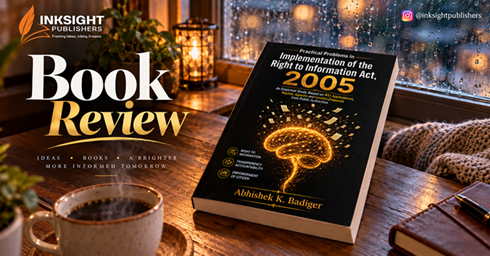
Book Review – Practical Problems in Implementation of the Right to Information Act, 2005 by Abhishek K. Badiger: Testing Transparency in Practice

The Right to Information Act, 2005 rests on a straightforward democratic principle: people should be able to ask public authorities for information and receive an answer within a legally defined process. Yet the value of such a right depends not only on what the law promises but also on what happens when an individual actually files an application. In Practical Problems in Implementation of the Right to Information Act, 2005, Abhishek K. Badiger approaches this distinction as the central question of his research. The result, as described by the author, is a grounded examination of how the RTI mechanism functions in ordinary administrative practice rather than an account limited to the wording of the statute.
The book’s most important choice is methodological. Instead of treating transparency as an abstract aspiration, Badiger looks at applications submitted to state and central public authorities and follows the responses those applications produce. Replies, transfers, first appeals, delays, non-responses, and deemed refusals become evidence of how accessible public information is in practice. This approach matters because a procedure can appear coherent on paper while remaining confusing or discouraging to the people who must use it. By directing attention to actual exchanges between citizens and institutions, the study brings implementation into sharper focus.
A citizen seeking information often starts with a reasonable expectation: an application will reach the appropriate office, be considered fairly, and receive a clear response. The path can be less direct. Applications may be transferred between authorities; responses may be incomplete or delayed; and some requests may not receive a response at all. The book examines precisely these kinds of procedural difficulties. It does not require a reader to be a specialist to appreciate their significance. Every avoidable transfer, unexplained delay, or missing reply can increase the effort needed to exercise a right that was designed to make government more answerable to the public.
A useful distinction running through the subject is the difference between formal compliance and meaningful access. An authority might carry out a procedural step without giving the applicant the information needed, or the applicant may have to appeal simply to obtain attention to a request. By examining first appeals alongside initial applications and responses, Badiger considers the wider journey of information-seeking rather than treating the first reply as the end of the process. That makes the study especially relevant to readers who are interested in whether administrative remedies work as ordinary citizens experience them.
The recurring themes of transparency and accountability give the work a clear public purpose. Transparency means more than the theoretical availability of records: it depends on accessible procedures, understandable communication, and timely disclosures. Accountability likewise requires a system in which public authorities respond to legitimate questions and procedural shortcomings can be identified. The empirical orientation of the book allows these principles to be tested against observable patterns. Its central concern is not whether openness sounds desirable, but whether institutions make it possible for citizens to obtain information in a dependable way.
Another strength of the proposed inquiry is its attention to non-responses and deemed refusals. These outcomes can be easily overlooked in discussions that focus on successful information requests. Yet silence from an authority is itself consequential. Applicants may need to track deadlines, prepare an appeal, or decide whether pursuing the matter remains worth the time and effort. Including such experiences provides a fuller picture of the burdens placed on information-seekers. It also highlights how delay can undermine a right even without an explicit rejection.
Badiger’s professional and academic interests help explain the emphasis on experience. A law student and legal researcher, he has undertaken practical institutional exposure involving legal services bodies and judicial proceedings, and his work with the Abhaya Legal Services Association reflects an interest in public legal awareness. Those details do not automatically establish the findings of the study, but they clarify why the author has chosen to connect legal principles with the operations of real institutions. His perspective is particularly suited to asking where the distance lies between a citizen’s legal entitlement and the administration’s day-to-day response.
The research also invites a useful discussion about reform. Identifying recurring procedural deficiencies is a necessary first step toward improving a system. The book is described as offering measures to strengthen implementation, a valuable ambition provided that recommendations remain closely tied to the evidence collected. Improvements may involve clearer handling of applications, more consistent communication, or closer attention to response processes, but the exact proposals and their effectiveness require consideration of the full study. The value of an evidence-led approach is that it creates a basis for more precise debate rather than relying only on general calls for greater openness.
Its readership should extend beyond academic law departments. Law students and researchers can use the book to think about empirical legal methods and the difference between doctrinal analysis and lived administrative practice. Advocates and RTI activists may find its attention to applications, appeals, and response patterns particularly relevant. Public authorities can also benefit from considering how routine procedural choices affect people seeking information. For citizens, the broader insight is that knowing a right exists is only part of understanding it; learning how the system responds is equally important.
This is not a book whose importance rests on dramatic storytelling or a promise of instant solutions. Its stated contribution is to make an everyday public-law process visible and open to scrutiny. The review must also recognise a limit: without independently examining the complete underlying application records and analysis, it would be inappropriate to claim particular statistical results or definitive conclusions about the performance of individual authorities. Based on the supplied description, however, the focus, scope, and research design offer a relevant foundation for discussing practical RTI reform.
Ultimately, Practical Problems in Implementation of the Right to Information Act, 2005 asks readers to judge a legal right by the experience of using it. That shift of attention is important for a democracy in which access to public information is connected to trust, participation, and institutional responsibility. Badiger’s inquiry is valuable as a contribution to a more practical conversation about administrative transparency: one that listens to what applications, replies, appeals, and silence reveal about the distance between the intention of a law and its operation on the ground.
Amazon Link https://www.amazon.in/Practical-Problems-Implementation-Right-Information/dp/9379000812/