Book Review- When a Neighbourhood Becomes a Public Question: A Documentary Reading of Ek Sangharsh Yatra

Some books begin with a character; others begin with a question that a community can no longer ignore. Vijay Sharma’s Ek Sangharsh Yatra, presented on its back cover as Sanjauli Andolan: Ek Sangharsh Yatra, belongs to the second category. Its stated subject is the Sanjauli movement, beginning with events dated 31 August 2024 and proceeding through different phases of collective action, legal process and public debate. That description immediately establishes an important expectation: this is not being marketed as escapist fiction but as an attempt to record a contested public experience while its memory is still relatively fresh.
The book’s most promising quality is its documentary ambition. A movement is usually remembered through a few photographs, slogans or dramatic dates. Yet the long life of a public controversy is made up of less visible stages: conversations among neighbours, the framing of demands, responses from authorities, legal developments, disagreement over methods and the fatigue of waiting. By placing the movement alongside judicial proceedings, the book’s description suggests a broader account than a simple chronology of demonstrations. It invites the reader to look at how claims move from streets and gatherings into institutions where rules, evidence and procedure matter.
The title is carefully chosen. Sangharsh, or struggle, evokes effort under pressure; yatra, or journey, implies change over time. Together they resist the idea that a public movement can be reduced to a single victorious or disappointing outcome. A journey has beginnings, pauses and unexpected turns. This framing is valuable because public life rarely follows a neat dramatic arc. Even when a movement attracts strong emotion, its effects are typically dispersed across local relationships, administrative decisions, political language and personal recollection. The word journey leaves room for these different levels of experience.
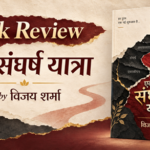
The cover strengthens that interpretation through an unusually clear visual metaphor. A solitary figure stands at the end of a winding red path that cuts across dark, fractured layers of rock toward a large golden sun. Around the path appear words associated with struggle, including doubt, fear, defeat, loneliness and failure. The image makes no claim about a particular event; instead, it visualises the emotional terrain of perseverance. Its upward movement suggests possibility without pretending the route is simple. In a book that concerns collective action, the lone figure can also be read as the individual citizen trying to locate a place within a much larger public narrative.
The back-cover description identifies a significant date, 31 August 2024, and the movement’s subsequent phases. That anchor gives potential readers a point of entry. But dates in documentary writing are most useful when accompanied by clarity about what is established, what is disputed and whose account is being presented. For a subject that can generate competing interpretations, distinguishing observation from allegation and legal record from popular belief is especially important. The strength of a book like this ultimately depends on the care with which it makes those distinctions. A factual account does not become less committed simply because it takes accuracy seriously; it becomes more useful.
Vijay Sharma’s biographical note describes him as a social worker and a prominent participant in the Sanjauli movement, engaged with Sanatan Samaj, public awareness and issues of local justice. That positioning matters. He approaches his subject, according to the supplied biography, not as a distant academic but as someone linked to the movement he writes about. Such proximity may provide insight into motivations, atmosphere and the everyday labour behind public mobilisation. At the same time, it asks readers to recognise the difference between participant testimony and a comprehensive, independent history. Both have value, but they answer different questions.
This is perhaps the most productive way to approach Ek Sangharsh Yatra: as a first-person-adjacent public record whose meaning is enriched by being read beside other perspectives. A participant can tell us what an event felt like from inside a community. A court order can show what a legal body determined within the issues before it. News reporting may explain how different constituencies understood the same incident. Together, those materials allow the social and institutional story to emerge in fuller detail. The book’s announced interest in public action and judicial process makes this wider reading particularly relevant.
The project also raises an urgent question about language. Discussions of local disputes can easily become abstractions about identity, authority, belonging or legality. But every such debate involves actual people whose safety, rights, dignity and sense of home must be taken seriously. Responsible documentation should allow disagreement without turning any community into a caricature. A meaningful account of a movement can record intensity while also making room for constitutional principles, peaceful civic participation and the complexity of a plural society. These standards are not obstacles to storytelling; they give the narrative moral and historical weight.
Visually, the volume appears designed to communicate endurance rather than celebration. The rough paper textures, broken black surfaces and red ascent suggest that the journey contains loss, tension and recovery. The short motivational lines printed on the cover speak of starting again after falling. Readers will notice that this language is broader than the specific movement. It gives the book a secondary dimension: a reflection on persistence, whatever position a reader may take on the particular public question. That breadth may help the book reach people interested in grassroots organisation and the psychology of collective resolve.
The most compelling promise of Ek Sangharsh Yatra is not that it can settle every debate about Sanjauli. No single participant’s book can reasonably do that. Its value lies in the attempt to preserve a situated record of an episode of civic life, with its sequence of events, institutional encounters and human stakes. For readers interested in local movements, contemporary social documentation and the complicated relationship between public emotion and lawful procedure, the book offers a subject worth examining critically. It also reminds us that history often starts as an argument among neighbours long before it becomes a chapter in a larger account.
Amaon Link: https: https://www.amazon.in/EK-SANGHARSH-YATRA-Vijay-Sharma/dp/9379001150