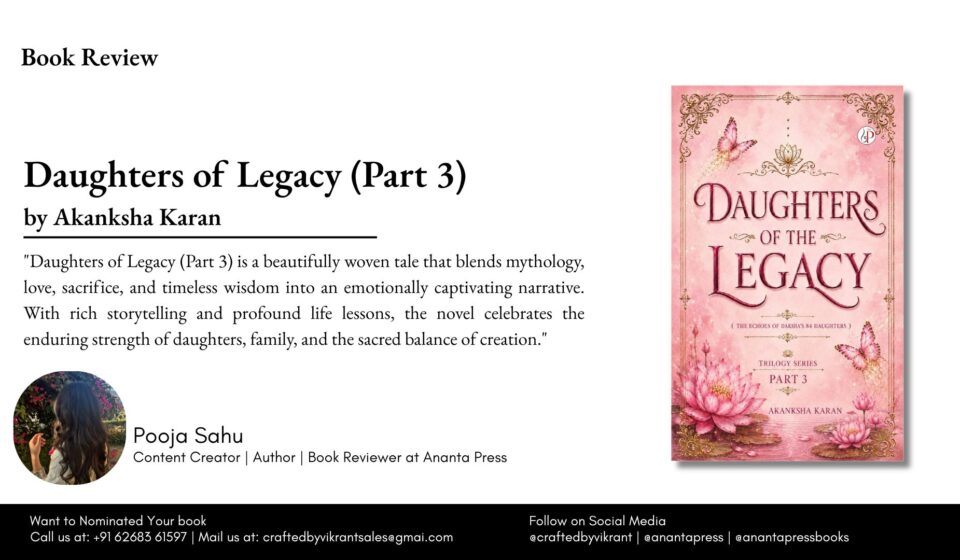

Some novels entertain, while others leave readers with thoughts that linger long after the final page. Daughters of Legacy (Part 3) belongs firmly to the latter category. It is a beautifully written novel that masterfully combines mythology, emotional storytelling, philosophy, and human relationships into a deeply meaningful narrative. Rather than presenting mythology as distant history, the author breathes new life into ancient legends by connecting them with the struggles, emotions, and moral questions of modern life.
The novel continues its journey through two parallel worlds. One follows the emotional lives of Krish, Keisha, and the people connected to Anantam, while the other revisits ancient Vedic stories narrated by Kalyani Ji. These two timelines complement each other perfectly, showing that human emotions—love, regret, sacrifice, hope, forgiveness, and redemption—remain unchanged across generations.
One of the greatest strengths of the novel is its emotional depth. The story begins with Krish returning to Anantam after three painful years. His emotions are portrayed with remarkable realism. The burden of unresolved love, unanswered questions, and suppressed anger creates a powerful emotional atmosphere from the very first chapter. The author captures silence as effectively as dialogue, allowing readers to experience Krish’s inner conflict rather than merely reading about it.
The reunion scenes are particularly memorable. Instead of relying on dramatic confrontations, the novel chooses subtle expressions, quiet moments, and restrained emotions. A simple glance, a pause in conversation, or an unspoken memory often carries greater emotional weight than lengthy conversations. This understated style gives the story authenticity and maturity.
Alongside the contemporary storyline runs the fascinating mythological narrative delivered through Kalyani Ji’s teachings. These chapters focus on Daksha Prajapati, Asikni, Virana, Narada, and the divine process of creation. Rather than presenting mythology merely as religious history, the author explores its philosophical significance. Every story becomes a lesson about responsibility, compassion, destiny, and the sacred role of daughters in creation.
The chapters describing Daksha’s transformation are among the most powerful in the novel. Initially consumed by duty, pride, and expectations, Daksha eventually realizes that true parenthood is not defined by lineage or gender but by unconditional love and acceptance. His heartfelt prayer for redemption after understanding the value of daughters becomes one of the novel’s most touching moments. This message feels timeless and socially relevant, especially in cultures where daughters have often been undervalued.
The title, Daughters of Legacy, perfectly reflects the novel’s central idea. Throughout the story, daughters are portrayed not merely as members of a family but as bearers of wisdom, compassion, continuity, and divine purpose. The author repeatedly emphasizes that a family’s true legacy is carried forward through values rather than inheritance, and daughters are equally capable of preserving and enriching that legacy.
Another impressive aspect of the novel is its treatment of mythology. Many modern retellings simplify ancient stories into action-driven adventures. This novel takes a different approach by respecting the philosophical depth of the original traditions. Mythological events unfold gradually, allowing readers to appreciate the spiritual significance behind each narrative. Even readers unfamiliar with Hindu mythology can easily follow the story because complex concepts are explained naturally through dialogue and storytelling.
Characterization is one of the novel’s strongest achievements. Krish emerges as a deeply human protagonist whose emotional journey feels authentic. His love for Keisha never appears exaggerated or melodramatic; instead, it reflects quiet endurance and unwavering loyalty. His gradual realization that Keisha’s disappearance was linked to her illness rather than rejection completely transforms the emotional landscape of the story.
Keisha herself remains a fascinating character despite her limited presence in some chapters. Her silence speaks volumes, and the revelation about her battle with cancer redefines everything the reader previously believed about her actions. Rather than portraying illness as mere tragedy, the novel presents it with dignity and emotional honesty.
Kalyani Ji serves as the moral and philosophical heart of the narrative. Through her storytelling, she bridges the gap between ancient wisdom and modern life. She never forces lessons upon her listeners; instead, she allows stories to reveal their own truths. Her calm presence adds warmth and spiritual richness to every chapter she appears in.
The supporting characters also contribute meaningfully to the narrative. Rishvika, Pahi, Asikni, Virana, Narada, and Daksha each represent different aspects of duty, compassion, sacrifice, and personal growth. None of them feel unnecessary or underdeveloped. Every character serves a purpose in advancing both the emotional and philosophical dimensions of the story.
The author’s writing style deserves special appreciation. The prose is elegant, descriptive, and poetic without becoming overly complicated. Nature is described beautifully, whether it is winter sunlight falling upon ancient stone pathways, ocean waves meeting the shore, sacred forests stretching endlessly across creation, or the quiet warmth of an oil lamp illuminating a mythology class. These descriptions create vivid imagery while enhancing the emotional atmosphere.
Dialogue throughout the novel feels natural and meaningful. Conversations rarely exist merely to move the plot forward. Instead, they reveal personalities, relationships, and emotional truths. Even brief exchanges often contain profound insights about forgiveness, family, or the nature of human suffering.
The pacing is generally steady and reflective. Readers seeking fast-paced action may find the novel slower than contemporary commercial fiction. However, this deliberate pacing suits the themes perfectly. The story invites contemplation rather than urgency, encouraging readers to absorb each emotional and philosophical moment fully.
One particularly commendable feature is the balance between mythology and contemporary fiction. Neither storyline overshadows the other. Instead, both narratives strengthen one another. Ancient stories illuminate modern emotions, while present-day struggles make mythological teachings feel surprisingly relevant. This structural balance demonstrates thoughtful planning and careful execution.
The novel also explores several universal themes beyond mythology. Love is presented not merely as romance but as sacrifice, patience, and enduring commitment. Parenthood becomes a responsibility grounded in compassion rather than authority. Legacy is shown to consist of values, wisdom, and kindness rather than wealth or social status. Redemption is portrayed as possible even after profound mistakes, provided one possesses humility and the willingness to change.
From a literary perspective, the symbolism throughout the novel is particularly effective. The recurring images of lamps, rivers, forests, oceans, and sacred fires reinforce themes of transformation, continuity, hope, and spiritual awakening. These symbols enrich the narrative without becoming repetitive or overly obvious.
Perhaps the novel’s greatest accomplishment is its emotional sincerity. It never manipulates readers through excessive sentimentality. Instead, genuine emotion emerges naturally through carefully crafted scenes, thoughtful dialogue, and believable character development. This authenticity allows readers to connect deeply with both the characters and the larger philosophical ideas explored throughout the book.
If there is one minor limitation, it is that readers unfamiliar with Hindu mythology may occasionally wish for additional background information regarding certain mythological figures. Nevertheless, the narrative provides enough context for most readers to understand the broader significance of each episode without feeling lost.
Overall, Daughters of Legacy (Part 3) is far more than a mythological novel. It is an exploration of humanity itself—our capacity for love, forgiveness, growth, sacrifice, and redemption. It reminds readers that ancient wisdom continues to hold profound relevance in modern life and that true legacy is created through compassion, integrity, and the values we pass on to future generations.
This book will particularly appeal to readers who enjoy emotionally driven fiction, philosophical literature, mythological retellings, family dramas, and stories that inspire reflection. It is a thoughtful, beautifully written work that combines literary elegance with emotional depth and spiritual insight.
Rating: ★★★★★ (5/5)
Daughters of Legacy (Part 3) is a remarkable continuation of the series—emotionally moving, philosophically enriching, and beautifully written. It is a novel that not only tells a compelling story but also encourages readers to reflect on the meaning of family, forgiveness, destiny, and the enduring strength of daughters as the true custodians of legacy.