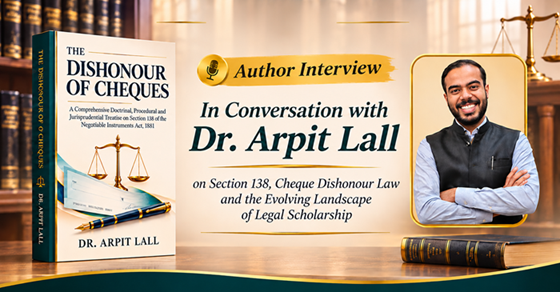
Exclusive Author Interview: Dr. Arpit Lall Discusses Section 138, Cheque Dishonour Law, and Legal Scholarship

An Exclusive Interview with the Classic Literature
The Classic Literature: What first prompted you to develop a full-length treatise on Section 138 of the Negotiable Instruments Act rather than a narrower practice guide?
Dr Arpit Lall: The book began life as a research paper of a little under sixty pages, and the decision to expand it into a treatise came when it became clear that a practice guide would be out of date before it was printed. Section 138 is not a field in which the rules are stable and only their application varies. The rule on territorial jurisdiction alone has passed through five distinct positions since 1999, from K. Bhaskaran to Dashrath Rupsingh Rathod, to the amendment of 2015 to Yogesh Upadhyay, and finally to Jai Balaji Industries in 2025, which declared its immediate predecessor per incuriam. The compounding tariff the Supreme Court laid down in 2010 was recalibrated in 2025 on materially different terms. And in May 2026, while the book was being written, a Bench of the Court in Dineshchand Surana v. UCO Bank doubted the characterisation of the offence that had stood since 2021 and referred the question of its juridical character to a larger Bench. A guide can tell a practitioner what the rule is on a given day. It cannot tell him why the rule is what it is, which way it is likely to move, or what to argue when the point has not been decided.
There is also the question of scale. When a Bench of five Judges took stock at the end of 2019, more than thirty-five lakh cheque complaints were pending, about fifteen per cent of the entire criminal docket of the country. A jurisdiction of that size is decided largely in the trial courts, on points that seldom reach an appellate court in a clean form: the security cheque, the disputed account, the complainant’s capacity to lend, the director who resigned after the cheque was dishonoured. Those questions need sustained argument, not checklists.
Finally, I came to the view that this field is governed to an unusual degree by judicial direction rather than by enactment. Parliament has repeatedly supplied machinery (compounding, summary trial, interim compensation) without saying how it is to work, and the Supreme Court has filled the gaps. Only a treatise could describe that pattern and trace its consequences from one end of the statute to the other. The practical material is still there, in a litigation lifecycle table, a defence taxonomy and a complainant’s checklist, but across nine Parts and forty-one chapters it rests on a doctrinal foundation rather than standing in for one.
The Classic Literature: How did you decide which aspects of the legislative history and judicial interpretation were essential to understanding cheque dishonour law today?
Dr. Arpit Lall: The test I applied was easy to state and harder to apply: does this piece of history still decide cases? History that merely records what happened was left out. History that explains why the present law is as it is went in.
On that test, three parts of the history proved indispensable. The first is the failure of the law before 1988. A suit on the cheque, even under the summary procedure of Order XXXVII, gave way to any defence that disclosed a triable issue, and the offence of cheating could not reach the ordinary defaulting drawer because it required a dishonest intention at the time of the transaction. Once that is understood, Section 140, which takes away the defence that the drawer had no reason to expect dishonour, reads not as an oddity but as Parliament’s direct answer to a known gap.
The second is the Statement of Objects and Reasons of 1988, which pursued two objects at once: the credibility of the cheque as an instrument, and adequate safeguards against the harassment of honest drawers. Much of what looks inconsistent in the modern case law comes from courts choosing between those two logics according to the question in front of them. The book calls this a bifurcation, and the argument starts with that document.
The third is the shape of the amendments. Apart from an increase in punishment in 2002, every amendment since 1988 has altered the machinery of the offence rather than its definition. Three of the four amendments to Chapter XVII were reactions: to the recorded failure of the original scheme, to a judgment of the Supreme Court, and to delay that the scheme itself had produced. I describe the pattern as legislation by correction, and it explains why so much of this field now rests on judicial direction.
For judicial interpretation the criterion was similar. Full treatment went to decisions that settled a question, displaced an earlier view or remain contested, and I traced lines of authority rather than listing cases: from Krishna Janardhan Bhat to Rangappa on the presumption, for instance, or from Indus Airways through Sunil Todi to Dashrathbhai Trikambhai Patel on when the debt must exist. Each chapter records the date on which its law was stated, and the book distinguishes throughout between what is settled, what is recent, what is developing and what is genuinely open. Where an older decision construed a provision of the Code of Criminal Procedure, I kept that provision in the discussion and noted the corresponding section of the Bharatiya Nagarik Suraksha Sanhita separately. I did not want to suggest that the Court had interpreted a statute it never saw.
The Classic Literature: Which recurring misunderstandings about legally enforceable debt, statutory presumptions or the burden of proof did you most want this book to clarify?
Dr. Arpit Lall: Three, above all.
The first is the phrase “no legally enforceable debt” itself. In practice it is pleaded as a single defence, but it conceals four different questions: whether the liability for which the cheque was given ever existed; whether a debt existed but was not one the law will enforce; whether the existence or amount of the debt is disputed; and whether a debt that once existed was paid or reduced before the cheque was presented. Each calls for different evidence and is answered by a different body of law. A defence that the money was repaid is not a denial that it was ever owed, and a court that treats it as one will place the burden of proof on the wrong party. The book sets out the four questions in a single table early on, and the Part on the legally enforceable debt is organised around them.
The second is the security cheque. It is the commonest answer to a complaint and the least analysed, because the Act recognises no such defence. After Sripati Singh and Sunil Todi, “security” describes the arrangement under which a cheque was handed over: when, and on what event, it could be presented. It is a fact to be proved, not a category of law. The real questions are whether the secured liability had arisen and fallen due, whether it remained unpaid in the amount of the cheque, and whether the parties had agreed to defer payment. The book suggests that the defence is best grounded in Section 46 of the Act, which allows a party to show that an instrument was delivered conditionally or for a special purpose only.
The third concerns the presumption and the burden of proof. Rangappa settled that the presumption under Section 139 includes the existence of a legally enforceable debt, and that the accused may rebut it on the preponderance of probabilities, including from the complainant’s own evidence. It did not settle everything, and two points are still widely misunderstood. Merely creating doubt does not rebut the presumption: the accused must make his defence probable. And the complainant’s financial capacity is not an ingredient of the offence that he must prove in chief. It is a circumstance the accused may raise, ideally in his reply to the statutory notice, and once it is raised with some foundation the complainant must answer it. A modest income does not by itself make a loan improbable. A related point concerns cash loans above the limit in Section 269SS of the Income-tax Act. After Sanjabij Tari in 2025, the breach does not by itself make the debt unenforceable, though the unusual mode of payment remains a circumstance to be weighed.
The Classic Literature: What was the most demanding part of organising the procedural discussion—from statutory notice and jurisdiction to trial and potential remedies—into a coherent structure?
Dr. Arpit Lall: The hardest decision was not about any single stage but about the organising principle itself.
The obvious approach is to follow the legal classification: the ingredients of the offence first, then the conditions of prosecution, then procedure. The difficulty is that the classification is itself contested. One line of Supreme Court authority, running from Dashrath Rupsingh Rathod to Dineshchand Surana, holds that the offence is committed when the cheque is dishonoured, and that the notice and the fifteen days are conditions of its prosecution. Another treats the failure to pay after notice as completing the offence. A book built on either view would have to defend it on every page. I therefore followed the sequence of events (transaction, presentation, dishonour, notice, default, complaint, trial, remedy) and kept the familiar six ingredients in the sense of facts that must be pleaded and proved, without letting that framework decide when the offence is committed. Where the question actually changes the result, as it can for a director who resigns between dishonour and default, the book states both positions and says which it prefers.
The second difficulty was the transition from the Code of Criminal Procedure to the Bharatiya Nagarik Suraksha Sanhita. Nearly every leading decision construed the old Code. It would have been easy, and wrong, to write as though those decisions had interpreted the new provisions. The procedural chapters therefore carry both. A single lifecycle table runs from the transaction to recovery and sets out, for each stage, the provision under the Act, the Code and the Sanhita, the time limit and the consequence of failure.
The third was that much of the procedure is not in the statute at all. The summons that invites payment, evidence on affidavit, the synopsis every complaint must now carry, electronic service and the compounding tariff all come from Supreme Court directions: Indian Bank Association in 2014, Meters & Instruments in 2017, the five-Judge decision in Expeditious Trial of Cases under Section 138 in 2021, and Sanjabij Tari in 2025. Separating what those decisions held from what they directed, and noticing when a later direction revised an earlier one, took more care than any single doctrinal question.
The demand notice needed three chapters of its own, because it does three things: it informs the drawer, it demands a sum, and it starts time running. Each function generates its own rules, and that analysis explains an apparent paradox in the case law. The content of a notice is construed strictly, so that after Kaveri Plastics even a typographical error in the amount is fatal, while the giving of it is construed liberally. Strictness ensures that the drawer knows exactly what he must pay. Liberality ensures that he cannot defeat the prosecution by declining to receive the notice.
The Classic Literature: How should advocates approach the differences between individual and corporate liability when analysing a cheque dishonour dispute?
Dr. Arpit Lall: The first question in any cheque case looks simple: who is the drawer? The drawer is the person who maintains the account on which the cheque is drawn. The debt need not be his own (a guarantor, or a company paying for supplies made to a sister concern, may be liable), but the account must be. The authorised signatory of a company cheque is not the drawer, as Bijoy Kumar Moni makes clear. That distinction is the hinge between individual and corporate liability.
An individual drawer answers for his own cheque. Liability beyond the drawer arises only through Section 141, and only where the drawer is a “company”, a word the Explanation extends to any body corporate and to a firm or other association of individuals. Section 141 is a deeming provision, and it is construed strictly. Three consequences follow for the advocate.
First, the company must be arraigned. Since the three-Judge decision in Aneeta Hada, a director or signatory cannot be prosecuted without the company unless a genuine legal impediment prevents its prosecution. A complainant who names only the officers cannot cure the omission once the period for complaint has run. Firms now stand somewhat differently after Dhanasingh Prabhu, but the prudent complaint still names the firm, gives notice to it and to each partner, and pleads each partner’s status.
Second, the two routes in Section 141 must be kept apart. Sub-section (1) turns on status: the person must have been both in charge of the company’s business and responsible to it for its conduct when the offence was committed, and the two requirements are cumulative. A managing director or joint managing director holds that status by virtue of office, and the signatory needs no averment of it. Every other director must be specifically alleged to hold it, because being a director is not enough. Sub-section (2) turns on causation, that is, consent, connivance or neglect in relation to the offence. The courts no longer require the words of the section to be recited “like a mantra”, in the phrase used in HDFC Bank in 2025, and the complainant is not expected to know how functions were divided inside the company. But an allegation of a different status, such as “managing the affairs” or simply “director”, is not enough.
Third, timing and role decide the case of a director who is not in operational control. Proceedings against non-executive and independent directors have repeatedly been quashed where nothing but their office was alleged. A director whose resignation was accepted and notified before the cheque was drawn is outside the section, and documents of unimpeachable character, such as filings with the Registrar, can support quashing at the threshold. Conversely, facts showing participation in the very transaction behind the cheque, such as signing the loan documents, strengthen an averment considerably.
My advice is to analyse every dispute in that order: the account, the principal offender, the route under Section 141, and the person’s status at the relevant time. Most errors in corporate cheque prosecutions come from skipping one of those steps.
The Classic Literature: Your book also considers settlement, compensation and insolvency. Why is it important to examine these issues alongside the offence and its procedural requirements?
Dr. Arpit Lall: Because that is where most cheque cases actually end, and because the questions they raise go to the nature of the offence itself.
Consider how a prosecution under Section 138 is resolved in practice. Only the complainant may set the law in motion, and only he may compound. The drawer has an opportunity to pay before the cause of action arises, and the courts have added more: on summons, at graduated cost under a compounding tariff, and even after a conviction has become final. Sections 143A and 148, inserted in 2018, add pressure to pay at the plea stage and on appeal. And since R. Vijayan and Somnath Sarkar, sentencing has been framed around restitution. No published statistics record how complaints end, and the book is careful to say so, but the structure of the procedure points strongly to settlement as the usual outcome. A book that stopped at conviction would describe a stage most litigants never reach.
The remedies also need precise treatment, because they are frequently confused. Substantive imprisonment, imprisonment in default, fine and compensation are distinct things with distinct sources. The power to award compensation, for example, comes from Section 357 of the old Code, now Section 395 of the Sanhita, and not from Section 138. Interim compensation under Section 143A has been discretionary rather than mandatory since Rakesh Ranjan Shrivastava in 2024, and an order must rest on a prima facie view of both sides’ cases. And the 2025 revision of the compounding tariff in Sanjabij Tari halved the percentage costs fixed in Damodar S. Prabhu fifteen years earlier.
Insolvency is where the stakes of characterisation are clearest. In P. Mohanraj the Supreme Court held that a Section 138 proceeding against a corporate debtor falls within the insolvency moratorium, describing it as a civil sheep in a criminal wolf’s clothing. Yet the criminal liability of directors survives a resolution plan that extinguishes the company’s debt, and in 2026 Dineshchand Surana doubted the Mohanraj characterisation and referred the question to a larger Bench. The book sets out in advance what each possible answer would mean for complainants, companies and directors.
The deeper point is this. The civil characterisation of the offence has produced liberal compounding, restraint in sentencing and the insolvency moratorium. The penal characterisation has produced the survival of directors’ liability and limits on payment before judgment. The label decides cases. The offence is penal in its definition and largely remedial in its administration, and neither half can be understood without the other.
The Classic Literature: What do you hope judges, advocates, law students and financial professionals will each take away from the book, and how might it support more careful legal practice?
Dr. Arpit Lall: I hope each of them will find something different, because the book was written with all of them in mind.
For judges, I hope it offers frameworks rather than slogans: the four questions into which disputes about the debt resolve, so that the burden falls on the right party; a synthesis of the decisions on financial capacity; the criteria that now govern interim compensation; and a clear indication, chapter by chapter, of what is settled and what is not. Trial courts carry this docket, and they deserve a text that is candid about the questions the Supreme Court has left open.
For advocates, I hope it raises the quality of pleading on both sides. An appendix consolidates the defences, with what each requires and where the burden lies, and sets out a checklist for the complainant. Many prosecutions fail, and many defences fail, on avoidable points: a notice that does not state the exact cheque amount; a complaint against directors that does not plead their status in substance; a company not arraigned; a complaint filed in the wrong court; or a defence of incapacity raised for the first time in the witness box when it should have been taken in reply to the notice.
For law students, I hope it shows how a short statutory provision grows into a large body of law, through construction where the statute speaks and through direction where it does not. It is also an introduction to reading doctrine critically: the reverse onus, strict liability, the presumption of innocence, and the question whether a commercial default should be a crime at all. The book sets out the case for and against criminalisation fairly before stating its own view.
For bankers, corporate counsel and other financial professionals, the book explains the banking side of dishonour, including return codes, the Cheque Truncation System and Positive Pay, along with the exposure that directors and signatories carry. It also has a practical lesson about security cheques: record the condition on which a cheque may be presented, and return it when the liability is discharged. A good deal of litigation would never begin if that were done.
As to careful practice more generally, the book tries to model it. Every authority carries an explicit verification status, a decision known only from a report is described as such, and the author’s own arguments are identified as his rather than attributed to a court. If readers take one habit from the book, I would like it to be that one: to know precisely what a court held, and to say no more than that.
The Classic Literature: How has writing this treatise shaped your thinking about legal scholarship, and what subjects or future writing projects would you like to explore next?
Dr. Arpit Lall: It has made me more exacting and, I hope, more honest about the limits of what can be said.
The first lesson concerned verification. Legal writing too often relies on citations carried forward from one secondary source to the next. I adopted a rule that no authority would be cited until it had been read in a primary or reported source, and that the footnote would record what had been read; where a decision was known only from a report, the text says “as reported”. No paragraph numbers appear in the book, because none could be verified against an authorised report, and I preferred leaving them out to giving references I could not stand behind. The same discipline applied to the research paper from which the book grew. Checking it against the judgments produced a numbered series of corrections, which the book records openly rather than making silently.
The second lesson was the importance of separating holding from synthesis. A treatise must argue, or it is only a digest. But a reader is entitled to know when he is reading what a court decided and when he is reading the author. Wherever the book advances an argument of its own, it says so and attributes it to no court.
The third was that the law does not wait for the author. The reference in Dineshchand Surana came in May 2026, in the middle of the writing, and put the character of the offence formally in issue. I chose to write around that uncertainty openly, stating the possible outcomes and their consequences in advance, rather than pretend the question was closed. The book ends with a table of thirteen questions that remained unresolved on the date its law was stated, and I regard that table as one of its more useful parts.
As for what comes next, the first obligation is to this book. Four references are pending before larger Benches of the Supreme Court, on the character of the offence, the complainant’s appeal, the appellate deposit and parallel prosecution for cheating, and when they are decided the treatise will need a supplement. Beyond that, two subjects interest me in particular. One is the institutional question on which the book closes: what a dedicated civil or administrative procedure for dishonoured instruments would have to provide in order to replace the criminal one, and whether it could be made fast enough to matter. The other is the parallel offence for failed electronic transfers under Section 25 of the Payment and Settlement Systems Act, 2007. It reproduces Chapter XVII almost entirely, yet it has received a fraction of the attention, even as payments move steadily away from paper. I would also like to write at greater length on the transition to the Bharatiya Nagarik Suraksha Sanhita, which raises questions well beyond cheque law.