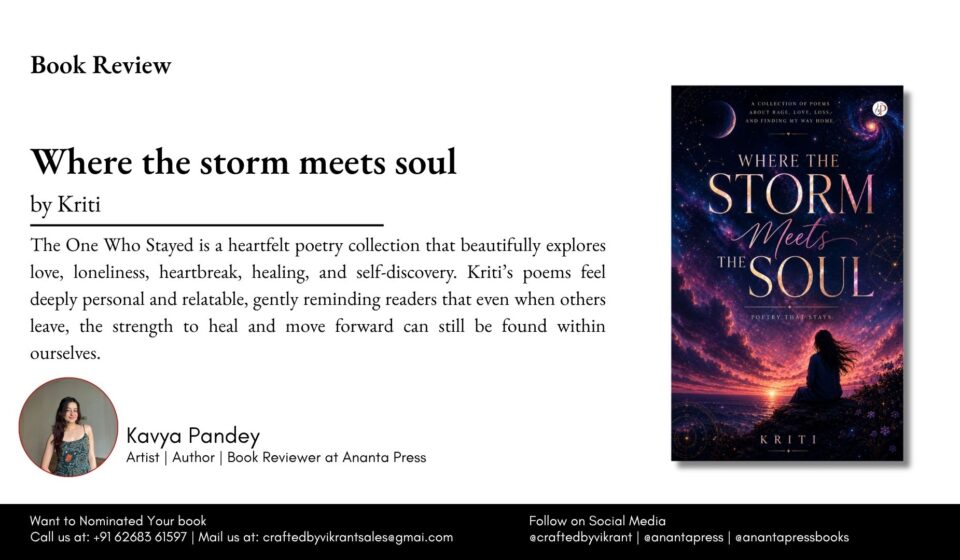

The One Who Stayed by Kriti is a deeply personal and emotionally expressive collection of poems that explores the complicated journey of loving, losing, questioning, breaking, healing, and eventually finding strength within oneself. Rather than presenting poetry merely as an artistic exercise, Kriti uses it as a space for emotional honesty. The collection feels like a private conversation between the poet and her own heart—one in which fear, attachment, loneliness, anger, love, abandonment, and self-discovery are allowed to exist without being hidden behind overly complicated language. The book contains fifteen poems arranged across four thematic sections: “The Fire Within,” “Where the Heart Gets Lost,” “The People Who Leave,” and “Finding My Way Home.” This structure gives the collection the feeling of an emotional journey rather than a random assortment of poems.
The first section, “The Fire Within,” introduces the reader to intense inner emotions. In “The Fire I Give Form To,” anger is not portrayed simply as destruction. Instead, it becomes a force that can be transformed into protection, courage, and responsibility. The speaker acknowledges the rage within but refuses to be defined by it, describing herself as the one who gives that fire form. This is an important idea because it establishes one of the book’s central concerns: emotions may be powerful, but they do not necessarily have to control us. We can acknowledge them, understand them, and redirect them.
That emotional complexity continues in “The Monster Outside My Door,” where fear is imagined as something waiting outside, while the thin light beneath the door represents a possible path toward freedom. The poem asks whether the door is truly protecting the speaker or preventing her from confronting what frightens her. It captures the strange experience of wanting safety while also knowing that remaining hidden can become another kind of imprisonment. This ability to turn an emotional state into a simple visual image is one of the more effective qualities of Kriti’s poetry.
“The Dream Catcher” and “The Leaf in the Storm” continue this exploration of vulnerability. The dream catcher, normally associated with protection, becomes darkened by unfulfilled dreams, while the leaf is perceived by others as dancing freely even though it never chose the storm carrying it away. Particularly striking is the idea that what looks like freedom from the outside may actually feel like helplessness to the person experiencing it. These poems show that the book is interested not simply in sadness but in the difference between how emotions appear externally and how they are experienced internally.
The second part, “Where the Heart Gets Lost,” focuses more closely on relationships, attachment, affection, and insecurity. “The Inside Joke” expresses the feeling of being excluded and emotionally disconnected, ending with the speaker admitting that she feels lost in a very large world. Meanwhile, “The Rope Between Us” offers a memorable metaphor for love. Two people hold onto the same rope in an attempt to move closer, but they grip it so tightly that they end up hurting themselves. The poem suggests that love can become damaging when attachment turns into pressure, fear, or possession.
A gentler emotional note appears in “If I Were Rich.” Here, wealth is imagined not as luxury but as the ability to give warmth, security, hope, and love to another person. The poem insists that no material treasure can outweigh meaningful affection and companionship. This creates an interesting contrast with the darker poems surrounding it. The collection is not entirely consumed by pain; it also contains tenderness and the desire to care deeply for others.
One of the strongest metaphors in the collection appears in “The Cup We Hold Too Tight.” The poem compares emotional attachment to holding a fragile cup so tightly out of fear of losing it that the pressure itself causes it to break. The message is simple but effective: insecurity can sometimes destroy exactly what we are trying desperately to preserve. The poem ultimately suggests that some things require space, flexibility, and acceptance rather than control. It concludes with the recognition that what is truly meant to remain will stay, while temporary things eventually fade.
The emotional centre of the collection grows even heavier in the third section, “The People Who Leave.” “You Forgot What We Had” looks back on a relationship that still occupies a tender place in the speaker’s memory. Yet the poem also recognizes that missing somebody does not necessarily mean that returning to them is right. The speaker remembers not only affection but also the pain of absence and the effort required to resist reaching out.
“The Weight of Letting Go” captures the exhaustion of knowing that separation may be necessary even when love remains. The poem describes emotional burden, heartbreak, and the difficult contradiction between wanting somebody near and recognizing that the relationship cannot continue in the same way. These moments give the collection its relatable quality. Kriti does not try to present healing as immediate or graceful. Instead, the poems often remain inside confusion long enough for the reader to recognize the reality of it.
“What They Say” is particularly relevant to anyone who has experienced the frustration of being told that their pain is “just a phase.” The speaker questions easy advice from people who may not understand what she is actually feeling and reveals a deeper need: not necessarily for solutions, but for someone willing to understand and stay. This theme of staying becomes increasingly important as the book approaches its final section.
“The Questions of the Night” moves gradually from loneliness toward hope. It begins with nights that feel longer than days and questions whether isolation is desired or simply painful. By the end, however, the poem imagines sunrise after darkness and acknowledges healing as something slow but possible. The speaker begins to understand that even during moments when strength feels absent, some part of the self is still moving toward belonging.
This transformation becomes clearest in the title poem, “The One Who Stayed.” The speaker remembers searching for warmth in other people and interpreting every goodbye as evidence that she might be difficult to love. Eventually, however, she discovers that after everyone else leaves, a voice within herself continues to say, “carry on.” The revelation is powerful because the person she had been waiting for was herself. Rather than continuing to pour her heart into places incapable of holding it, she begins to acknowledge and care for the vulnerable part of herself she had ignored.
“The Stranger at the Door” develops the same realization even further. After becoming accustomed to people leaving, the speaker encounters a presence that seems unfamiliar but eventually recognizes it as her own inner self—the part abandoned while searching desperately for other people to stay. The poem concludes with the mind leading the speaker “home” to the soul, perfectly explaining why the final section is titled “Finding My Way Home.”
The collection closes with “Wide Awake,” a poem about sleepless nights, emotional triggers, inner storms, and the difficulty of finding peace when the mind continues replaying pain. Yet its final image is quiet rather than hopeless: despite the storms created by the heart, the speaker still imagines herself lying calmly beneath the starlight. It is a subtle but appropriate ending for a book that does not promise that every wound disappears, only that a person can learn how to remain present through it.
What makes The One Who Stayed meaningful is its emotional accessibility. Kriti writes about experiences many readers—particularly young readers—may recognize: feeling excluded, loving too deeply, fearing abandonment, struggling to let go, staying awake with unanswered questions, and hoping someone will understand. The language often feels conversational, which allows the emotions to remain immediate rather than distant or overly literary.
Ultimately, The One Who Stayed is not simply a collection about people leaving. It is a collection about discovering who remains after loss. Its journey moves from uncontrolled inner fire and fear, through attachment and heartbreak, toward the quieter realization that healing begins when we stop measuring our worth through the presence or absence of others. Kriti’s poems suggest that sometimes the person we keep waiting to rescue, understand, or remain beside us is already there within ourselves. That realization gives the title its emotional power and leaves the reader with a comforting thought: even after love changes, relationships end, and nights become difficult, there can still be a way back home to oneself.