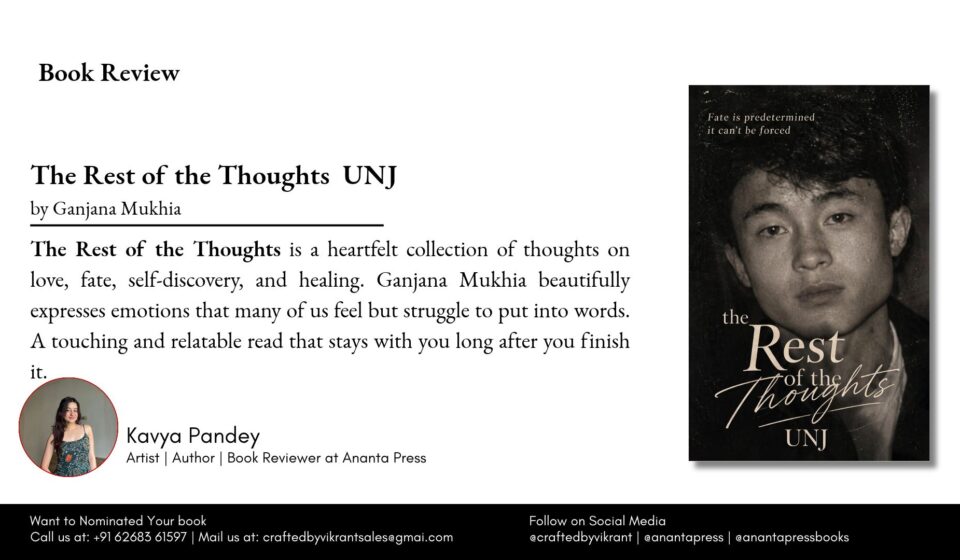

The Rest of the Thoughts by Ganjana Mukhia is a deeply personal and emotionally meaningful collection of thoughts that explores love, fate, self-discovery, relationships, and the process of becoming a stronger version of oneself. The book gives words to feelings that often remain hidden in the heart, unspoken and difficult to explain. Through short reflections, poetic expressions, and powerful observations, the author invites readers to pause, reflect, and connect with their own experiences.
One of the most beautiful aspects of this book is its simplicity. The author does not rely on complicated language or lengthy explanations to communicate emotions. Instead, the thoughts are brief, direct, and meaningful. Each reflection carries its own message, allowing readers to interpret the words through the lens of their personal experiences. Sometimes, a few carefully chosen words can express more than an entire page, and this book captures that quality wonderfully.
The book begins with the theme of faith and fate, encouraging readers to think about the things they cannot control and the choices they can still make. It explores the idea that life does not always unfold according to our expectations. Sometimes, we hold on too tightly to people, situations, or dreams that may not be meant for us. Through its reflections, the book reminds us that forcing an outcome does not always bring happiness. Learning to accept certain endings can be painful, but acceptance can also become the beginning of a new chapter in life.
Another significant theme is self-discovery. In the rush to meet expectations, maintain relationships, and fulfill responsibilities, people sometimes forget to pay attention to their own feelings. The author captures the experience of understanding others while struggling to understand oneself. These reflections may resonate especially with readers who have spent a long time putting other people’s needs before their own. The book encourages a quiet but important question: Have we given ourselves the same care, patience, and understanding that we so freely offer to others?
The section on the self also explores emotional exhaustion, inner struggles, and the difficulty of forgiving oneself. These are experiences that many people face but rarely discuss openly. The author presents them without unnecessary drama, allowing the emotions to speak for themselves. The reflections remind readers that feeling lost does not mean being broken forever. Sometimes, recognizing our pain is the first step toward understanding it. The book creates space for these feelings rather than suggesting that every struggle must have an immediate solution.
Love and longing form another important part of the collection. The author looks beyond the idealized image of love and explores the reality of unspoken feelings, emotional distance, changing relationships, and the sadness of loving someone who may not feel the same way. The writing acknowledges that love can be beautiful while also being complicated and painful. It captures the uncertainty of relationships in which people may care deeply but still find themselves growing apart.
What makes these reflections particularly relatable is their honesty. The book does not suggest that every relationship will last forever or that every feeling will eventually be returned. Instead, it recognizes that two seemingly contradictory emotions can exist together. A person can have loved someone sincerely and still reach a point where moving forward becomes necessary. Such reflections offer a mature perspective on emotional growth and remind readers that letting go does not necessarily mean that the feelings were never real.
The theme of people and places adds another layer to the book. Relationships are not defined only by how long they last but also by the comfort, support, and memories they leave behind. Some people remain important even after distance enters the relationship, while certain places become connected to specific periods of our lives. The author acknowledges these complicated connections with sensitivity, showing how gratitude and sadness can exist side by side.
The collection also explores writing, time, and memory. There are moments when people become so occupied with the past that they struggle to appreciate the present. Regrets, unfinished conversations, and memories can occupy the mind long after a situation has ended. The author’s reflections encourage readers to consider how their relationship with the past affects their ability to live in the present. The message is not that memories should be forgotten, but that they should not prevent us from experiencing the life that is still unfolding.
The final section, Becoming, brings a sense of personal growth and renewed possibility to the collection. Growth is not always dramatic or immediately visible. Sometimes, it begins with the willingness to try again, the courage to face uncertainty, or the decision to stand up after a difficult experience. The reflections suggest that even painful phases can become part of our journey toward understanding ourselves better. They encourage readers to recognize their progress, including the small steps that may otherwise go unnoticed.
Another strength of The Rest of the Thoughts is the way it allows readers to engage with the book at their own pace. Since many of its reflections are short, readers can open it for a few minutes, spend time with a particular thought, and return to it later. This makes the collection suitable for people who enjoy reflective writing and prefer to think deeply about individual lines rather than follow a continuous narrative. Different readers may connect with different sections depending on what they are experiencing in their own lives.
The book’s emotional appeal comes from its ability to make ordinary feelings feel seen and understood. Loneliness, uncertainty, longing, regret, hope, and the desire to become better are not unusual experiences, yet they can sometimes make people feel isolated. Reading words that reflect these emotions can offer a sense of recognition. The collection does not promise to solve every problem, but it offers something valuable: an opportunity to pause and reflect without feeling the need to have all the answers.
The title itself, The Rest of the Thoughts, feels appropriate for a collection that brings private reflections into the open. It suggests that some thoughts remain unfinished, some emotions are still being understood, and some stories continue beyond the words already written. The book does not need to present every feeling as a final conclusion. Its openness is part of its appeal, leaving readers with ideas they can revisit and interpret differently over time.
Overall, The Rest of the Thoughts by Ganjana Mukhia is a thoughtful and relatable collection for readers who appreciate emotional honesty, introspection, and concise writing. Its exploration of fate, identity, love, relationships, time, and personal growth gives the book a broad emotional range while maintaining a personal and intimate tone. Although its brief reflections may appeal more to readers who enjoy poetry-like observations and contemplative writing than to those who prefer a traditional story with a continuous plot, the collection offers meaningful moments of recognition and reflection.
This book is especially worth exploring for anyone who has experienced the uncertainty of love, struggled to prioritize themselves, carried memories from the past, or tried to find strength during a difficult phase of life. It reminds readers that growth is a continuing process, that acceptance can be an act of courage, and that even a small thought can sometimes change the way we understand an experience.
The Rest of the Thoughts is ultimately a gentle reminder that not every feeling needs an immediate explanation, not every ending erases what came before, and not every difficult phase defines who we are. Some thoughts simply need to be acknowledged, some emotions need time, and some journeys require patience. Through its honest reflections, Ganjana Mukhia offers readers an opportunity to reconnect with themselves and discover meaning in the thoughts they may have carried silently for years.