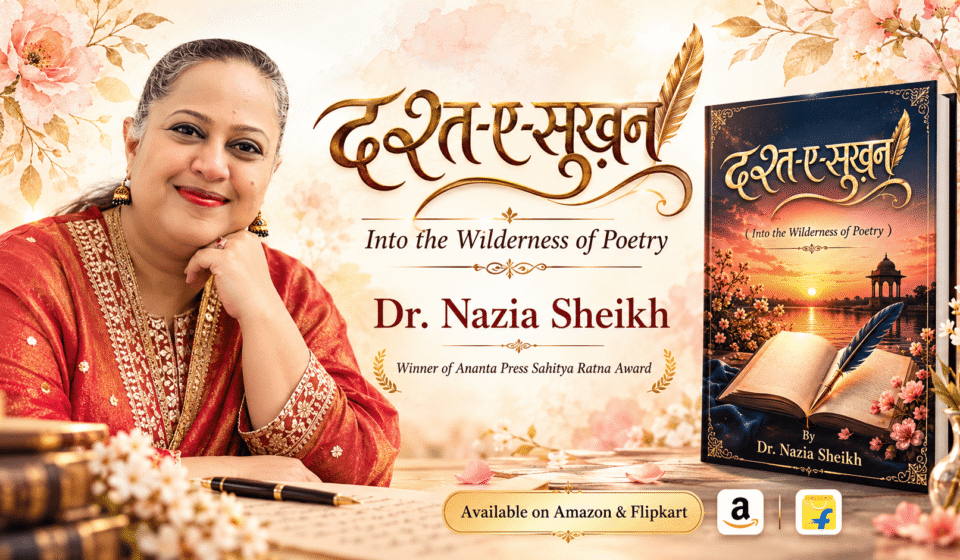

An emotional reading of love, absence and recognition in Dr. Nazia Sheikh’s दश्त-ए-सुख़न
There are books one approaches for a story, books one approaches for information, and books one approaches because ordinary language has failed to explain a feeling. Dr. Nazia Sheikh’s दश्त-ए-सुख़न belongs to the third category. Presented as a collection of Hindi and Urdu-inflected poetry about love, separation, longing, resilience, hope and self-reflection, it promises something more intimate than entertainment. Its central invitation is to recognize an emotion that may have remained unnamed. The appeal is not that every reader has lived the same life as the poet. It is that different lives can contain surprisingly familiar forms of waiting, affection, regret and courage. That promise of emotional recognition gives this collection a compelling point of entry.
The title itself offers an evocative frame. दश्त suggests an open wilderness or vast expanse, while सुख़न points toward speech, expression and poetry. Together, they evoke a landscape in which words must find their way through distances that cannot always be measured. It is an especially fitting image for verse concerned with inward experience. The emotional world is rarely arranged in straight roads. Love can lead toward certainty and confusion at once; memory can be comforting even as it hurts. A wilderness of poetry allows for those contradictions. Rather than demanding that every feeling be resolved, the collection’s stated vision makes room for the unsettled, the incomplete and the deeply human.
One of its most attractive qualities is the refusal, at least in its guiding idea, to treat vulnerability as weakness. The themes of separation and longing may sound familiar to regular readers of romantic poetry, yet familiarity does not mean exhaustion. Their power depends on whether a poet can restore the freshness of a common feeling. Here, the book is described as seeking emotional truth through suggestive imagery, quiet intensity and the meaning of what remains unsaid. Those are thoughtful priorities. A line of poetry does not need to announce the scale of a heartbreak in order to convey its presence. Sometimes an omission, a pause or a small shift in tone can express what a louder declaration would diminish.
This sensitivity matters because longing is not one simple emotion. It can be a desire for someone absent, a wish to recover an earlier version of oneself, or a hope for a future that never quite arrived. Poetry can hold these possibilities beside one another without forcing them into a single explanation. The imagined reader of दश्त-ए-सुख़न might arrive with a recent disappointment or with a memory that has lasted for decades. In either case, the themes invite a private conversation. The book’s strength as a concept lies in making space for multiple interpretations while preserving the sincerity of the feeling at the center.
Love, too, becomes more interesting when it is allowed to remain complex. It is tempting to describe love poetry only in the language of romance, yet mature affection also contains responsibility, uncertainty, patience and the quiet labor of remembrance. Dr. Sheikh’s account of her project embraces both joy and solitude, suggesting an emotional range larger than a single romantic mood. A collection organized around human experience can speak not only to the person celebrating love, but also to the person learning to live with its transformation. That wider emotional reach helps explain why such poetry can accompany readers through different chapters of their lives.
The collection’s bilingual literary sensibility adds another dimension. Hindi and Urdu have distinct histories and registers, but they also share an expansive everyday emotional vocabulary. Words associated with desire, memory, hope and heartbreak often carry a resonance that straightforward explanation cannot reproduce. The author describes her poetry as accessible even when it draws upon this richness, a balance worth valuing. Language can be musical without turning into a test of a reader’s credentials. It can be nuanced without being deliberately obscure. If the poems sustain this balance, newcomers may find a welcoming introduction to an expressive tradition while experienced poetry readers enjoy its textures and echoes.
Accessibility should never be confused with simplicity of thought. A clear phrase can carry complicated emotional knowledge. In fact, literary restraint often requires the greatest confidence: the poet must trust readers to complete an image, hear a pause and bring their own memories into the space. The portrait supplied for दश्त-ए-सुख़न emphasizes emotional honesty rather than ornamental display alone. That orientation is particularly attractive in contemporary poetry, where intensely decorative language can sometimes create distance from the very feelings it is meant to illuminate. A voice that seeks to be understood without surrendering depth has a chance to build a lasting relationship with readers.
Another noteworthy feature is the book’s emphasis on companionship. Many people reach for a poem not because they expect advice, but because they want assurance that a difficult feeling has been experienced and articulated by another human being. Literature cannot remove grief or solve every private conflict. What it can do is change the texture of solitude. A well-matched poem may make an isolated emotion feel less peculiar, less shameful or less impossible to express. The stated aim of this collection recognizes that quiet service. It asks readers to see poetry not simply as beautiful writing, but as a place where silence can acquire meaning.
This idea of recognition also explains the importance of rereading. A poem first encountered during happiness may reveal another dimension in a period of loss. A line that once seemed melancholy can later appear hopeful; a reflection on strength may feel tender rather than triumphant. Because the advertised themes of दश्त-ए-सुख़न are rooted in recurring human experiences, its value need not depend on one reading or one moment. Its appeal is cumulative. The reader returns with a changed life, and the same emotional subject becomes new again. The ability of lyric poetry to remain open to life’s revisions is part of its enduring fascination.
Dr. Nazia Sheikh’s background lends the project an additional human interest. Alongside her work as a General Practitioner and Diabetologist, she has maintained a longstanding literary practice that began in her school years. Her bibliography extends across several Hindi collections, an English poetry book and anthology contributions. These details establish that poetry is not an occasional afterthought in her life; it is a sustained form of expression. Nevertheless, credentials and awards are not substitutes for the experience of a poem. The more meaningful reason to engage with this collection is its articulated commitment to giving shape to emotions that might otherwise remain hidden.
The book should appeal especially to readers who prefer contemplative verse over dramatic narrative, who welcome a blend of Hindi and Urdu expression, and who find personal reflection as valuable as literary performance. It may also interest readers just beginning to explore poetry, provided they approach it with openness rather than the expectation that every poem should deliver a definite lesson. Such writing is best received slowly. One might sit with a small passage, consider an image, or allow the feeling behind a phrase to change direction. The reward is participation, not passive consumption.
Ultimately, दश्त-ए-सुख़न is distinctive for the kind of relationship it seeks to establish with its audience. Its guiding proposition is beautifully direct: people often read poetry in the hope of discovering themselves within someone else’s words. Love, absence, resilience and hope are universal subjects, but they remain personally charged for every reader. By bringing these experiences into a shared poetic space, Dr. Sheikh presents literature as a bridge between private feeling and collective understanding. That makes the collection worth considering not only as an expression of one poet’s inner world, but as an invitation to listen more carefully to our own.
Amazon purchase link: https://amzn.in/d/0042oEEO


