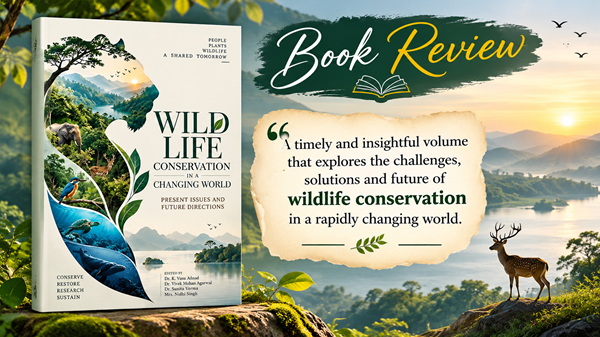
Wild Life Conservation in a Changing World: A Scientific Perspective on Biodiversity, Ecological Challenges, and Sustainable Conservation

Book Review
In an era when environmental challenges are becoming increasingly complex, the importance of wildlife conservation has moved beyond the traditional objective of protecting endangered species. Today, conservation requires a deeper understanding of ecosystems, biodiversity, climate change, habitat degradation, and the relationship between human activities and the natural world. Wild Life Conservation in a Changing World: Present Issues and Future Directions, edited by Dr. K. Venu Achari, Dr. Vivek Mohan Agarwal, Dr. Sunira Verma, and Ms. Nidhi Singh, addresses these pressing concerns through an interdisciplinary and scientifically oriented approach.
The book presents a valuable framework for examining the changing dimensions of wildlife and biodiversity conservation. Bringing together ecological research, environmental management, conservation strategies, and policy considerations, the volume emphasizes that protecting nature requires scientific understanding, cooperation, and long-term commitment. Its central message is especially relevant at a time when environmental sustainability has become a major global priority.
One of the most significant aspects of this volume is its recognition that wildlife conservation cannot be separated from wider environmental changes. Wildlife populations are influenced by multiple interconnected factors, including climate variability, habitat fragmentation, pollution, land-use changes, and expanding human activities.
The book’s interdisciplinary scope encourages readers to examine these challenges as parts of a larger ecological system rather than isolated environmental problems. This perspective is essential because the decline of biodiversity is rarely caused by a single factor. Instead, it often results from a combination of pressures that gradually weaken ecological stability.
Habitat destruction, for instance, not only reduces the living space available to wildlife but may also disrupt breeding patterns, food availability, and migration routes. Similarly, climate change can alter vegetation, water resources, and seasonal environmental conditions, creating additional difficulties for species already facing human-induced pressures.
By emphasizing these interconnected challenges, the volume promotes a more comprehensive understanding of conservation science.
Biodiversity forms the foundation of healthy ecosystems. Plants, animals, microorganisms, and their interactions contribute to ecological processes that support life on Earth. When biodiversity declines, the consequences extend beyond individual species and can affect entire ecosystems.
The book identifies biodiversity loss as a major conservation concern and encourages scientific examination of its causes, consequences, and possible solutions.
This focus is particularly important because biodiversity conservation involves maintaining ecological relationships, not merely preserving the existence of particular organisms. A forest ecosystem, for example, depends on interactions among vegetation, herbivores, predators, insects, and microorganisms. Disturbances affecting one component can influence the functioning of the larger ecological community.
The volume’s attention to ecological quality and connectivity therefore represents an important contribution to conservation discussions. It reinforces the understanding that protected areas alone cannot guarantee long-term biodiversity conservation unless habitats remain functional and connected.
Climate change is among the most serious challenges influencing contemporary wildlife conservation. Changes in temperature, rainfall patterns, extreme weather events, and seasonal cycles can alter species distributions and disrupt established ecological relationships.
The book’s emphasis on climate-adaptive management offers a forward-looking perspective on this challenge.
Traditional conservation measures often focus on maintaining existing habitats and species populations. However, changing climatic conditions require strategies capable of responding to evolving ecological circumstances.
Climate-adaptive conservation may involve long-term environmental monitoring, identification of vulnerable ecosystems, protection of climate refuges, and flexible management practices. Such approaches acknowledge that environmental conditions are dynamic and that conservation strategies must evolve accordingly.
By including climate change within its wider scientific framework, the volume highlights the necessity of preparing for future ecological uncertainty rather than responding only after environmental damage becomes severe.
Habitat fragmentation represents another important dimension of the conservation challenges addressed in this work.
As natural landscapes are altered by infrastructure, agriculture, urbanization, and other human activities, wildlife habitats can become increasingly isolated. Fragmented landscapes may restrict animal movement, reduce access to resources, and limit genetic exchange between populations.
The volume’s interest in landscape connectivity is therefore particularly relevant.
Maintaining ecological corridors and improving connections among suitable habitats can support wildlife movement and help preserve ecosystem functionality. However, effective connectivity planning requires scientific assessment of species behavior, habitat quality, land-use patterns, and local environmental conditions.
The book’s broader emphasis on evidence-based conservation encourages such integrated thinking and reflects the importance of moving beyond fragmented management practices.
A major strength of the book’s proposed scientific approach is its recognition of community participation as an essential component of biodiversity conservation.
Conservation initiatives frequently operate in landscapes where human communities depend on forests, water bodies, agricultural land, and other natural resources. Consequently, environmental management cannot succeed through scientific or administrative measures alone.
Local participation, awareness, and inclusive decision-making can contribute significantly to the long-term effectiveness of conservation programmes.
Community-based conservation recognizes that people living near wildlife habitats often possess valuable knowledge of local ecosystems. Their involvement can support monitoring, restoration, sustainable resource management, and the development of practical solutions to human-wildlife interactions.
The book’s inclusion of community participation also highlights an important ethical consideration: conservation strategies should seek ecological protection while recognizing legitimate human needs and livelihoods.
This balanced perspective makes the volume relevant not only to researchers but also to environmental administrators and policymakers.
Another notable feature of the volume is its commitment to scientific inquiry.
By bringing together original research, scientific reviews, field-based studies, case studies, and evidence-based perspectives, the book aims to provide a platform for interdisciplinary knowledge exchange.
This approach is particularly valuable because conservation decisions require reliable information. Effective strategies depend on understanding species populations, ecological conditions, habitat changes, environmental threats, and the outcomes of earlier interventions.
Long-term biodiversity monitoring is especially important in this context. Repeated observations allow researchers to identify ecological trends, evaluate conservation measures, and detect emerging threats.
The volume’s emphasis on research-driven management encourages conservation practices that can be tested, evaluated, and improved over time.
It also supports collaboration among wildlife biologists, environmental scientists, conservation practitioners, academic researchers, and policymakers.
Perhaps the most distinctive quality of Wild Life Conservation in a Changing World is its future-oriented perspective.
Rather than concentrating exclusively on existing environmental problems, the book encourages consideration of emerging challenges, scientific knowledge gaps, and innovative conservation strategies.
Ecological restoration, climate-adaptive management, biodiversity monitoring, landscape connectivity, and inclusive environmental governance represent important areas for future research and action.
The integration of scientific knowledge with environmental policy is another essential element of this forward-looking approach.
Scientific findings can contribute meaningfully to conservation only when they inform practical decisions and appropriate management strategies. Similarly, environmental policies become more effective when supported by ecological evidence and regular evaluation.
By connecting science, management, and governance, the volume promotes a comprehensive vision of conservation that recognizes both immediate needs and long-term environmental responsibilities.
The book’s interdisciplinary framework makes it particularly relevant to a wide academic and professional readership.
Researchers and wildlife biologists can engage with its scientific themes and research directions. Students of environmental science, zoology, ecology, and biodiversity conservation can use its subject matter to develop a broader understanding of contemporary conservation challenges.
Environmental managers and conservation practitioners may find its emphasis on monitoring, restoration, and adaptive management useful for professional reflection.
Policymakers can also benefit from its central argument that effective environmental governance requires scientific evidence, ecological connectivity, and community involvement.
Conclusion
Wild Life Conservation in a Changing World: Present Issues and Future Directions presents an important scientific vision for understanding and addressing the challenges confronting wildlife and biodiversity conservation.
Under the editorial guidance of Dr. K. Venu Achari, Dr. Vivek Mohan Agarwal, Dr. Sunira Verma, and Ms. Nidhi Singh, the volume brings attention to the interconnected relationships among ecological change, biodiversity loss, climate pressures, habitat degradation, human activities, and environmental governance.
Its greatest strength lies in promoting conservation as an adaptive, interdisciplinary, and collaborative responsibility rather than a narrow exercise in species protection.
The book’s emphasis on research, ecological restoration, community engagement, and forward-looking management reinforces a fundamental principle: protecting wildlife requires protecting the ecological systems that sustain it.
For readers concerned with the future of biodiversity and environmental sustainability, this volume offers a relevant and thought-provoking framework for exploring the scientific and practical dimensions of conservation in a rapidly changing world.