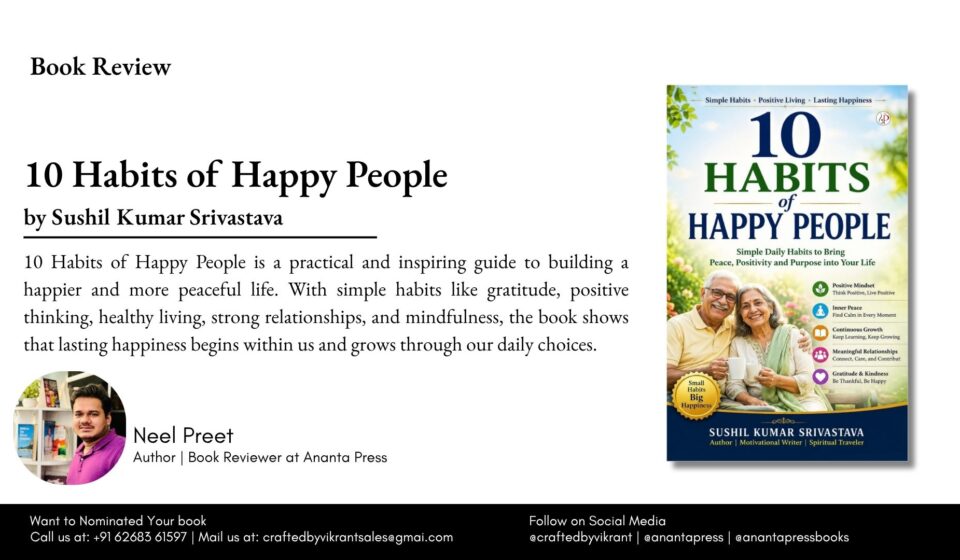

10 Habits of Happy People by Sushil Kumar Srivastava is a thoughtful and practical guide to understanding happiness and making it a meaningful part of everyday life. With the subtitle “Simple Daily Practices for a Peaceful, Positive, and Successful Life,” the book presents happiness not as something that depends on wealth, success, fame, or perfect circumstances, but as a way of living that can be developed through conscious choices and positive daily habits.
One of the most important ideas presented in the book is that happiness begins from within. Modern life often encourages people to measure happiness through material possessions, professional achievements, social status, and external recognition. However, the book explains that these things may provide temporary pleasure but cannot guarantee lasting peace or satisfaction. A person can have money and success and still experience loneliness, stress, dissatisfaction, or emotional emptiness. At the same time, a person living a simple life can experience contentment, peace, and genuine joy.
The book therefore shifts the reader’s attention from external circumstances to internal habits, thoughts, relationships, health, purpose, and attitude. This makes its message relevant to people from different age groups and different stages of life. The author does not suggest that happy people have no problems. Instead, happiness is presented as the ability to face problems with patience, hope, positivity, gratitude, and emotional balance.
The central structure of the book is built around ten habits. These habits are simple enough to understand and practical enough to incorporate into everyday life. The first habit is practicing gratitude. Gratitude encourages people to notice and appreciate what they already have instead of constantly focusing on what is missing. Family, health, relationships, opportunities, nature, and even small moments of daily life can become sources of appreciation. The book suggests that developing gratitude can gradually change the way a person looks at life.
The second habit is thinking positively. The author makes an important distinction between positive thinking and ignoring problems. Being positive does not mean pretending that everything is perfect. Rather, it means trying to identify solutions, possibilities, lessons, and hope even during difficult situations. Replacing negative self-talk with constructive thinking can improve confidence and emotional well-being. This is particularly useful in a world where people often become trapped in overthinking and unnecessary worry.
The third habit, living in the present moment, addresses another common source of unhappiness: excessive attachment to the past and anxiety about the future. Many people lose the happiness available today because they repeatedly regret previous experiences or constantly worry about what may happen next. The book encourages mindfulness, conscious breathing, fewer distractions, and greater appreciation of ordinary moments. This idea is simple but powerful because the present is the only part of life that we can actually experience.
The fourth habit is maintaining good health. The book recognizes that physical and mental well-being are closely connected to happiness. Balanced nutrition, physical activity, adequate sleep, water, relaxation, and self-care can contribute to better energy and emotional balance. Health is presented not simply as protection from illness, but as a foundation that enables people to participate actively in life and enjoy their experiences.
The fifth habit, building strong relationships, highlights the importance of human connection. Family members, friends, and loved ones can provide affection, emotional support, trust, companionship, and a sense of belonging. The book emphasizes that healthy relationships require effort. Trust, respect, empathy, honest communication, kindness, and quality time help relationships grow stronger. In a world where people can be highly connected digitally while still feeling emotionally isolated, this message is especially meaningful.
The sixth habit is helping others. One of the refreshing aspects of the book is its understanding that happiness is not only about receiving but also about giving. Helping someone, sharing knowledge, offering encouragement, giving time, supporting a friend, or performing a simple act of kindness can create a deep sense of satisfaction. By making a positive difference in another person’s life, individuals can also discover greater meaning in their own lives.
The seventh habit, managing stress calmly, is particularly relevant to modern lifestyles. Stress is described as a natural part of life, but the way people respond to it can significantly affect their happiness. The book discusses practical approaches such as deep breathing, meditation, exercise, proper planning, relaxation, adequate sleep, and sharing feelings with trusted people. An important lesson here is that while we cannot always control circumstances, we can learn to manage our responses to them.
The eighth habit is having goals and purpose. Goals give direction, while purpose gives meaning to that direction. The book encourages readers to set realistic goals and understand the deeper reason behind their efforts. A purposeful life is not necessarily about achieving more and more; it is about understanding why our actions matter. This perspective can help people remain motivated while also preventing achievement from becoming an endless race.
The ninth habit is continuing to learn and grow. The author encourages readers to remain curious throughout life. Reading, learning new skills, asking questions, attending courses, learning from experience, and even learning from mistakes can keep the mind active. Continuous learning can build confidence, adaptability, and a sense of progress. The message is particularly valuable because personal development does not have an age limit. Every day can provide an opportunity to learn something new.
The tenth habit is choosing simplicity. The book challenges the idea that a happier life necessarily requires more possessions, more commitments, and greater complexity. Instead, simplicity involves removing unnecessary physical and mental clutter and creating space for what truly matters. Health, relationships, meaningful experiences, purpose, and peace of mind receive greater importance than material competition. This approach can help readers reduce distractions and focus on the things that genuinely contribute to well-being.
An important strength of the book is that these ten habits are not presented as completely separate ideas. They are connected to one another. Gratitude supports positive thinking; positive thinking makes it easier to appreciate the present; living in the present can reduce unnecessary stress; good health provides energy; relationships offer emotional support; helping others creates meaning; goals provide direction; learning supports growth; and simplicity creates space for peace. Together, these habits form a practical framework for a more balanced and fulfilling life.
The book also goes beyond the ten primary habits by discussing happiness during difficult times, digital life, retirement, meditation, and daily routines. Its discussion of digital life is particularly relevant. Technology and social media can be useful, but excessive use can lead to comparison, distraction, and stress. The book encourages balance and mindful use of technology so that digital life does not replace real experiences and meaningful relationships.
The section on happiness after retirement is another valuable part of the book. Retirement can sometimes create feelings of uncertainty, loneliness, or loss of purpose because people may suddenly lose their professional routine and identity. The book offers a more positive perspective, presenting retirement as an opportunity for freedom, personal interests, relationships, learning, spirituality, and meaningful activities. Staying physically active, developing hobbies, spending time with family and friends, managing finances wisely, and maintaining spiritual and emotional balance can make retirement a peaceful and fulfilling stage of life.
The practical nature of the book is further strengthened by its inclusion of inspirational quotes, a daily happiness checklist, a 21-day happiness challenge, simple meditation practices, and frequently asked questions. These additions make the book more than something to read once; they encourage readers to actively practice the ideas. The book repeatedly emphasizes that lasting change does not usually happen through one major decision. Instead, small positive actions repeated consistently can gradually create meaningful transformation.
Another strong feature is the book’s accessible language and straightforward approach. The ideas are not presented as complicated psychological theories. Instead, the author focuses on everyday experiences and practical actions that readers can understand and apply. This makes the book suitable for students, working professionals, homemakers, older adults, and retired people. The author’s stated purpose is to provide guidance that can be used in everyday life rather than simply offering inspiration.
The book’s overall message is optimistic without suggesting that life will always be easy. Challenges, disappointments, uncertainty, stress, and difficult periods are unavoidable parts of life. Happiness therefore cannot mean the complete absence of problems. Instead, it means developing the inner strength and habits needed to respond to those problems more calmly and positively. The conclusion reinforces the idea that happiness can be found in ordinary moments through kindness, gratitude, love, learning, meaningful relationships, and inner peace.
What makes 10 Habits of Happy People especially useful is its reminder that readers do not need to wait for perfect circumstances before beginning to live more happily. Happiness can start with something as simple as appreciating what we have, spending quality time with someone we love, taking care of our health, reducing unnecessary comparison, helping another person, learning something new, or taking a few quiet moments to breathe and reflect.
Overall, 10 Habits of Happy People is a positive, practical, and encouraging book about developing a healthier relationship with life. It does not promise instant happiness. Instead, it presents happiness as a gradual process shaped by daily choices and consistent habits. Its ten habits provide a simple roadmap for readers who want greater peace, emotional balance, meaningful relationships, purpose, and contentment.
The book ultimately leaves the reader with a powerful realization: happiness is not a destination that we reach after achieving everything we want. It is something we can cultivate while living our ordinary lives. By complaining less, appreciating more, worrying less, living more consciously, giving more, learning continuously, and choosing simplicity, we can create a life that feels more peaceful and meaningful.
10 Habits of Happy People is therefore a worthwhile read for anyone looking for practical reminders about positive living and personal growth. Its greatest lesson is simple yet profound: a happier life does not always require changing the world around us; sometimes, it begins by changing the habits with which we experience the world.