Two Hands, One Foundation: Exploring the Parenting Philosophy of Arv’s The Rolling Stone That Gathered Moss

Book Review
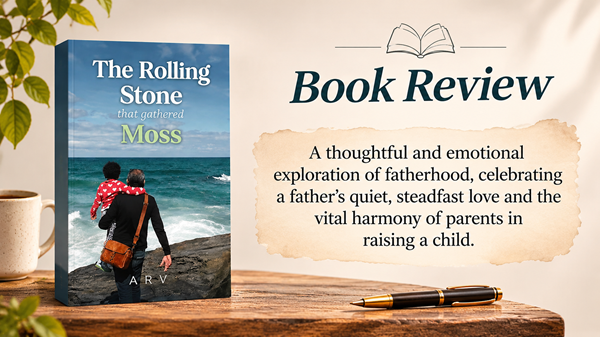
Parenting is often discussed through the language of responsibility, discipline, sacrifice, and care. Yet beneath these familiar expressions lies a more fundamental question: what creates the emotional foundation that allows a child to feel protected, understood, and supported? In The Rolling Stone That Gathered Moss, author Arv places this question within a thoughtful reflection on fatherhood and the relationship between mothers and fathers.
The book’s central idea is that raising a child requires two distinct hands working in harmony. By comparing the contributions of parents to hands joining in prayer or coming together in an embrace, Arv presents a powerful image of unity. It is an image that emphasizes cooperation without demanding sameness and recognizes individual contributions without turning parenting into a competition.
This distinction gives the book an important place within contemporary conversations about family life.
Parenting discussions frequently focus on the responsibilities of individual parents. Mothers may be celebrated for emotional nurturing, while fathers may be recognized for financial provision and protection. Although these associations remain familiar, they can also become restrictive when treated as fixed rules.
A child’s needs are far more varied than conventional expectations sometimes suggest. Children require security, affection, boundaries, encouragement, patience, and opportunities to develop independence. These needs do not belong exclusively to one parent.
Arv’s emphasis on equally vital parental energies can be read as an invitation to appreciate differences while preserving equality. Effective parenting need not mean that two adults approach every situation identically. What matters is whether their approaches contribute to a supportive and consistent environment.
Consider the everyday challenges involved in raising a child. One parent may respond to a difficult situation by encouraging conversation, while another may focus on helping the child understand practical consequences. Both approaches can offer value when guided by compassion and mutual respect.
The difficulty arises when different approaches become opposing forces rather than complementary contributions.
The metaphor of two hands is particularly useful here. Two hands work best when their movements are coordinated. Similarly, parents can strengthen family relationships when they discuss expectations, listen to one another, and communicate disagreements constructively.
The title The Rolling Stone That Gathered Moss adds a second layer to this philosophy. Its apparent contradiction challenges an old assumption that constant movement prevents lasting attachment. In the context of family life, the title suggests that individuals do not have to abandon personal growth in order to form meaningful roots.
Parents continue learning throughout their lives. Their beliefs change, their circumstances evolve, and their understanding of responsibility deepens. The arrival and upbringing of a child can accelerate that process.
A person who once measured progress through professional advancement or personal freedom may begin to understand success in terms of stability, shared experiences, and the well-being of loved ones. This does not necessarily represent the disappearance of individuality. Instead, it may signal the development of a more expansive identity.
Arv’s focus on fathers is especially important within this transformation.
Fatherhood has sometimes been represented as a destination: a man becomes a father and assumes a defined set of obligations. Yet parenting is better understood as a continuing process. The emotional challenges facing a father of a newborn differ from those encountered while supporting an adolescent or an adult child.
Each stage demands adaptation.
A father may need to learn patience when a child is young, the art of listening during adolescence, and the importance of respecting independence as the child grows older. His role changes even while his commitment remains.
The concept of being rooted together speaks directly to the importance of maintaining family relationships during these transitions. Stability, in this sense, does not mean that circumstances remain unchanged. It means that relationships can provide a dependable source of support while life continues moving forward.
One of the strongest implications of the book’s central message is that cooperation between parents is valuable not only for practical reasons but also for the emotional lessons it offers children.
Children observe how adults communicate, resolve differences, acknowledge mistakes, and express appreciation. The relationship between caregivers can influence a child’s understanding of respect and partnership.
When parents demonstrate that disagreements can be handled with patience, children witness a constructive model of communication. When adults acknowledge one another’s contributions, children learn that care and responsibility deserve recognition.
These observations can become part of a child’s emotional education.
The book’s message also encourages reflection on the invisible work involved in family life. Much of parenting happens outside moments of celebration or crisis. It consists of repeated decisions, ordinary sacrifices, interrupted plans, and small acts of attention.
A father ensuring that practical needs are met and a mother offering reassurance after a difficult day may both contribute to an atmosphere of security. Yet these examples should not be understood as rigid divisions. Either parent can provide emotional comfort, practical support, or both.
The deeper lesson is that parenting becomes stronger when responsibilities are shared according to circumstances, abilities, and mutual understanding.
This makes Arv’s vision of harmony particularly meaningful. Harmony does not require the elimination of differences. Rather, it involves an ongoing willingness to recognize and accommodate them.
It also requires emotional availability.
A family may function efficiently while its members remain emotionally distant. Tasks can be completed, schedules maintained, and obligations fulfilled without the deeper conversations that build understanding.
For this reason, parental partnership should include more than coordinated responsibility. It should also allow space for affection, vulnerability, gratitude, and shared reflection.
The book’s attention to fathers contributes to this wider discussion by challenging the assumption that a father must always appear unaffected by difficulty. Emotional openness does not weaken parental authority. When expressed appropriately, it can demonstrate honesty, self-awareness, and resilience.
Readers approaching the work from different stages of life may discover different meanings. Young adults may reflect on the relationships that shaped them. New parents may reconsider their expectations of one another. Experienced parents may find themselves reflecting on how their understanding of partnership has changed over time.
Even readers without children can engage with the book’s broader concern: the importance of creating lasting relationships through commitment and mutual respect.
As a parenting philosophy, the idea of two hands working together is appealing because of its simplicity. Yet living according to that principle requires patience, flexibility, and sustained effort. It means recognizing that love is not measured by whose contribution is greater, but by whether those contributions genuinely support the people who depend on them.
The Rolling Stone That Gathered Moss offers a reflective starting point for these conversations. Its family-centered message places fathers within the emotional heart of parenting while emphasizing the value of cooperation with mothers.
Ultimately, the work reminds readers that a child’s foundation is strengthened not by perfect parents but by dependable care, thoughtful communication, and relationships built on respect. Two hands may differ in strength, movement, and purpose, yet when joined in a shared commitment, they can create something enduring: a sense of belonging that continues to matter long after childhood has passed.
Amzon link – https://www.amazon.in/Rolling-Stone-That-Gathered-Moss/dp/9379001541/