The Rolling Stone That Gathered Moss by Arv: A Moving Reflection on the Silent Strength of Fatherhood

Book Review
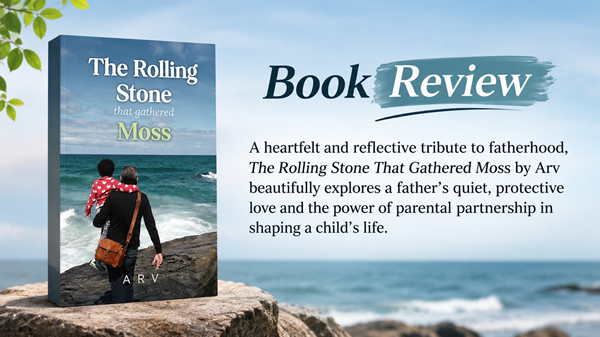
In the vast landscape of literature dedicated to love, family, and human relationships, the emotional world of fathers often remains comparatively unexplored. Mothers have long occupied a prominent place in stories of affection, sacrifice, and emotional nurturing, while fathers are frequently portrayed as providers, protectors, or disciplined figures standing quietly in the background. Arv’s The Rolling Stone That Gathered Moss offers an opportunity to reconsider this familiar portrayal. Through its central emphasis on paternal love and the shared responsibility of raising a child, the book presents fatherhood as a deeply emotional experience deserving recognition, understanding, and respect.
The book’s central message is both straightforward and significant: a father’s love may not always be expressed through elaborate words or visible displays of affection, but its presence can shape a child’s emotional foundation. It is a love that often operates quietly, finding expression through responsibility, concern, protection, and consistent involvement.
One of the most meaningful aspects of the book’s premise is its recognition of emotional restraint. Fathers are often expected to remain composed, even when confronted with uncertainty, exhaustion, or personal difficulties. Society frequently celebrates their strength without sufficiently acknowledging the emotional effort required to maintain it. By giving voice to fathers, Arv challenges the idea that emotional depth must always be openly demonstrated to be genuine.
This perspective encourages readers to reconsider the ordinary moments of family life. A father preparing for another demanding day, considering his child’s future, making practical decisions, or silently worrying about responsibilities may be expressing love in ways that are easily overlooked. The significance of these actions becomes clearer when viewed not merely as duties but as expressions of an enduring emotional commitment.
The title, The Rolling Stone That Gathered Moss, is particularly thought-provoking. Traditionally, a rolling stone is associated with movement, restlessness, and an unwillingness to settle. Moss, by contrast, suggests growth, attachment, and the gradual influence of time. Bringing these contrasting images together creates a compelling metaphor for personal transformation.
The title invites readers to imagine that movement and rootedness need not be opposites. A person may travel through changing responsibilities, shifting ambitions, and unexpected challenges while gradually developing deeper connections to the people who matter most. Fatherhood itself can become one such transformative experience, changing the meaning of achievement, stability, and belonging.
Another compelling dimension of the book is its emphasis on the partnership between mothers and fathers. The description draws a memorable comparison between parenting and two hands joining in prayer or a warm embrace. This imagery offers a simple yet meaningful representation of cooperation. Two hands may perform different functions, but together they create something unified.
Applied to parenting, this metaphor reinforces the importance of shared responsibility. A child’s upbringing is not simply a collection of separate tasks divided between adults. It is an ongoing process involving emotional presence, understanding, communication, guidance, and the creation of a secure environment.
Arv’s emphasis on different yet equally vital parental contributions is especially relevant in a time when discussions about parenting increasingly examine fairness, involvement, and emotional availability. The book’s vision encourages readers to look beyond competition between parental roles and recognize the benefits of working together.
At the same time, this message can be understood more broadly than a single traditional family arrangement. The underlying principle is that children benefit from dependable, loving adults who cooperate in supporting their development. While the book specifically centers mothers and fathers, its emphasis on mutual respect and emotional commitment has wider relevance.
What makes this subject particularly affecting is the distance that can exist between love and its recognition. A father may believe that fulfilling responsibilities communicates everything his family needs to know. His child, however, may long for spoken encouragement, shared experiences, or visible affection. Similarly, family members may fail to notice the pressure a father experiences because he rarely discusses it.
The emotional challenge, therefore, is not simply whether love exists, but whether it is understood.
This distinction gives the book’s premise considerable depth. It suggests that recognizing paternal love requires attention to both actions and communication. Fathers deserve appreciation for their dedication, but they also deserve the freedom to express vulnerability, affection, and uncertainty without feeling that such emotions diminish their strength.
The book also raises important questions about the relationship between personal identity and parenthood. Becoming a father does not erase individual dreams, fears, or ambitions. Instead, it adds another dimension to them. Personal decisions acquire new significance when they influence the well-being of another human being.
This transformation can be rewarding, but it may also be complicated. The responsibility of creating stability often arrives alongside the unpredictable demands of life. Through its evocative title and family-centered message, the book invites reflection on how individuals adapt to these changes and find meaning through commitment.
For younger readers, the work offers a chance to reconsider their relationships with their fathers. It encourages appreciation of the efforts that may have gone unnoticed during childhood. For parents, it provides an occasion to examine how love is communicated within the family. For fathers themselves, its message offers something especially valuable: acknowledgment.
The emotional significance of such acknowledgment should not be underestimated. Many fathers are praised for what they provide but rarely asked about what they feel. Recognizing their inner lives can help create families in which responsibility and emotional openness coexist.
The strength of The Rolling Stone That Gathered Moss lies in the universality of the questions raised by its premise. What does it mean to protect someone? How does love change with responsibility? Can affection remain powerful when it is expressed quietly? And how can parents work together without losing sight of their individual emotional experiences?
These are questions that extend beyond any one generation or cultural setting.
Ultimately, Arv’s book invites readers to recognize fatherhood not merely as a social position but as an evolving relationship shaped by love, sacrifice, patience, and emotional growth. Its emphasis on two parents remaining rooted together gives the message a hopeful direction, suggesting that family strength emerges through cooperation rather than competition.
The Rolling Stone That Gathered Moss stands as a meaningful tribute to the often-unspoken emotional world of fathers. More importantly, it reminds us that love does not become less profound simply because it is quiet. Sometimes, its greatest strength lies in remaining present, dependable, and deeply rooted through the changing seasons of life.
Amazon Link – https://www.amazon.in/Rolling-Stone-That-Gathered-Moss/dp/9379001541/