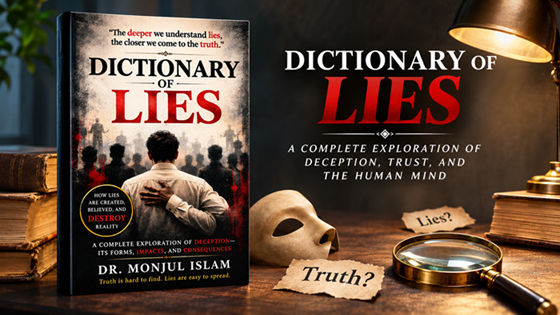
Dictionary of Lies by Dr. Monjul Islam: When Trust Meets Deception: A Thoughtful Inquiry into the Fragility of Truth

Few subjects are as familiar in everyday life and yet as difficult to examine carefully as lying. In Dictionary of Lies, Dr. Monjul Islam takes this ordinary human behaviour and treats it as a question with far-reaching personal and social consequences. His central concern is not merely whether people tell falsehoods. It is what happens after a falsehood enters a relationship, acquires credibility, and begins to shape decisions. The book approaches this question with a seriousness born of personal reflection, but its ambitions extend beyond autobiography. It asks readers to think about the conditions that make deception possible and the responsibilities involved in protecting truth.
The author’s note provides an unusually revealing point of entry. Islam explains that experiences of pain and broken trust encouraged him to investigate lies, deceit and deception. Importantly, he also says that the book is not intended as a personal grievance against particular individuals or institutions. That distinction matters to the reading experience. Rather than narrating an identifiable dispute and asking the audience to take sides, he attempts to turn an intimate question into a broader exploration. The movement from hurt toward inquiry gives the book its emotional foundation while leaving room for readers to consider their own experiences.
One of the book’s strongest organizing ideas is the paradox of trust. Human relationships cannot flourish without trust, but unquestioning trust can create vulnerability. Islam does not resolve this contradiction by advising universal suspicion. He repeatedly argues for a more discriminating response: verify consequential claims, listen carefully, and preserve fairness. The difference between suspicion and verification is especially useful. Suspicion may turn uncertainty into accusation, while verification asks what evidence actually supports a conclusion. The book is most persuasive when it encourages readers to hold both intellectual caution and human warmth together.
The early chapters show how a seemingly small distortion can become significant. An omission, exaggerated statement or misleading account may initially appear harmless. Once accepted, however, it can generate further explanations and reshape how people understand events. In the chapters on relationships, the author connects this process to emotional intimacy and psychological safety. The concern is not only that someone has hidden a fact; it is that the other person may discover that their understanding of the relationship was incomplete. That observation helps explain why the aftermath of deception often exceeds the apparent size of the original lie.
Islam then widens the discussion from private life to families, workplaces, healthcare, education and public institutions. These passages suggest that dishonesty is not simply an individual defect but a problem of systems and incentives. In a workplace, a misleading report can influence a chain of decisions. In healthcare, unreliable information may carry serious risks. Within families, stories repeated without scrutiny can become inherited assumptions. The examples are presented to illustrate the same recurring principle: when people act on inaccurate representations, the consequences can spread beyond the original conversation.
The book’s broadest historical and philosophical passages consider how different religious and intellectual traditions have approached deception, temptation, ignorance and truthfulness. Islam explicitly acknowledges that theological accounts are not interchangeable historical records. That qualification is valuable because it keeps the discussion from reducing complex traditions to a single explanation. The author is interested in recurring human concerns rather than in declaring one belief system superior. Readers may approach these sections as an invitation to compare perspectives, while recognizing that the book’s panoramic treatment cannot substitute for specialized scholarship on each tradition.
The discussion of modern communication gives the book an immediate contemporary dimension. Social media can accelerate the circulation of rumours, emotionally charged claims and manipulated images. Repetition can lend familiarity to information that has not been verified. The author’s proposed response is deliberately practical: pause before sharing, examine sources, seek corroboration and remain open to correction. These suggestions may sound simple, but their importance lies in the everyday moments when readers must decide whether to believe, repeat or challenge a claim. The book connects media literacy with the ethical duty to avoid harming others.
Dictionary of Lies is expansive, and that expansiveness is both a strength and a limitation. Its coverage ranges from personal betrayal to philosophy, organizational ethics and artificial intelligence. Readers looking for a tightly bounded academic argument may find some sections more exploratory than conclusive. The author himself describes the project as an incomplete journey and a guide to reflection rather than a definitive recipe. That framing should guide expectations. Its contribution is the set of questions it assembles and the insistence that truthfulness needs active protection, not merely passive admiration.
Ultimately, the book’s most humane message is that recognizing deception should not destroy the ability to trust. It asks for patience before judgment, evidence before accusation and humility when new facts emerge. These principles have relevance to relationships, classrooms, offices and digital conversations alike. Dictionary of Lies may not offer a final answer to why people deceive, but it offers a useful vocabulary for examining how belief and responsibility interact. Its lasting invitation is to become more careful with truth while remaining capable of empathy.
Amazon Link : https://www.amazon.in/Dictionary-Lies-Dr-Monjul-Islam/dp/9373359266