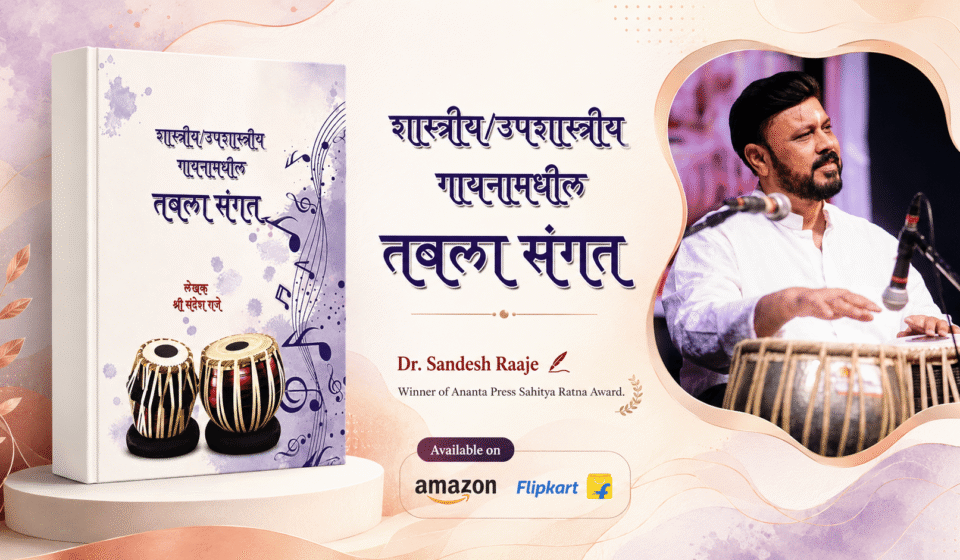

Sandesh Raaje’s “Shastriya/Upashastriya Gayanamadhil Tabla Sangat” is a thoughtful and much-needed contribution to the literature surrounding Hindustani music because it directs attention toward an area that is frequently discussed in practice but not always explored with sufficient depth in writing: the role of tabla in accompanying classical and semi-classical vocal music. Many books on tabla quite naturally concentrate on the instrument itself—its history, gharanas, construction, bols, talas, compositions, solo presentation, and technical vocabulary. This book takes a different route. It studies tabla in relationship with another performing voice, and that shift in perspective gives the work a distinctive educational value.
The central quality of the book lies in its focus. Accompaniment is not merely a reduced form of solo tabla playing. It requires a separate artistic intelligence: the ability to listen, anticipate, support, respond, control volume, understand lyrical and melodic movement, recognize the architecture of a raga presentation, respect the singer’s breathing and phrasing, and maintain the pulse without disturbing the aesthetic balance of the performance. By choosing this subject as the core of the book, Dr. Raaje highlights the collaborative nature of Hindustani music. A tabla player on the concert platform is not simply keeping time. The accompanist is actively shaping the flow of the performance while remaining sensitive to the priorities of the vocalist.
This is what makes the book particularly useful for students. A learner can often memorize theka, compositions, tihais, peshkar patterns, kayda structures, and various rhythmic materials, yet still remain unsure of how these ideas should be used when sitting behind a vocalist. In actual accompaniment, knowledge has to become judgment. When should the tabla player remain restrained? When may a phrase be answered? How can theka be kept alive without becoming intrusive? How does accompaniment change according to tempo, composition, genre, mood, or the individual style of the singer? These are practical questions, and a book dedicated to the role of tabla in vocal music can help students bridge the gap between classroom learning and stage responsibility.
The author’s background gives the project special credibility. Dr. Sandesh Raaje comes from a family with a legacy of tabla and pakhavaj and spent twenty-eight years learning under the legendary tabla maestro Pt. Bhai Gaitonde, a recipient of the Sangeet Natak Akademi Award. That long guru-shishya association matters because accompaniment cannot be understood only from notation or isolated theory. It grows through years of listening, observation, correction, rehearsal, and exposure to artists. The author’s own musical journey, shaped by family tradition, formal education, radio grading, and sustained contact with musicians, allows the book to emerge from lived musical experience rather than abstract description alone.
One of the strongest aspects of the work is therefore its sense of responsibility toward tradition. The author acknowledges that numerous important books on tabla already exist and that great musicians and scholars have written on the instrument’s origin, structure, compositions, technical system, and performance traditions. Instead of trying to replace those works, he identifies a specific area that he believes deserves deeper and more illustrative exploration. This approach is admirable because it shows scholarly humility while also defining the book’s purpose. The work is not presented as a complete encyclopedia of tabla; it is presented as a concentrated study of how tabla functions as an accompanying instrument in Hindustani classical and semi-classical singing.
That distinction also gives the book a strong place in music education. Hindustani music training is traditionally transmitted orally and experientially. Much of what an accompanist learns comes from sitting with gurus, observing senior artists, attending concerts, and participating in rehearsals. Such learning is invaluable, but written resources can help organize that experience. A student may hear a senior accompanist make a subtle decision on stage without fully understanding why it worked. A text that discusses the principles and role of accompaniment can provide a framework for reflection. It can help learners develop vocabulary for choices that they may otherwise understand only intuitively.
The book is also likely to be meaningful beyond tabla students. Vocalists can benefit from understanding what an accompanist is listening for and what kind of communication produces a balanced performance. Music teachers may use the subject to explain ensemble sensitivity. General music lovers can gain a deeper appreciation for the complex dialogue taking place on stage. Listeners often notice spectacular rhythmic passages, but the highest quality accompaniment may sometimes be heard in restraint, placement, and timing rather than overt virtuosity. A work of this kind can train the ear to recognize those subtleties.
Another important quality is the book’s relevance to semi-classical forms. Semi-classical Hindustani music often brings different rhythmic expectations, expressive freedoms, lyrical priorities, and performance conventions. The role of tabla must adapt accordingly. A sensitive accompanist cannot apply the same approach mechanically to every genre. By addressing both classical and semi-classical vocal contexts, the book widens its practical reach and acknowledges the variety within North Indian performance culture.
What also stands out is the ethical dimension implicit in the author’s motivation. Dr. Raaje describes a sense of social, moral, and artistic bonding with the field of music, created through family legacy, the guidance of his guru, and association with numerous artists. The book can therefore be read not only as an instructional effort but as an act of giving back. In Indian classical traditions, knowledge is often received through relationships. Writing becomes one way of passing that knowledge forward to students who may not have direct access to the same teachers or experiences.
From the point of view of originality, the book succeeds because of its chosen lens. Tabla literature is broad, but a specialized treatment of accompaniment creates a clear identity for this volume. Its uniqueness is not based on novelty for its own sake; rather, it comes from examining an essential performance function that deserves sustained attention. This is especially valuable at a time when many learners have access to online videos, short demonstrations, and fragmented lessons but may lack a coherent understanding of the accompanist’s role. A dedicated book encourages slower, more reflective learning.
The author’s academic and professional credentials further support the seriousness of the work. He holds a B.Com from Mumbai University, a Master of Performing Arts from Shivaji University, Kolhapur, a B High grade from All India Radio, Sangeet Alankar from ABGMV, the Rashtriya Gaurav Award from IIFS Delhi, and an honorary doctorate in Music and Performing Arts from WCAEPC Delhi. These qualifications do not replace musicianship, but in combination with his long discipleship and practical background they demonstrate a sustained engagement with music from multiple perspectives: traditional, academic, institutional, and performance-oriented.
For serious tabla learners, the book’s greatest potential value is that it asks them to think beyond speed and repertoire. A mature accompanist must cultivate patience, alertness, aesthetic proportion, humility, and the ability to serve the composition while still bringing rhythmic life to the performance. These qualities are difficult to measure, yet they are central to musical excellence. A book devoted to accompaniment helps place them at the center of study.
For teachers, the volume can serve as a starting point for discussion. It can be paired with listening assignments, concert analysis, demonstrations, and comparative observation of different accompanists. Students can read about a principle and then hear how it manifests in performances. Such use would make the book especially effective as a bridge between theory and listening practice.
Overall, “Shastriya/Upashastriya Gayanamadhil Tabla Sangat” is a purposeful, specialized, and culturally grounded book. It reflects the author’s respect for his guru, awareness of existing tabla scholarship, and desire to explore a subject that deserves more focused documentation. Its usefulness lies not only in what it can teach about tabla, but in the larger musical lesson it represents: accompaniment is an art of relationship. Rhythm, melody, text, improvisation, and personality meet in real time, and the accompanist’s responsibility is to help those elements coexist beautifully. For tabla students, performers, teachers, vocalists, and serious music lovers, this book offers a valuable direction of study and a meaningful addition to the conversation around Hindustani performance practice.