Finding Meaning in a Universe That Does Not Promise It: A Powerful Reading of Meaninglessness

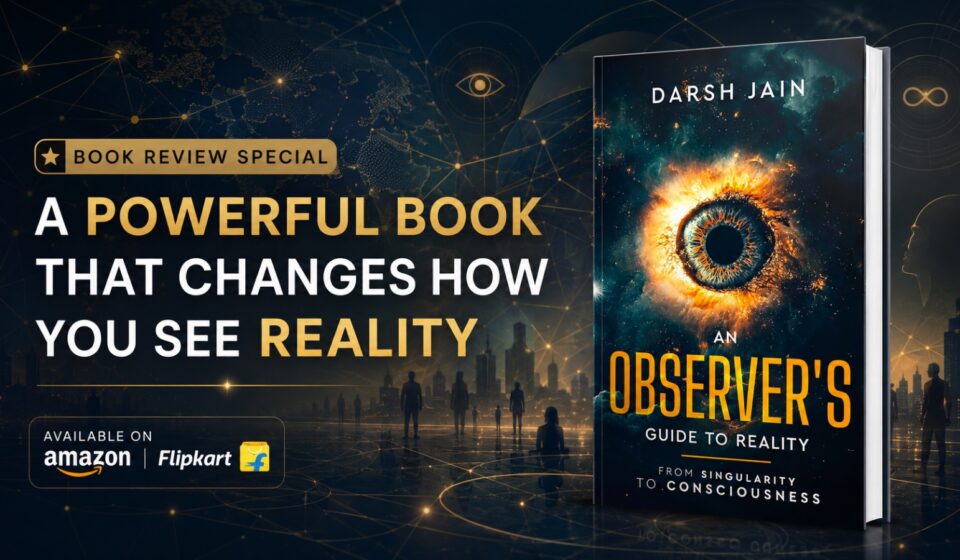
The title The Meaning of Meaninglessness sounds like a contradiction, but it captures one of the central tensions in An Observer’s Guide to Reality. Human beings want purpose. We ask why we were born, why suffering happens, what our lives are for, whether there is a plan behind events, and whether death is an ending or a transition. The universe, however, does not give us direct answers. Stars burn, planets move, species evolve, and bodies age without explaining themselves. Darsh Jain places the reader inside this gap between a silent universe and a meaning-seeking mind. That gap is uncomfortable, but it is also where the book becomes most philosophical. Rather than hiding the discomfort behind quick reassurance, the author asks readers to examine why we need meaning so strongly in the first place.
The book arrives at this question only after building a scientific background. We have already seen how matter forms, how life develops, and how organisms are shaped by natural selection. This order matters. Meaning is not discussed in isolation from biology. The book asks us to consider whether our search for purpose is itself an evolved feature of a brain that predicts, remembers, imagines, and tries to organise experience into stories. A mind that can connect causes and effects is useful for survival. A mind that can imagine tomorrow can prepare for danger. A mind that can understand social approval can cooperate. But the same brain may also search for patterns where none were intended and may turn random events into messages about destiny.
Jain repeatedly distinguishes between objective processes and human interpretation. A rainbow can be explained through light and water droplets, yet it can still feel beautiful or sacred to the person looking at it. The scientific explanation does not remove the experience. It simply tells us what physical process is happening. This is an important idea because discussions about meaning often become trapped in a false choice: either the universe has a divine purpose, or nothing matters. The book suggests another possibility. Something can matter deeply to a conscious being even if the cosmos did not design it to matter. Love does not become worthless because it has biology. Music does not become empty because sound is vibration. Grief does not become unreal because it is processed by a brain.
The author’s treatment of death makes this especially clear. Human cultures have created many ways to soften death: souls, afterlives, rebirth, ancestors, heavens, spiritual journeys, and sacred rituals. The book interprets these stories as responses to uncertainty and loss. When someone we love dies, the physical event is simple and brutal, but the emotional reality is enormous. The mind wants the relationship to continue. It wants an answer to absence. Jain asks the reader to see meaning-making not only as error but also as a human response to the pain of not knowing. Even when he argues for a material view of death, he does not deny the reality of grief. We mourn because a life mattered to us.
This makes the book more compassionate than the word “meaninglessness” might suggest. It does not celebrate emptiness. It challenges cosmic certainty while leaving room for human value. Meaning may be something we create through relationships, curiosity, kindness, work, art, learning, and attention. In fact, the lack of a guaranteed cosmic purpose can make personal responsibility more important. If there is no external script ensuring justice, then justice becomes something human beings must build. If there is no promise that suffering will be corrected elsewhere, reducing suffering here becomes more urgent. If life is finite, then the time we give to another person becomes more precious, not less.
The book also connects meaning with imagined orders. Human beings do not only create private meanings; we create shared meanings. A nation offers belonging. A religion offers purpose. A profession offers identity. A family story offers continuity. A moral code offers direction. These systems can help people live, but they can also become dangerous when we mistake them for unquestionable physical truths. The book’s argument is strongest when it asks readers to hold two ideas at once: shared stories are powerful and often necessary, but they should still be examined. A story can inspire cooperation without becoming immune to evidence. A tradition can provide comfort without being treated as a scientific explanation.
Readers who are familiar with existentialism, nihilism, or absurdism will recognize some of the territory, but Jain writes for a general audience. He does not turn the discussion into a history of philosophers. Instead, he keeps returning to ordinary human experience. Why do we chase success? Why do we fear failure? Why do we need to be remembered? Why do we feel that life “should” unfold in a certain way? Why does an unexpected loss feel unfair when nature never promised fairness? These are questions that can reach readers who have never opened a philosophy textbook because they arise naturally during illness, grief, career disappointment, heartbreak, or simply a quiet night spent looking at the sky.
The author’s own story near the end gives these questions a personal foundation. He describes preparing intensely for the civil services examination, collecting knowledge across many subjects, and then not clearing the exam. That failure became a turning point because it made him question what knowledge was for. Memorising facts had not automatically produced understanding. He began exploring history, anthropology, biology, quantum mechanics, and philosophy, following questions rather than a syllabus. The book grows from that movement: from wanting mastery through knowledge to seeking clarity through understanding. It is a useful message for readers who have ever confused achievement with meaning.
The discussion can be challenging for religious or spiritually inclined readers because the author openly questions divine purpose, the soul, cosmic justice, and supernatural explanations. Yet the best way to approach these chapters is not as a demand for agreement. Read them as an invitation to test your assumptions. What do you believe? Why do you believe it? Which part comes from experience, which part from family, which part from culture, and which part from evidence? Can a belief be emotionally valuable and still remain unproven? Can scientific explanations coexist with a sense of wonder? These questions are more productive than simply deciding whether the author is “right” or “wrong.”
Why is this book important today? Because modern life is filled with messages that promise ready-made meaning. Advertising tells us what success looks like. Social media tells us which lives are desirable. Politics tells us who belongs. Communities tell us which values are respectable. Religions tell us what existence means. Careers tell us what achievement should feel like. A person can spend decades living inside purposes supplied by other people without ever asking whether those purposes fit. An Observer’s Guide to Reality encourages the opposite habit. It asks the reader to examine the stories, see their origins, and decide what deserves attention.
The book’s most liberating possibility is that meaning does not have to be discovered like a hidden object. It can be created with awareness. A finite life can still contain love. A purposeless universe can still contain curiosity. A biological mind can still create art. A society built on imagined orders can still choose compassion. We can accept that nature is indifferent without becoming indifferent ourselves. That is why The Meaning of Meaninglessness is not a depressing section. It is a difficult invitation to grow up intellectually: to stop demanding that the universe reassure us and begin taking responsibility for the meanings we build. Readers who are willing to sit with that idea may find the book not emptying their lives of meaning, but helping them choose meaning more consciously.
Why readers should consider this book
- It confronts the fear that a universe without guaranteed purpose must be empty.
- It separates cosmic purpose from human meaning and lived value.
- It encourages readers to choose meaning consciously rather than simply inherit it.
Book link: https://www.amazon.in/dp/934747276X