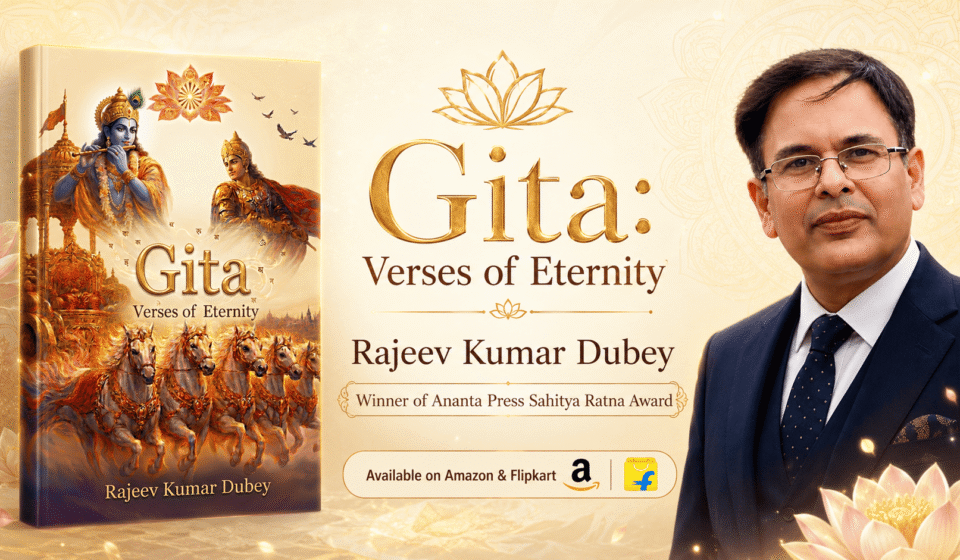

There are books that ask readers to enter a world, and there are books that help readers understand the world they are already living in. Gita: Verses of Eternity by Rajeev Kumar Dubey belongs strongly to the second kind. Inspired by the enduring philosophical and spiritual influence of the Bhagavad Gita, this poetic work is conceived as an accessible pathway into ideas that have shaped generations of thinkers, seekers, reformers, leaders, and ordinary people trying to live with greater clarity. Its most compelling quality is not that it attempts to replace the original scripture, but that it creates a welcoming point of entry for readers who may find classical Sanskrit, traditional commentary, or densely philosophical language difficult to approach.
The central strength of the book lies in its desire to make wisdom usable. The Gita is often remembered as a sacred dialogue, yet its enduring power also comes from the fact that the questions at its heart are recognisably human: What should I do when duty is difficult? How should I respond when emotions overwhelm judgment? What is the difference between action and attachment? How can a person remain responsible, purposeful, and inwardly steady in a complicated world? Dubey’s poetic approach brings these questions closer to readers who may not have formal training in Indian philosophy. By presenting the spirit of the Gita through poetry, he turns reflection into an experience that can be absorbed gradually rather than studied only intellectually.
This accessibility gives the book an unusually broad readership. It can speak to someone opening a Gita-related work for the first time, but it can also engage a reader already familiar with the text who wants to encounter its ideas in a fresh literary form. Spiritual seekers may appreciate the contemplative quality, while professionals can recognise the relevance of ethical decision-making, responsibility, discipline, and balanced action. Young readers looking for direction may find the poetic format less intimidating than a formal philosophical treatise. In this sense, the book succeeds as a bridge: it connects an ancient conversation to the language, pace, and emotional concerns of contemporary life.
One of the most valuable ideas reflected in the book’s premise is that spirituality need not require withdrawal from ordinary responsibilities. The Gita’s call is famously rooted in a moment of crisis and action, and Gita: Verses of Eternity preserves that practical orientation. The reader is not invited simply to admire lofty ideas from a distance. Instead, the larger message is to engage with life intelligently and consciously. This makes the work relevant to family responsibilities, professional challenges, moral uncertainty, social pressures, and personal ambition. A modern reader may not stand on a battlefield, yet many people know the inner conflict of wanting to do the right thing while feeling fear, doubt, attachment, or confusion. The book’s poetic form allows those tensions to be approached with gentleness rather than abstraction.
As poetry, the work also has a distinct advantage: it can preserve emotional resonance while communicating philosophical meaning. Philosophical prose can sometimes become explanatory at the cost of feeling, while sacred language can seem too elevated for unfamiliar readers. Poetry occupies a fertile middle ground. It can suggest, evoke, and invite. A poetic line may stay in memory long after an argument has been forgotten. This is particularly suitable for a work inspired by the Gita, whose original form is itself verse. Dubey’s choice therefore feels not only reader-friendly but artistically appropriate. He is engaging with a tradition of wisdom through a literary form that respects contemplation, rhythm, and inward response.
The author’s background adds another layer of interest. Rajeev Kumar Dubey is a Professor of Anaesthesiology at the Institute of Medical Sciences, Banaras Hindu University, with academic experience that includes anaesthesiology, critical care, and hospital administration. That professional life is one of precision, responsibility, and service. Alongside it, he has cultivated a serious engagement with Indian culture, literature, history, spirituality, meditation, and yoga. The combination is significant because this is not the voice of someone approaching philosophy as an isolated intellectual exercise. It comes from a person whose working life involves human vulnerability, critical decisions, teaching, and care. His literary identity as a sensitive poet further balances the scientific and clinical dimensions of his career.
That blend of disciplines helps explain why the book’s purpose feels grounded rather than ornamental. A physician knows that abstract principles matter most when they influence real decisions. A teacher knows that difficult ideas must be communicated in ways that learners can receive. A poet knows that meaning is not always best delivered through explanation alone. Gita: Verses of Eternity sits at the intersection of those instincts. It is interested in wisdom, but equally interested in communication. It values tradition, but does not treat tradition as something that should remain inaccessible to the uninitiated.
Another notable quality is its inclusive intention. The book is meant not only for readers from a particular spiritual background but for thoughtful readers more generally. That is important because the Gita has long been read at multiple levels: religious, philosophical, ethical, psychological, and literary. A poetic rendering can highlight its universal human questions without demanding that every reader approach them from exactly the same belief system. The emphasis on purpose, self-understanding, ethical action, inner steadiness, social harmony, and human values can resonate across differences of age, profession, and personal faith.
The title, Verses of Eternity, aptly captures the project’s ambition. “Eternity” here need not be understood merely as something distant or metaphysical. It can also refer to the persistence of certain questions across time. Human beings continue to face ambition, grief, indecision, responsibility, fear, attachment, and the search for meaning. Civilisations change, technology advances, and social structures evolve, but the inner dilemmas of choice and conscience remain. By recasting Gita-inspired wisdom in a contemporary poetic voice, the book suggests that an ancient dialogue continues whenever a reader sincerely asks how to live well.
What makes the book stand out, then, is the combination of reverence and accessibility. It does not need to diminish the depth of the source tradition in order to welcome a new reader. Instead, it acts as an invitation. A reader who begins here may be inspired to explore the Bhagavad Gita more deeply; another may simply carry a few ideas into daily life. Both outcomes are meaningful. The value of such a book lies not in how complicated it can make philosophy sound, but in how effectively it can awaken reflection.
Gita: Verses of Eternity is therefore best approached as a companion for contemplation. It can be read slowly, returned to, and allowed to converse with the reader’s own circumstances. Its subject is ancient, but its intention is immediate: to help people think more clearly about purpose, action, responsibility, and inner life. In making sacred philosophical wisdom more approachable through poetry, Rajeev Kumar Dubey offers readers a thoughtful literary doorway into one of humanity’s longest-running conversations about what it means to act, choose, and live with understanding.
Amazon purchase link: https://amzn.in/d/0e2udQ4o