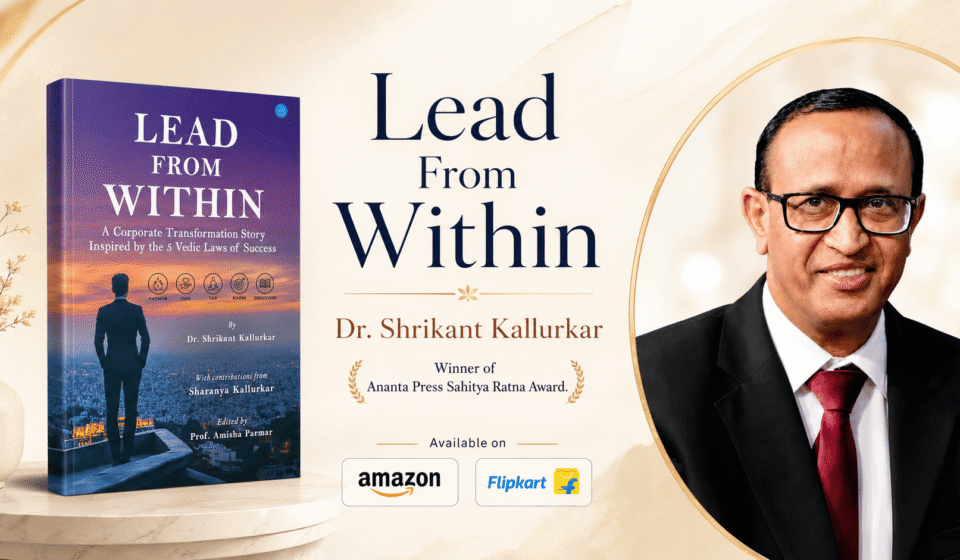

Many books on professional growth begin with strategy: communicate more clearly, manage time better, build influence, learn new skills, or become more visible. Lead From Within: A Corporate Transformation Story by 5 Vedic Laws of Success begins at a more fundamental point. It asks what happens when a professional has the knowledge required to succeed but no longer has the inner energy, clarity, confidence, or sense of purpose needed to use that knowledge well. That starting point gives Dr. Shrikant Kallurkar’s book a distinctive place among works on leadership and personal development. Rather than treating success as a collection of external techniques, it presents professional excellence as the visible result of an inner system that has been understood, strengthened, and aligned.
The story of Michael Smith makes this idea immediately relatable. Smith is a capable Cyber Security Engineer who works hard and produces technically sound results. On paper, he is the kind of employee who should be progressing. Yet the reality of his professional life is very different. He is tired, increasingly invisible, hesitant in meetings, and unable to convert competence into momentum. Younger colleagues appear to be moving ahead while he remains in the same emotional and professional position. The book’s central insight emerges from this gap between ability and actual experience. It suggests that stagnation is not always caused by a lack of talent, opportunity, or effort. Sometimes a person continues to perform tasks while gradually losing the inner conditions that make meaningful performance possible.
This is why the line of thought behind “Inner System -> Outer Performance” is so effective. The phrase is simple, but the implications are broad. Professionals often invest in certifications, deadlines, tools, metrics, targets, and domain expertise. They may carefully maintain systems, projects, budgets, or teams while paying almost no attention to the condition of the person doing the work. Lead From Within turns attention toward that neglected dimension. The body, energy, emotions, thought patterns, judgment, values, and sense of meaning are not treated as private matters unrelated to work. They are presented as components of professional functioning. When they become unstable, the consequences eventually appear in communication, confidence, decision-making, consistency, and leadership.
The Panchakosha framework provides the book with an unusually coherent map for this inner dimension. Annamaya Kosha refers to the physical layer: sleep, health, food, energy, and vitality. Pranamaya Kosha brings attention to breath and the regulation of energy and emotions. Manomaya Kosha concerns the mind, including fear, assumptions, interpretations, and recurring thought patterns. Vijnanamaya Kosha deals with discernment, wisdom, values, and the ability to make clear decisions. Anandamaya Kosha brings the reader to purpose, joy, fulfilment, and the question of why success matters at all. Presented in this sequence, the framework has practical power because it prevents professional problems from being reduced to a single cause. A person who appears “unmotivated” may actually be physically depleted. A person who avoids speaking in meetings may be dealing with mental assumptions, emotional patterns, or a weakened sense of professional identity. A decision problem may not be about intelligence but about clarity and values.
The second major strength of the book is the way it connects inner stability to outward behaviour through the Five Vedic Laws of Success. Yadnya is interpreted as contribution: giving one’s best without making recognition the only reason for effort. Dana becomes giving and kindness through appreciation, patience, respect, time, and support. Tapa becomes discipline and steadiness, especially the ability to remain consistent under pressure. Karma is presented as right action, emphasizing responsibility, integrity, and courage rather than mere busyness. Swadhyaya becomes self-reflection: observing one’s own patterns, learning from experience, correcting behaviour, and continuing to grow. These principles are old in origin, but the book’s importance lies in translating them into the realities of professional life.
That translation is essential. A common weakness in books that draw from philosophical or spiritual traditions is that they remain inspirational without becoming operational. Lead From Within appears designed to avoid that problem. The Vedic principles are not presented as decorative quotations or as abstract ideals that belong only to meditation halls. They are connected to meetings, recognition, work pressure, emotional reactions, professional courage, health routines, self-observation, and leadership behaviour. The reader is encouraged to see how a principle changes a response, a habit, or a decision. This makes the book useful not only for readers interested in Indian Knowledge Systems but also for professionals who want a structured method of self-development.
Smith’s transformation gives the frameworks a human context. His “glitch moment,” when his boss tells him that he is shrinking, is effective because it captures a phenomenon many professionals experience but find difficult to name. A career can look stable from the outside while the person inside it becomes smaller: less willing to speak, less energetic, less hopeful, less assertive, and less connected to purpose. The painful moment when a colleague presents Smith’s work and receives the recognition intensifies this theme. It is not simply a workplace injustice; it becomes a mirror. Smith begins to see that technical strength has not been matched by self-leadership. The story therefore avoids making the transformation purely motivational. It grows out of discomfort, self-recognition, and the decision to examine patterns that have been allowed to continue.
Another valuable quality is the book’s refusal to define leadership only as authority. Leadership here begins before a person manages a team. A professional who regulates reactions, cares for physical energy, thinks clearly, acts ethically, contributes generously, and reflects honestly is already practising leadership. That idea makes the book relevant to a broad audience. Young professionals can use it before they receive formal responsibility. Managers can use it to examine the inner habits influencing their teams. Educators can connect it to human development and professional preparation. Entrepreneurs can apply it to resilience and decision-making. Senior leaders can use it as a reminder that external position does not automatically produce internal steadiness.
Dr. Kallurkar’s background adds credibility to this integration. With decades of experience across engineering education, academic leadership, research, institution building, entrepreneurship, and mentoring, his interest in professional excellence is grounded in long observation of how people learn and perform. His work with the Panchakosha and Five Vedic Laws is also consistent with his larger effort to bring Ancient Indian Wisdom and Contemporary Science into conversation. The book therefore feels less like a sudden attempt to attach spiritual terminology to corporate life and more like the product of a sustained concern: how can people become professionally competent without sacrificing wellbeing, values, and meaning?
The book’s uniqueness lies in the architecture of its message. The Panchakosha explains the inner system. The Five Vedic Laws explain how inner awareness should become outer conduct. The story of Smith shows what happens when those ideas meet an ordinary professional life. The result is a three-part design: diagnosis, principle, and application. Readers are not merely told to “be confident” or “find purpose.” They are given categories through which they can investigate the conditions beneath confidence and purpose. They are not simply told to work harder. They are asked whether their action is disciplined, ethical, reflective, contributive, and sustainable.
For readers who are exhausted by conventional success literature, this is perhaps the book’s greatest strength. Lead From Within does not reject ambition, achievement, or professional excellence. Instead, it argues that lasting excellence requires a better foundation. The body cannot be permanently ignored. Emotions cannot be treated only as interruptions. The mind cannot be allowed to run on unexamined assumptions. Wisdom and values cannot be postponed until convenient. Purpose cannot be replaced indefinitely by targets. When these dimensions are brought together, work can become more effective without becoming less human.
Lead From Within is therefore best read as more than a corporate transformation story. It is a framework for self-leadership that uses the language of modern professional life while remaining rooted in Vedic thought. Its value comes from integration: health and performance, breath and emotion, thought and judgment, contribution and discipline, action and reflection, ambition and meaning. The book stands out because it does not ask readers merely to become more successful. It asks them to understand the person from whom success is expected to emerge. That is a more demanding question, but also a more enduring one.
Amazon link: https://www.amazon.in/Lead-Within-Corporate-Transformation-Inspired/dp/9378256465/ref=tmm_pap_swatch_0