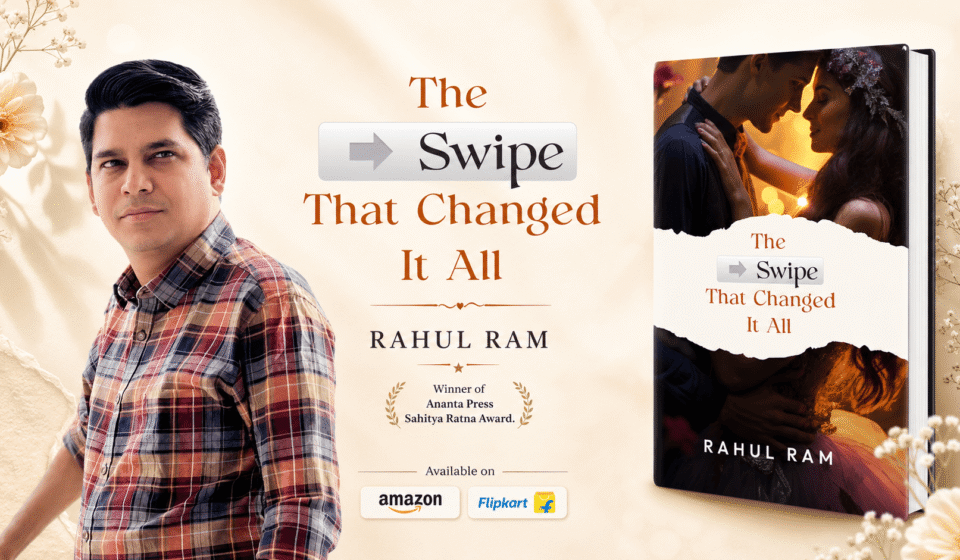

The Swipe That Changed It All by Rahul Ram
Some novels begin with a familiar romantic situation and then search for a fresh way to present it. The Swipe That Changed It All begins with a genuinely striking question: what happens when a person tries to solve emotional pain through technology? Rahul Ram’s debut novel brings together romance, grief, invention, memory, and the human need to heal. Its central idea feels contemporary because technology increasingly promises to make life faster, easier, safer, and more comfortable. Yet the novel asks whether comfort is always the same as healing, and whether the removal of pain can also remove something essential from love.
At the centre of the story is Vivaan, an inventive genius who is carrying the burden of losing people he loved. His grief is not presented merely as sadness. It becomes a force that shapes his thinking, his choices, and his relationship with the world. Instead of accepting pain as a difficult but meaningful part of life, Vivaan tries to defeat it through creation. He designs a machine intended to remove the sensation of pain, hoping that technology can free him from memories that refuse to leave. This premise immediately gives the novel a distinctive identity. It turns grief into both an emotional struggle and an intellectual problem, allowing the story to explore what happens when a brilliant mind treats the heart as if it were a system that can be repaired by engineering.
The book’s strongest quality is the way it places a deeply human conflict inside a technological framework. Vivaan’s invention may be extraordinary, but his desire is understandable. Many people have wished they could forget a painful event, silence a memory, or wake up without the heaviness of loss. The machine therefore works as more than a plot device. It represents the temptation to avoid suffering instead of moving through it. In that sense, the novel speaks not only about futuristic technology but also about everyday emotional habits. People often hide from pain through work, distraction, social media, ambition, or emotional distance. Vivaan’s machine is a dramatic expression of a very common impulse.
Aanya gives the story its emotional centre. She is described as Vivaan’s passionate love and as something precious that he loses while pursuing the machine. Her presence raises the most important question in the novel: can love survive when one person becomes more committed to escaping pain than to experiencing life fully? Romance in this story is not simply about attraction or companionship. It becomes a test of emotional availability. Love requires vulnerability, memory, risk, and the possibility of being hurt. A person who tries to eliminate every painful sensation may also weaken the very qualities that make closeness possible.
This is where The Swipe That Changed It All becomes more than a conventional love story. The relationship between Vivaan and Aanya is tied to a larger discussion about what makes human experience meaningful. Happiness has value partly because people understand sorrow. Reunion matters because separation has been felt. Forgiveness matters because damage has occurred. Second chances matter because the first chance was not protected. By placing these ideas within a story of invention and romance, Rahul Ram gives readers a narrative that can be enjoyed emotionally while also encouraging reflection.
The title adds another layer of relevance. The word “swipe” belongs strongly to contemporary digital culture. A swipe can accept, reject, connect, dismiss, select, or transform. It is a small gesture that can create surprisingly large consequences. In modern life, relationships, opportunities, entertainment, and information can all be shaped by the movement of a finger across a screen. The title therefore suggests both speed and consequence. A simple action can redirect a life, yet the emotional results may be anything but simple. This contrast between effortless digital action and complicated human feeling is one of the book’s most appealing ideas.
Rahul Ram’s professional background gives the concept additional authenticity. With an M.Sc. in Software Engineering and more than twelve years of experience in digital marketing, he has worked in a world shaped by systems, platforms, algorithms, data, and changing user behaviour. At the same time, he has long been interested in books and films, particularly stories involving emotion, mystery, action, and human connection. The novel grows naturally from this combination. It does not treat technology as an external decoration. Instead, technology becomes part of the emotional problem the story is trying to understand.
The novel is also notable for the balance of accessibility and ambition in its premise. Readers do not need a technical background to connect with Vivaan’s struggle. The emotional stakes are clear: he has suffered, he wants relief, and his attempt to protect himself threatens the love that once gave his life meaning. At the same time, the story opens the door to larger ethical questions. Should every form of suffering be removed simply because it can be removed? Can a machine distinguish between destructive pain and pain that teaches, warns, or connects? If memories are tied to identity, what happens when a person tries to weaken their emotional effect? These questions give the book depth without taking it away from its central romantic journey.
Another important strength is the theme of second chances. Second chances are often presented in fiction as simple opportunities to begin again, but this story suggests that beginning again requires change. Vivaan cannot merely return to Aanya while remaining the same person who allowed obsession and grief to separate them. Healing asks for honesty. Love asks for presence. Reconciliation asks for responsibility. The promise of a second chance becomes meaningful only when the characters are willing to understand the damage that has already taken place.
The book’s general fiction classification suits its broad appeal. It contains elements of romance, emotional drama, speculative technology, and personal transformation. Readers who enjoy relationship-driven novels will be drawn to Vivaan and Aanya. Readers interested in technology and its influence on human life will appreciate the central invention. Readers who have experienced grief may recognise the desire to escape memory, while readers who value hopeful stories may connect with the themes of healing and renewal.
The Swipe That Changed It All stands out because it understands that the greatest danger of technology is not always that it becomes too powerful. Sometimes the danger is that human beings use it to avoid truths they need to face. Vivaan’s machine promises freedom from pain, but the story asks what that freedom might cost. Aanya represents love not as an escape but as a reason to remain emotionally alive. Between them lies the central conflict of the novel: whether life becomes meaningful by removing discomfort or by learning how to live, love, and grow through it.
Rahul Ram’s debut is therefore a thoughtful and emotionally relevant work. It combines a modern technological idea with timeless themes of love, grief, regret, and hope. Its originality comes from treating pain as both a human experience and a design problem, then showing why the heart cannot be reduced to a machine. The result is a story with a clear emotional message: healing does not always mean forgetting, and love can endure only when people are willing to feel fully.
For readers seeking contemporary fiction with romance, emotional depth, and a distinctive technological premise, The Swipe That Changed It All offers a compelling journey. It reminds us that pain may shape us, but it does not have to control us. More importantly, it suggests that the courage to love again may be the most powerful form of invention of all.
Buy the Book on Amazon: https://www.amazon.in/Swipe-That-Changed-All/dp/B0DWXFBFZJ/