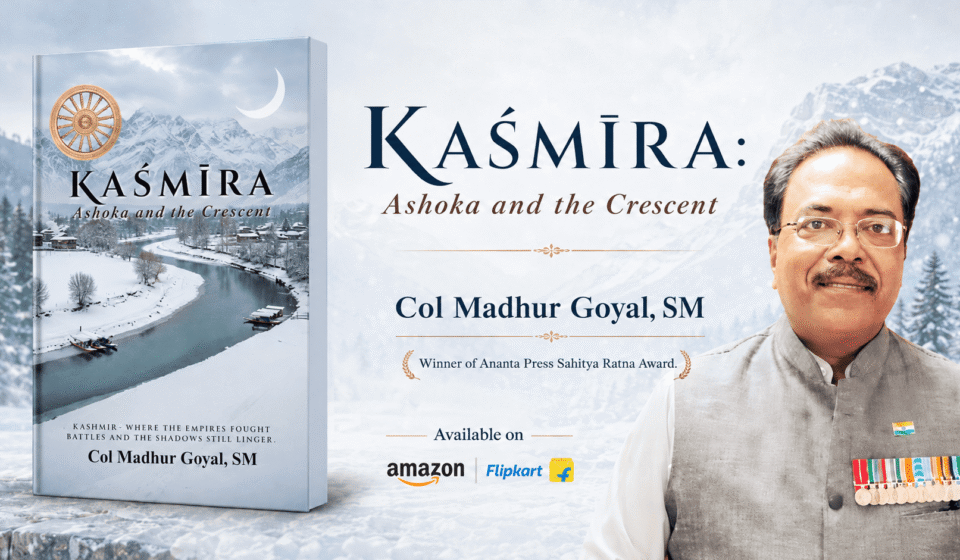

Book: Kaśmīra: Ashoka and the Crescent | Author: Col Madhur Goyal, SM
Kashmir is one of those places that is almost impossible to understand through a single lens. It can be approached as a landscape, a civilisation, a strategic frontier, a spiritual centre, a political question, a battlefield, or a home marked by memory and loss. The strength of Col Madhur Goyal, SM’s Kaśmīra: Ashoka and the Crescent lies in its decision not to choose only one of these perspectives. Instead, the book attempts to hold them together and trace the long arc through which geography, faith, empire, conflict and strategic rivalry have repeatedly shaped the valley.
What immediately distinguishes the book is its scale. Rather than beginning in the twentieth century, where most contemporary conversations about Kashmir tend to become concentrated, the narrative begins with the land itself. Mountains, rivers, passes, snowbound routes and difficult frontiers are not treated as passive scenery. They are presented as forces that influence settlement, statecraft, invasion, commerce, identity and war. This is an important choice because Kashmir’s history cannot be separated from its terrain. A valley enclosed by enormous mountain systems develops differently from an open plain; a region connected through difficult passes becomes both protected and vulnerable; glacial spaces such as Siachen turn geography into an active participant in military history. By grounding the narrative in physical landscape before moving into kingdoms and political movements, the book gives readers a framework through which later events become easier to understand.
From there, Kaśmīra travels across ancient dynasties and religious change. Buddhism, Hinduism, Sikhism, Islam and Sufism enter the story not merely as labels attached to succeeding periods but as traditions that contributed to Kashmir’s layered identity. This broader civilisational approach is one of the book’s most valuable qualities. It resists the temptation to imagine Kashmir as a place whose history began with Partition. Instead, the reader is reminded that the region has carried centuries of philosophy, devotion, cultural exchange, political ambition and competing forms of sovereignty. The title itself hints at this long historical tension. “Ashoka” evokes an Indian civilisational and political imagination of unity, while “the Crescent” represents another powerful historical and ideological current. The book later adds the “Dragon” as the strategic presence of China, making the title’s symbolism part of a much wider geopolitical argument.
The transition to the twentieth century gives the book its most immediate political weight. Maharaja Hari Singh’s dilemmas, the upheaval of Partition and the wars that followed are framed not as isolated episodes but as the point at which older histories were compressed into new national borders. The conflicts of 1947, 1965 and 1971, the rise of militancy in 1989, the exodus of Kashmiri Pandits and the Kargil War are all part of the book’s attempt to show how unresolved questions accumulate rather than disappear. Each event changes the strategic and emotional map of Kashmir. This cumulative structure is important: readers are invited to see how one crisis becomes context for the next, and how the past remains active in the political present.
The military dimension is especially compelling because the author is not approaching high-altitude warfare as an abstract subject. Col Madhur Goyal, SM served in demanding operational environments that included Siachen and Kashmir and was awarded the Sena Medal for Gallantry following an anti-terrorist operation in Budgam. That background does not automatically settle historical or political debates, but it gives his treatment of soldiering a lived seriousness. When the book turns to the “Frozen Battlefield” of Siachen, the enemy is not only the opposing force. It is cold, altitude, frostbite, avalanche, isolation and the physical exhaustion of surviving where the landscape itself can kill. This humanises a strategic dispute that is often reduced to lines on a map.
Another strong feature is the widening of the frame beyond India and Pakistan. Aksai Chin and the memory of the 1962 India-China war bring China into the story; the China-Pakistan Economic Corridor adds another layer to the strategic contest. Kashmir is therefore presented not merely as a bilateral quarrel but as part of a triangular strategic environment in which India, Pakistan and China pursue different security interests. The book further places this triangle within a larger international setting, suggesting that global powers such as the United States and China view the region through wider rivalries. This expansion is useful because it demonstrates how local history can become entangled with regional infrastructure, great-power competition and military calculations far beyond the valley itself.
Yet the book’s ambition would feel incomplete if it dealt only with states and armies. Its central question is ultimately a human one: can a land of faith and fire find peace beyond the shadows of history? That question gives the narrative its emotional centre. The valley is not merely territory to be possessed; it is inhabited by people with divergent memories, identities, griefs and aspirations. The book’s stated framework acknowledges competing dreams: India’s vision of unity, Pakistan’s call for self-determination, China’s strategic calculus and the diverse voices of Kashmiris themselves. Even when readers disagree with particular interpretations, the effort to set these competing visions beside one another makes the work more intellectually useful than a narrowly one-dimensional account.
The writing concept is also notable for combining sweeping history with intimate experience. Col Goyal returns to a region connected deeply to his military life, including four tenures in Kashmir. That personal relationship changes the texture of the project. Kaśmīra is not only an attempt to explain what happened; it is also an attempt to understand a land that shaped the author’s own service. The result, at its best, is a meeting point between strategic history and personal memory. Readers interested in military affairs will find familiar themes of terrain, operational pressure and national security, while readers drawn to culture and history will encounter the older civilisational layers that make the conflict so difficult to reduce to a single narrative.
What makes Kaśmīra: Ashoka and the Crescent unique, then, is not simply the number of historical events it covers. Its distinctiveness comes from the architecture of the story: geography first, civilisation next, modern political rupture after that, and finally the widening strategic contest involving India, Pakistan, China and global power interests. This creates a sense of continuity across centuries. The book suggests that today’s conflict is not floating free from history; it rests on accumulated layers of empire, faith, borders, wars, displacement and strategic ambition.
For general readers, this approach can serve as an entry point into a subject that often appears overwhelmingly complex. For students of history, international relations or military affairs, the book offers a broad narrative in which multiple periods are connected. For readers with a personal or emotional relationship to Kashmir, it raises difficult questions about memory, belonging and peace. Most importantly, it does not present the valley as a simple headline. It presents Kashmir as a historical world: beautiful, wounded, spiritually rich, strategically contested and still unfinished.
Kaśmīra: Ashoka and the Crescent is therefore best read as an ambitious attempt to understand why Kashmir continues to carry such extraordinary political and emotional weight. Its greatest success is in showing that the answer lies not in one war, one ruler or one ideology, but in the interaction of land, belief, empire, memory and power across time. The closing question remains deliberately unresolved. Perhaps that is appropriate. A region with such a layered history cannot be reduced to an easy conclusion, but it can be approached with greater context, seriousness and empathy. This book invites readers to do exactly that.
Amazon: https://amzn.in/d/2VeZbFr