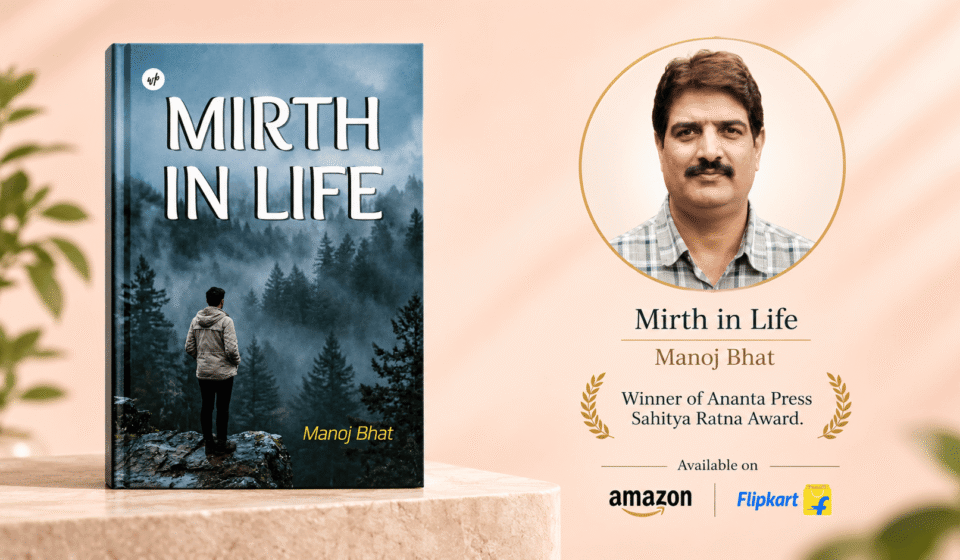

Manoj Bhat’s Mirth in Life is a reflective work of general fiction built around a deceptively simple question: what does it actually mean to be happy? Through the journey of Rohan and his close circle of friends—Gurdeep, Akriti, Irfan, and Tapas—the novel explores the distance between outward success and inward contentment. Its premise is immediately relatable because it speaks to a conflict that many people experience but do not always articulate. A person may be intelligent, disciplined, financially secure, professionally successful, and still feel that something essential is missing. Bhat takes that tension and turns it into the emotional and philosophical center of his story.
Rohan is introduced as the most intellectually gifted member of his group, someone with an abundance of “grey matter” and a persistent desire to do something different with his life. Yet the novel does not present intelligence as an automatic solution. Instead, it gradually becomes one of the central ideas under examination. Rohan discovers that sharp thinking, planning, foresight, and financial freedom can solve many practical problems, but they cannot guarantee peace of mind. This makes him an effective protagonist because his struggle is not based on a lack of ability. His challenge is deeper: he must understand the limitations of ability itself.
The title, Mirth in Life, works well because it suggests more than temporary pleasure. The book is interested in cheerfulness, amusement, inner ease, and the larger emotional state that allows a person to live meaningfully. The distinction matters. Happiness in this novel is not treated as a reward one automatically receives after checking the conventional boxes of adulthood. Rohan and his friends begin their adult lives with plans and defined objectives. They hope to avoid negativity, skepticism, and the melancholy that surrounds them. Yet life does not remain obedient to a plan. Unexpected turns, regrets, emotional struggles, and the pressure of time gradually complicate their assumptions.
One of the novel’s strengths is this contrast between the planned and the unplanned. The prologue itself suggests that the unplanned phase becomes the most interesting one. That observation gives the book an appealing philosophical tension. Human beings often feel secure when they can predict outcomes, but some of life’s most important realizations arise from circumstances that were never invited. Bhat seems interested in how people respond when control begins to fail. Rohan’s journey therefore becomes more than a quest for success; it becomes a test of adaptability, perspective, and emotional endurance.
The group of friends is also significant. Rohan does not undertake the search alone. Gurdeep, Akriti, Irfan, and Tapas represent companionship in a journey that might otherwise become too inward or abstract. Their presence allows the book to explore shared struggle and collective reflection. Friendship becomes a practical counterweight to isolation. Even when people cannot solve one another’s problems, they can still help each other interpret them. This is especially important in a story concerned with regret, hardship, doubts, and questions of purpose.
The use of wisdom drawn from scriptures and meaningful messages adds another layer. Rather than presenting happiness as a purely psychological or financial problem, the book opens the discussion toward values, ethics, spirituality, and self-understanding. This broadens the novel’s scope. Readers are invited to consider whether true contentment depends not only on what one possesses but also on how one understands one’s place in the world. The spiritual dimension does not replace the human drama; it gives the characters another vocabulary with which to confront it.
The reference to Robert Frost’s “The Road Not Taken” is especially appropriate. The image of diverging roads mirrors Rohan’s awareness that every decision closes one possibility while opening another. Life is shaped not merely by ambition but by the choices through which ambition is expressed. The road metaphor also emphasizes uncertainty. A person can make a thoughtful choice and still not know exactly where it will lead. In that sense, Rohan’s life resembles the poem not because he simply chooses an unconventional path, but because he must live with the consequences, ambiguities, and irreversible nature of choice.
Another appealing quality of Mirth in Life is its insistence that financial freedom and inner freedom are not identical. This is an important distinction in contemporary life. Much motivational culture treats money, productivity, or career progress as reliable indicators of a successful existence. Bhat’s story complicates that formula. Rohan can reach milestones and still find that cheerfulness remains clouded. The novel asks readers to look at success from the inside rather than only from the outside. What is the value of achievement if a person cannot experience peace? What happens when intelligence becomes excellent at solving external problems but cannot quiet internal unrest?
The book’s emotional terrain also gives it weight. Regret, woes, miseries, skepticism, and negativity are not presented as isolated incidents but as forces that can accumulate. The idea of a “final assault” by Rohan and his friends on these burdens creates narrative momentum. It suggests that happiness may require effort, discipline, courage, and a willingness to reconsider one’s ideology of life. Mirth, in this telling, is not passive luck. It is something the characters must learn to approach differently.
Manoj Bhat’s own background makes his choice of subject particularly interesting. Born in Kashmir and educated in Jammu and Kashmir before studying English Literature, he later moved through both corporate and government service. His professional life includes achievement, recognition, and long-term public service. That combination of literary interest and practical professional experience seems well suited to a book examining success, duty, ambition, and fulfillment. The novel’s concerns feel grounded in the kinds of questions that often emerge after a person has observed many stages of adult life.
Stylistically, the material has the character of reflective fiction. The reader is encouraged not only to follow what happens but to think alongside the characters. The philosophical passages are central to the book’s identity, and readers who enjoy fiction that asks larger questions about destiny, purpose, and contentment are likely to find the approach engaging. The book is less interested in glamourizing achievement than in testing its meaning.
What ultimately makes Mirth in Life distinctive is its effort to connect ordinary adult concerns with a broader inquiry into happiness. Its characters are not chasing an exotic mystery; they are confronting one of the most universal mysteries of all. Why can a life that appears successful still feel incomplete? Can deliberate choices overcome despair? Can friendship, reflection, wisdom, and a change of perspective help restore joy? By placing these questions inside a fictional journey, Manoj Bhat creates a book that can be read as both a story and an invitation to self-examination.
Mirth in Life is therefore a meaningful choice for readers who appreciate character-centered fiction with a philosophical dimension. It recognizes that life is rarely solved by a single achievement and that the road toward contentment can be harder than the road toward material stability. Rohan’s search reminds us that the deepest forms of success may be measured not by possessions or status, but by clarity, resilience, relationships, and the ability to experience genuine peace. That makes the novel relevant, humane, and potentially thought-provoking long after its central question has been asked.
Amazon Purchase Link: https://amzn.in/d/0aKhgiLE