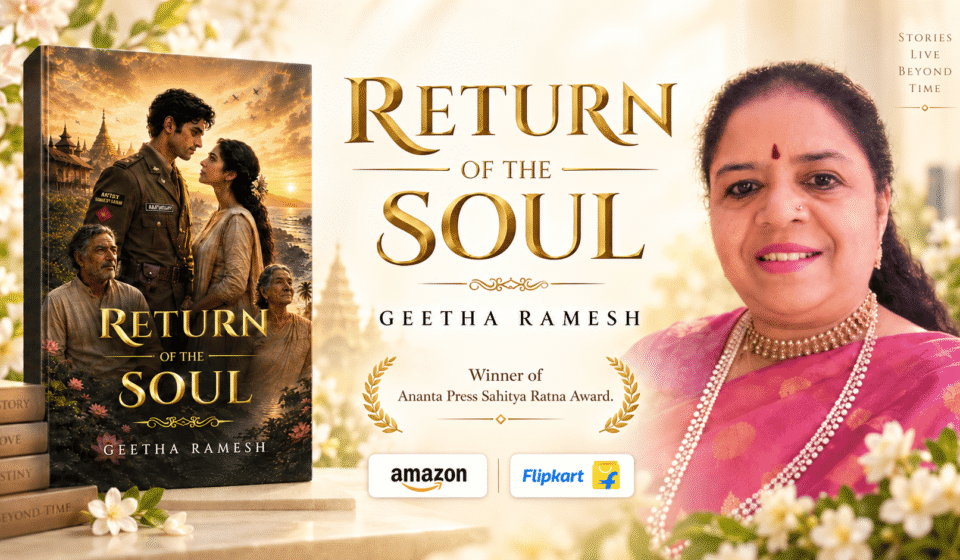

Geetha Ramesh’s Return of the Soul begins with a premise that is immediately dramatic: an Indian family living in Burma is pushed into hardship by the upheaval of the Second World War. Yet the novel does not use war merely as a decorative historical background. The conflict becomes the pressure under which family loyalties, personal courage, love, loss and memory are tested. At the centre of this world is Roopini, the eldest daughter of the family, a young woman who shares responsibility for the family business with her father. Through her, the story acquires both emotional intimacy and a sense of practical reality. She is not introduced only as someone waiting for romance to enter her life; she is already participating in the difficult work of family survival.
This aspect gives the novel one of its strongest qualities. The love story grows within a world where ordinary life has been destabilised. Roopini meets Amudhan, a South Indian soldier who is also a poet. The combination is meaningful: he belongs to the discipline and danger of military life, but he also represents sensitivity, language and imagination. Their relationship therefore carries a natural tension between the demands of history and the private desires of two individuals. In wartime fiction, romance can sometimes feel detached from the larger events around it. Here, the opposite appears to be true. The uncertainty of the period intensifies every emotion because the characters cannot assume that tomorrow will resemble today.
The central tragedy of Roopini and Amudhan is powerful precisely because it comes from that uncertainty. Amudhan dies during the war in Roopini’s lap, but before dying he promises that he will return to live with her. In a conventional romantic tragedy, this moment might function as a final farewell. Return of the Soul uses it as a beginning. The promise becomes a bridge between one life and another, transforming personal grief into the novel’s larger question: can a bond survive death, time, changing identities and the pressures of another lifetime?
The reincarnation element allows Ramesh to move beyond the boundaries of historical romance. Roopini is reborn as Sreeja, remarkably within the same extended family, as the daughter of Roopini’s own sister. Sreeja remembers her previous birth from childhood. That detail is especially effective because it introduces reincarnation not as a sudden supernatural revelation but as a memory that grows alongside the child. It also creates psychological complexity. A child may accept such memories without resistance, but an adult is trained to question them. As Sreeja grows older, she begins to treat these memories as fantasy. This shift is believable at the emotional level: the very experiences that once seemed natural become difficult to reconcile with ordinary adult expectations.
Sreeja’s later marriage, undertaken under family pressure and a sense of gratitude, adds another layer to the story. The novel is therefore not simply about two souls finding each other again without obstacles. It asks what happens when destiny arrives late, after society, family duty and personal decisions have already created a different life. That makes the premise far more compelling than a straightforward “lovers reborn” narrative. Reincarnation here does not erase consequences. The characters still have to live within relationships and responsibilities created in the present.
Amudhan’s return as Sridhar deepens this tension. He reappears in his mid-forties and remains unmarried. When he and Sreeja meet, the story begins to bring the buried past into confrontation with the present. Sridhar too eventually recalls his previous birth. This mutual recognition becomes the emotional hinge of the novel. Readers are invited to consider not only whether the old love was real, but also what moral and emotional meaning it should have now. Is a promise made in one life binding in another? Does remembering the past give a person the right to rearrange the present? Can love remain pure when it is complicated by time, age, duty and social expectation? These questions give the novel substance beyond its romantic premise.
The title Return of the Soul is therefore well chosen. It suggests more than physical rebirth. The “return” can also be understood as the return of memory, unfinished emotion, longing and identity. Roopini does not simply become Sreeja in a mechanical cycle. The earlier life survives as an emotional imprint that refuses to disappear completely. Likewise, Amudhan’s promise survives in Sridhar before the full understanding of that promise comes back to him. The soul returns, but it returns into altered circumstances. That distinction gives the story its dramatic force.
Another quality of the book is its combination of historical, romantic and philosophical interests. Readers who enjoy family sagas may be drawn to the Indian family in Burma and the experience of wartime displacement. Readers of romance will find the intense connection between Roopini and Amudhan, followed by the later encounter between Sreeja and Sridhar. Readers interested in spiritual ideas may be most engaged by questions of reincarnation, memory and destiny. Because the narrative moves across these registers, it has the potential to appeal to more than one type of fiction reader.
The author’s own background also makes the choice of material interesting. Geetha Ramesh grew up as the daughter of an army engineer and travelled widely during childhood and adolescence. She studied English literature and later spent decades in banking before returning to her early passion for writing after retirement. That combination of exposure to military life, movement across places, literature and professional experience may help explain the novel’s interest in duty, travel, practical responsibility and inner imagination. Return of the Soul is her third book, following Divine Will and Niranjana, and it is described as a purely imaginary romantic fiction. Even so, the story reflects a writer interested in large questions: the nature of life, the persistence of relationships and the possibility that human experience may not be limited to a single lifetime.
What makes Return of the Soul distinctive is the way it connects a deeply personal love story to a much larger arc of history and metaphysical possibility. The Second World War creates the original rupture. Reincarnation creates the possibility of return. Family and social obligations create the new conflict. Memory creates the connection between the two. Rather than relying on one dramatic idea, the book layers these elements so that each complicates the others.
For readers, the emotional appeal lies in the question left alive after Amudhan’s death: can a promise survive circumstances that neither lover could have imagined? The answer cannot be simple because the people who return are both the same and not the same. Roopini becomes Sreeja; Amudhan becomes Sridhar. Their souls may carry continuity, but their lives have changed. This tension between continuity and change is the heart of the novel.
Return of the Soul therefore stands out as a romance shaped by war, reincarnation and family responsibility rather than by attraction alone. Its historical beginning gives weight to the tragedy, while its second-life narrative opens a space for mystery and reflection. The novel invites the reader to follow not only whether two lovers reunite, but whether love can remain meaningful after identity itself has been transformed. That is a compelling question, and it gives Geetha Ramesh’s story a memorable emotional and philosophical dimension.
Amazon Link