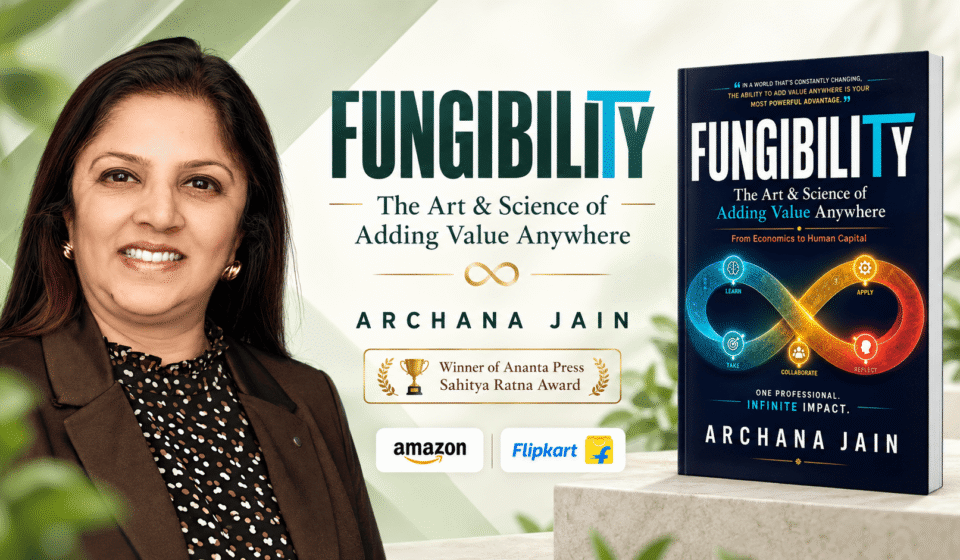

There are books that respond to a trend, and there are books that try to give readers a way to think beyond the trend. Fungibility: The Art & Science of Adding Value Anywhere belongs to the second category. Its central concern is not merely artificial intelligence, automation, changing industries, or shorter skill cycles. Those are the conditions surrounding the modern professional. The deeper question is what a person can build within themselves so that their usefulness does not disappear when a role, tool, team, or industry changes. Archana Jain approaches that question through the idea of “fungibility,” taking a term usually associated with interchangeability and reworking it into a more human, ambitious concept: the ability to transfer one’s capabilities across contexts while continuing to create value.
That reframing is the book’s strongest intellectual move. Many career books still organize professional growth around a ladder. Learn a role, become good at it, move upward, and protect the expertise that made the climb possible. Fungibility challenges the security of that model. A job title can become obsolete. A department can be reorganized. A technical skill can lose its advantage when a new platform makes it easier, faster, or cheaper. If identity is attached too tightly to a specific task, disruption feels like erasure. Jain’s argument offers another foundation for professional confidence: understand the capabilities beneath the task. Problem solving, learning agility, communication, judgment, collaboration, adaptability, and the ability to make sense of unfamiliar situations can travel farther than a job description.
This makes the book especially relevant to the present moment. Artificial intelligence has intensified a concern that has existed for years: how do people remain useful when technology changes the nature of work? The book does not appear to rely on fear as a motivational device. Instead, its premise is constructive. The future is not asking professionals to predict every change. It is asking them to become better at responding to change. That distinction matters. Prediction creates anxiety because no individual can know exactly which tools, functions, or industries will be transformed next. Adaptability creates agency because it is something that can be practiced. A professional cannot control the market, but can improve the speed with which they learn, the clarity with which they identify value, and the confidence with which they enter unfamiliar territory.
The author is well positioned to make this argument because her own professional journey reflects the principle she is describing. Her background spans multiple kinds of work, including advertising, public relations, customer service, coaching, team management, business operations, and technology environments. Those experiences are not presented as a collection of unrelated stops. They illustrate the book’s core proposition that a career can be understood as an accumulation of portable capabilities. That lived connection gives the concept credibility. Fungibility is not simply a theoretical recommendation to become versatile. It emerges from a career shaped by transition, learning, and repeated reinvention.
Another important strength is the shift from “what do you do?” to “what value do you create?” That sounds simple, but it changes the way professional identity is understood. People are often taught to introduce themselves through roles: manager, analyst, marketer, engineer, consultant, trainer, founder. Titles are efficient labels, but they can also become cages. If someone sees themselves only as a project manager, they may overlook the deeper abilities they bring to situations: structuring ambiguity, coordinating people, setting priorities, communicating risk, or moving teams toward decisions. Those capabilities may be valuable in operations, consulting, entrepreneurship, education, or leadership. By asking readers to identify value rather than merely role, the book encourages a more durable and expansive view of professional worth.
The practical promise of the book is equally compelling. The description emphasizes transferable skills, learning agility, adaptability, career resilience, cross-functional opportunity, and lasting impact. These themes make the book useful across career stages. A student can use the framework to avoid over-specializing too early. An early-career professional can use it to understand which abilities are worth strengthening beyond immediate performance metrics. A mid-career professional facing restructuring can use it to map experience into new functions. A senior leader can use it to think about workforce capability rather than static job architecture. An entrepreneur can use it to recognize that versatility is often essential when resources are limited and responsibilities shift quickly.
Fungibility also stands out because it does not treat adaptability as constant motion for its own sake. The goal is not to become a generalist who knows a little about everything and masters nothing. The more useful interpretation is to build a strong core while learning how to translate that core into new settings. A person may possess deep expertise, but the question is whether they can apply the thinking behind that expertise elsewhere. That is a more sophisticated model than simply advising readers to “learn new skills.” Skill accumulation without reflection can become another treadmill. The book’s emphasis on transferability asks readers to understand why a skill matters, where else it can matter, and how it can combine with other capabilities to produce impact.
There is also a human dimension running beneath the future-of-work discussion. Jain’s broader philosophy, as reflected in her professional and writing journey, is that technology may change how work is performed, but qualities such as empathy, judgment, trust, responsibility, and genuine connection remain central to how people lead and collaborate. That perspective gives Fungibility depth. Adaptability is not portrayed as a purely mechanical response to market conditions. It is connected to self-awareness, resilience, relationships, and the ability to remain grounded while environments change. In an era when many professional conversations reduce people to “human capital,” the book’s focus on value can be read in a richer sense: value is not only output. It is also the ability to help people and systems function better.
The book’s language of becoming “known for your capabilities, not just your job title” may be particularly liberating for professionals whose careers do not follow a neat path. Many people move through different industries, return after career breaks, switch functions, take lateral roles, or discover late that their strengths lie somewhere other than where they began. Traditional career narratives can make such paths appear inconsistent. Fungibility offers a different reading: variety can be evidence of capability if a person learns to recognize the patterns connecting their experiences. What looks fragmented from the outside may actually be a coherent portfolio of skills, judgment, and perspective.
Its usefulness for organizations should not be overlooked either. A future-ready workforce cannot be built only through hiring for today’s vacancies. Organizations need people who can move toward emerging problems, learn new systems, collaborate across silos, and remain effective during uncertainty. A fungible workforce in this sense is not a workforce of interchangeable people. It is a workforce of adaptable people whose abilities can be redeployed without losing the human judgment that makes those abilities valuable. That distinction prevents the concept from becoming cold or transactional. The book invites leaders to think beyond positions and toward capability ecosystems.
What ultimately makes Fungibility distinctive is its combination of urgency and optimism. It acknowledges that work is changing quickly, that AI is reshaping tasks, and that expertise can depreciate. Yet it does not conclude that individuals are powerless. Its answer is not to compete with machines on speed or volume. It is to become better at learning, transferring knowledge, understanding context, building trust, solving new problems, and creating value in changing conditions. That is a more sustainable form of professional confidence because it is not dependent on one employer, one platform, one credential, or one moment in the market.
For readers looking for a self-help or motivational book grounded in the realities of modern work, Fungibility offers a useful and memorable framework. It asks a demanding question: if your current role disappeared, what would remain valuable about you? More importantly, it gives readers a direction for answering that question. Build capabilities that travel. Learn faster. Reflect on what you actually contribute. Stay curious. Do not confuse a title with an identity. In a period when certainty is scarce, that may be one of the most practical forms of career preparation available.