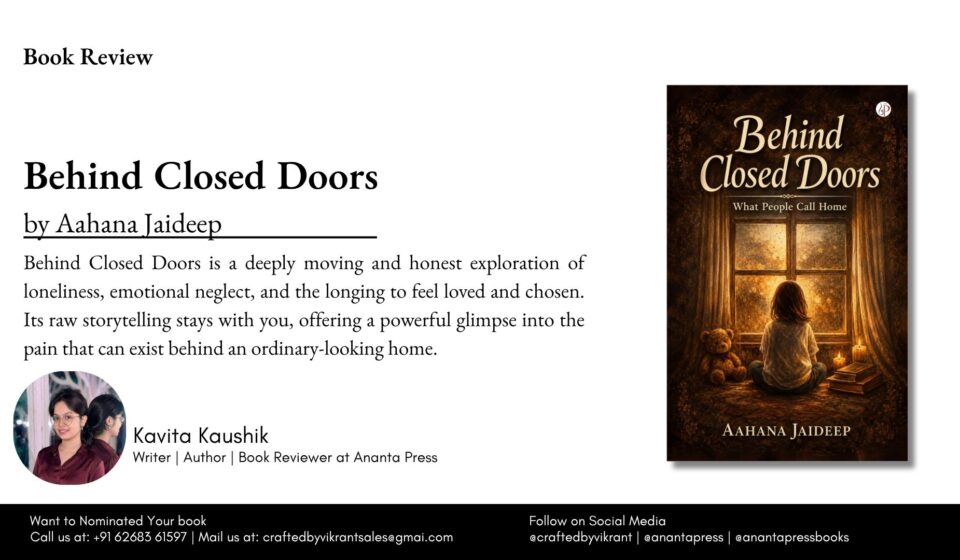

Behind Closed Doors: What People Call Home by Aahana Jaideep is a deeply personal and emotionally intense book that explores a side of family life that often remains invisible to the outside world. It is not simply a story about a house or a family; it is about what happens when the place that is supposed to provide safety, warmth, and belonging instead becomes a source of silence, loneliness, and emotional emptiness. The book presents its subject with remarkable honesty and vulnerability, making it an experience that is difficult to read without becoming emotionally invested in the narrator’s journey.
One of the strongest aspects of the book is its honesty. From the very beginning, the author makes it clear that the pages contain real emotions, real moments, and fragments of a life that she has chosen to share. She also acknowledges that the book is not the entirety of her story, but rather the part of her truth that she was ready to put into words. This creates an immediate sense of intimacy between the writer and the reader. It feels less like reading a conventional narrative and more like being allowed into someone’s most private thoughts.
The central idea of the book is both simple and powerful: a home can look perfectly normal from the outside while feeling profoundly lonely to the person living inside it. There may be walls, doors, family members, routines, meals, and ordinary conversations, yet none of these things automatically create a sense of home. The author beautifully distinguishes between physical shelter and emotional safety. For her, safety is found in warmth, affection, attention, understanding, and the feeling of being genuinely wanted. When these things are absent, even a familiar house can become a place of profound isolation.
The book’s treatment of silence is particularly effective. Here, silence is not peaceful or comforting. It becomes something heavy that follows the narrator through different spaces of her life. Conversations may happen, but emotional connection is missing. The narrator gradually learns that asking for attention, affection, or understanding may not produce the response she needs. As a result, she begins asking for less and eventually learns not to ask at all. This is one of the most painful ideas in the book because it shows how emotional neglect can change the way a person understands their own needs.
The author also captures a particularly complicated form of loneliness: being surrounded by people while still feeling completely alone. This kind of loneliness is difficult to explain because there may be no single dramatic event that defines it. Instead, it develops through countless small absences—the absence of someone noticing your silence, asking whether you are truly okay, or making you feel that your presence matters. Over time, these experiences begin to influence the way the narrator sees herself. She starts questioning whether she is too much, not enough, or simply not someone people choose.
Another powerful theme is the narrator’s childhood adaptation. Children do not always have the language to understand emotional neglect, but they learn to adapt to their surroundings. The narrator describes becoming quieter, more careful, and easier to manage. She learns to read the room before speaking and to suppress emotions before they become problems. What begins as a way of coping eventually becomes part of her identity. This section demonstrates how experiences from childhood can influence a person long after the original circumstances have passed.
The chapter dealing with “hunger” expands this idea in an especially meaningful way. The hunger described in the book is not simply physical. It is a hunger for warmth, affection, belonging, attention, and unconditional love. The narrator watches other people receive forms of affection that seem completely natural to them and begins to wonder why those experiences feel so distant from her own life. The question becomes not merely “Why don’t I have this?” but “What is wrong with me that I don’t?”
This emotional hunger becomes one of the forces shaping the narrator’s relationships. When someone has spent a long time feeling unseen or unchosen, even small acts of kindness can feel enormous. The desire to hold on to people can become intertwined with the fear that they will eventually leave. The book portrays this cycle with painful honesty: attachment, fear, distance, loss, and the belief that every departure confirms an existing fear of being difficult to love.
The section about “Her (My Favourite Person)” introduces another important emotional dimension. The narrator develops a deep attachment to someone who becomes associated with safety and comfort. The feelings grow gradually, remain largely unspoken, and become increasingly difficult to ignore. At the same time, the fear of losing this person becomes stronger. The narrator’s jealousy is not presented simply as possessiveness; it is connected to the deeper longing to belong and to experience the kind of effortless closeness that she has spent much of her life missing.
The book becomes particularly compelling because it does not reduce relationships to simple categories of good and bad. The narrator’s feelings toward her mother, for example, are complicated. There is anger and hurt, but there is also the painful realization that the person she needed most was never present in the way she needed her to be. This creates an emotional conflict that is much more difficult than straightforward resentment. The author shows how someone can be physically present in your life while still feeling emotionally distant.
Another notable strength is the book’s exploration of how pain can influence behaviour. The narrator recognizes that her reactions sometimes become larger than the situations themselves. Small changes can feel like rejection, small distances can feel like abandonment, and ordinary moments can trigger emotions that have been accumulating for years. The book makes an important distinction between the visible reaction and the invisible history behind it. Others may judge the reaction without understanding the experiences that created it.
The chapter structure also contributes to the emotional progression of the book. Beginning with The House That Didn’t Feel Like Home, the narrative moves through ideas such as hunger, attachment, a significant relationship, reality, distance, breaking points, and returning to where everything began. The progression gives the reader a sense of moving deeper into the narrator’s emotional world rather than simply presenting disconnected memories.
One of the most memorable qualities of Behind Closed Doors is its ability to focus on things that are often difficult to see. There are no dramatic outward signs required for a person to feel deeply neglected. Sometimes the pain exists in what is missing: affection that never arrives, conversations that never become meaningful, comfort that must be earned, and questions that are never asked. The book gives language to these quiet experiences.
Aahana Jaideep’s writing is raw and unfiltered. She does not attempt to make her experiences appear neat or easily resolved. Instead, the book embraces uncertainty, contradiction, longing, anger, attachment, and emotional confusion. This makes the narrative feel authentic. The author writes from the hidden parts of life—the silence inside a home, the pain of not being chosen, and the persistent desire to feel loved and understood.
The book may be particularly meaningful to readers who have ever felt invisible within a family, misunderstood by people around them, or uncertain about whether their emotional needs were legitimate. It can also encourage readers to look beyond outward appearances. A family that seems perfect to outsiders may have experiences and struggles that outsiders never see. The book reminds us that emotional suffering does not always announce itself loudly.
At the same time, this is not a light or easy read. The book contains themes of emotional neglect, family trauma, loneliness, longing, and belonging, and the author herself provides a trigger warning because some sections may be difficult to read. Its emotional intensity is therefore an important part of the reading experience.
Overall, Behind Closed Doors: What People Call Home is a courageous and deeply vulnerable exploration of what it means to grow up feeling unseen, unheard, and emotionally unchosen. Its greatest strength lies in the way it transforms quiet pain into words. Rather than presenting a polished version of life, Aahana Jaideep allows the reader to encounter the uncertainty, emptiness, longing, attachment, and confusion that exist beneath the surface.
This is a book about more than a difficult home. It is about the lasting impact of not receiving the love and reassurance a person longs for, and about the ways those experiences can shape identity, relationships, expectations, and self-worth. Most importantly, it is a book about giving a voice to feelings that have remained silent for too long.
Behind Closed Doors leaves the reader with an important thought: sometimes the deepest struggles are the ones nobody can see. A home is not defined only by its walls or the people inside it. It becomes a home when a person feels safe, valued, understood, and chosen. Through her raw and personal writing, Aahana Jaideep invites readers to look beyond appearances and recognize the stories that may be unfolding behind closed doors.