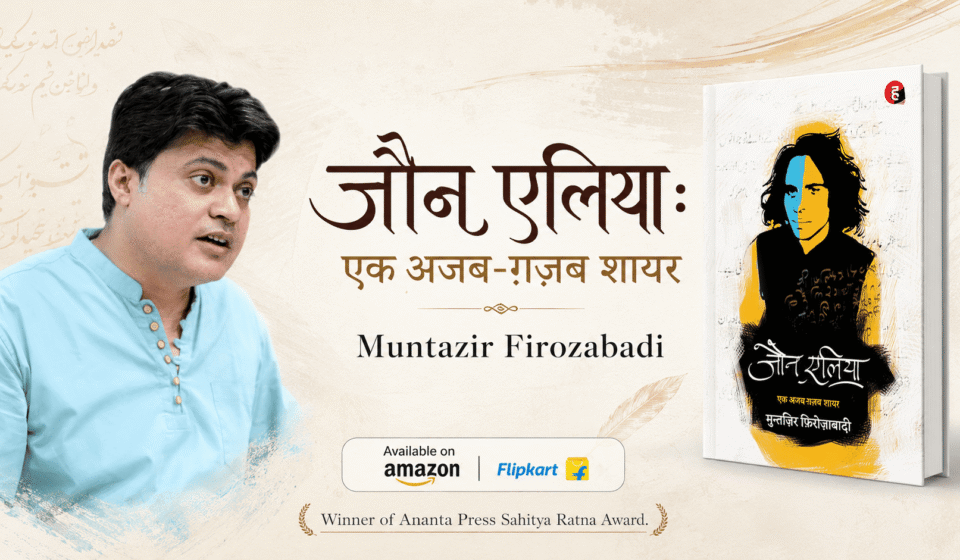

Book: Jaun Elia: Ek Ajab Ghazab Shayar | Author: Muntazir Firozabadi (Anant Bhardwaj) | Category: Poetry
Some poets are remembered through books, some through movements, and a rare few through a cultural afterlife that seems to grow larger with every passing year. Jaun Elia belongs decisively to the third category. His verses circulate in conversations, social media posts, mushairas, literary gatherings, private diaries, and the vocabulary of young readers who often encounter him first as a voice of wounded intelligence and only later as a major Urdu poet. Muntazir Firozabadi’s Jaun Elia: Ek Ajab Ghazab Shayar is valuable because it does not treat that popularity as a substitute for understanding. Instead, it uses the reader’s curiosity as a doorway into a fuller encounter with Jaun: the poet, the personality, the rebel, the thinker, and the cultural phenomenon.
The book’s central strength lies in its refusal to reduce Jaun Elia to a handful of viral couplets. The author presents a more layered literary field by bringing together ghazals, nazms, qata’at, and a particularly engaging dimension described as ‘Jauniyat’—an attempt to touch those less discussed aspects of Jaun’s personality that explain why his poetry feels so inseparable from his public image. This is important because Jaun’s appeal has never been purely textual. His manner of speaking, his theatrical irritability, his uncompromising opinions, his intellectual restlessness, and his visible emotional turbulence have all contributed to the way readers receive his poetry. A book that recognizes this relationship between literary voice and literary persona is therefore not merely collecting material; it is mapping an entire sensibility.
Firozabadi’s framing of Jaun as a blunt, fearless, rebellious poet immediately establishes the energy of the volume. Jaun’s poetry is often marked by contradiction: tenderness and cruelty can occupy the same emotional space; philosophical abstraction can suddenly collapse into intimate confession; irony can appear where a reader expects grief; and grief can become strangely performative without becoming false. The description of his style as containing drama, frustration, resistance to established rules, and philosophy is especially apt. These are not separate ornaments in Jaun’s writing. They often coexist within a single poetic gesture. This book’s appeal lies in drawing attention to that coexistence rather than presenting Jaun as simply a poet of heartbreak.
Another quality that makes the book stand out is its accessibility. Urdu literary culture can sometimes feel intimidating to readers who arrive without formal training in meter, classical traditions, or Persianized vocabulary. Yet Jaun’s popularity has created an unusual bridge between the classical inheritance of Urdu poetry and contemporary youth culture. The book seems consciously positioned on that bridge. Readers familiar with names such as Mir, Momin, Ghalib, Faiz, or Khumar will notice the broader genealogy in which Jaun is being situated, while newer readers can approach him through the emotional immediacy that has made his work widely beloved. The result is a volume that can function as both an introduction and a companion.
The biographical arc also deepens the literary experience. Jaun’s life between Amroha and Karachi carries historical and emotional weight. Born in India and later buried in Pakistan, he became a literary figure whose readership refuses to remain confined by borders. For South Asian readers, that fact gives his poetry an additional resonance. Language, memory, migration, identity, and cultural continuity hover around his life even when they are not the explicit subject of every poem. Firozabadi’s commitment to commemorating Jaun’s life allows the book to remind us that literary history in the subcontinent is often a history of movement, rupture, and shared inheritance.
The section or conceptual focus on ‘Jauniyat’ is perhaps the most distinctive promise of the book. Biographies of poets often fall into one of two traps: they either become dry chronological records or dissolve into gossip. A literary portrait succeeds when it shows how temperament, experience, reading, politics, philosophy, and private habits shape a writer’s imaginative universe. The idea of ‘Jauniyat’ suggests an effort in that direction. It allows readers to approach Jaun not as a statue in literary history but as an unstable, provocative, living presence. That approach is particularly suited to a poet whose personality continues to fascinate audiences almost as much as his lines do.
The author’s own literary background adds credibility to this project. Anant Bhardwaj, writing as Muntazir Firozabadi, has not approached Jaun as a casual admirer who discovered a few popular verses. His engagements with Hindi-Urdu literature, literary platforms, radio, podcasts, panel discussions, Rekhta, mushairas, and his earlier ghazal collection Daur-e-Hazir suggest a sustained participation in the ecosystem from which this book emerges. His involvement in a film project on Jaun’s life and his continuing work on figures such as Sahir Ludhianvi, Parveen Shakir, and Shiv Kumar Batalvi further indicate that literary remembrance is not a one-off subject for him but a long-term commitment.
That commitment matters because the subject demands balance. Jaun inspires devotion, imitation, mythology, and even a kind of fandom. The risk in writing about such a poet is either excessive reverence or deliberate iconoclasm. A useful book must preserve the electricity of admiration while still giving readers room to interpret. The present volume’s mixture of poetic forms and personality-oriented material appears designed to keep the reader close to the source: Jaun’s language, Jaun’s voice, Jaun’s habits of thought. Rather than speaking over the poet, the structure encourages the poet’s many registers to emerge.
For readers who know Jaun primarily through isolated social-media quotations, this book can be particularly rewarding. A couplet detached from its larger poetic and emotional environment can easily become a slogan. Reading ghazals, nazms, and qata’at in a curated literary context restores texture. The repetitions, tonal shifts, obsessions, self-mockery, arguments with love, metaphysical unease, and emotional extremity become visible as recurring features of a world-view. One begins to understand not simply what Jaun said, but how he habitually thought. This transition—from quotation to oeuvre—is one of the most meaningful services a book of this kind can perform.
The volume also invites a wider reflection on why Jaun has become so contemporary after his death. Many readers today respond to his dissatisfaction with certainty. He often sounds like someone suspicious of ready-made answers, impatient with social performance, unconvinced by conventional consolations, and painfully aware of the distance between intellect and emotion. That tonal modernity helps explain why his work keeps finding new audiences. Firozabadi’s book captures this phenomenon by treating Jaun not as an archival poet but as an ongoing conversation.
As a poetry-category title, Jaun Elia: Ek Ajab Ghazab Shayar succeeds most clearly in combining literary pleasure with literary curiosity. A reader can enter for the poetry and stay for the personality; another may arrive because of the myth of Jaun and discover the range of his poetic expression. The book’s uniqueness lies precisely in this two-way movement. It neither separates the man entirely from the work nor allows biography to overshadow the writing. Instead, it explores the charged space where the two meet.
There is also a strong element of literary preservation here. In an era when attention is fragmented and poets are often consumed in excerpts, carefully assembled books become acts of cultural memory. They preserve not only texts but contexts, associations, stories, and interpretive possibilities. Firozabadi’s broader work on Hindi-Urdu poets makes this volume part of a larger preservation project. That gives the book value beyond immediate fandom: it contributes to the transmission of literary heritage to readers who may not otherwise enter formal archives or scholarly criticism.
The best way to read this book may be slowly. Jaun is not a poet who becomes smaller under repetition; his lines often change emotional temperature when revisited. The biographical and ‘Jauniyat’ material can make those rereadings even richer by suggesting new angles without closing interpretation. Readers may find themselves moving back and forth between a poem and an anecdote, between a rhetorical flourish and a philosophical attitude, between the public rebel and the private wounded individual. That movement is not a distraction from poetry; it is part of the book’s design.
Ultimately, Jaun Elia: Ek Ajab Ghazab Shayar offers something more substantial than a tribute. It offers an invitation to inhabit a literary personality whose contradictions remain compelling. The book recognizes that Jaun’s power lies in being difficult to summarize: romantic yet abrasive, philosophical yet impulsive, theatrical yet vulnerable, historically rooted yet strikingly modern. Muntazir Firozabadi embraces that complexity and turns it into the organizing energy of the volume. For readers of Urdu and Hindi poetry, for admirers of Jaun, and for newcomers wondering why his voice refuses to disappear, this is a distinctive and engaging doorway into the phenomenon called ‘Jauniyat’.
Amazon purchase link: https://amzn.in/d/09j2BZ3r