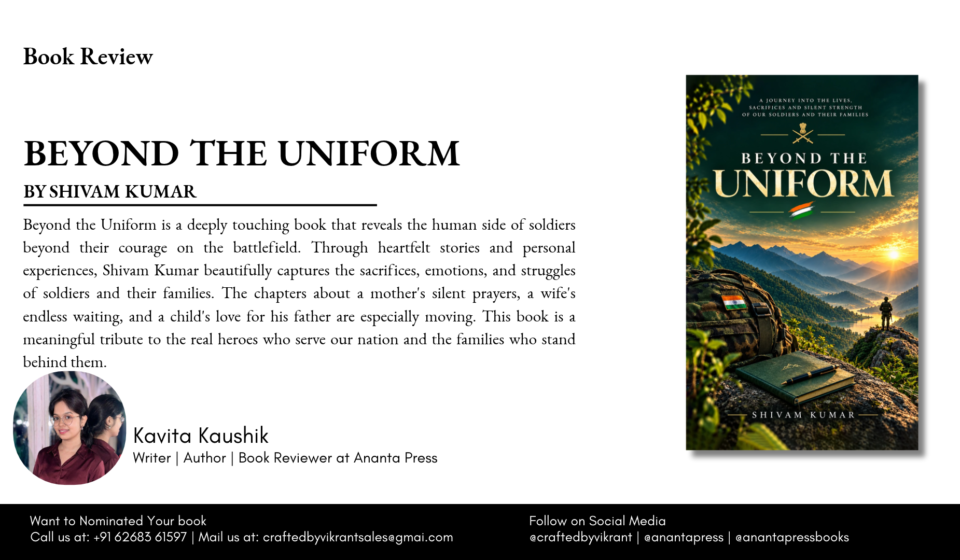

BY SHIVAM KUMAR
Powerful Exploration of Duty, Family, and the Human Cost of Service
There are many books that celebrate the bravery of soldiers, describe military operations, and highlight the victories achieved on the battlefield. However, very few take readers into the personal lives of the people who wear the uniform and the families who support them. Beyond the Uniform by Shivam Kumar approaches military life from this deeply personal perspective. Instead of concentrating only on heroism and national pride, the book explores the emotional realities of military service, including separation, uncertainty, responsibility, love, and the sacrifices that often remain unnoticed.
What makes this book particularly interesting is the author’s connection to its subject. As the son of an Indian Army officer, Shivam Kumar writes with an understanding shaped by his own childhood experiences. His reflections give the book a personal foundation, while the stories of other soldiers and their families broaden its emotional scope.
The result is a thoughtful collection that encourages readers to reconsider what military service truly means.
A Different Perspective on the Life of a Soldier
One of the strongest aspects of Beyond the Uniform is its decision to begin a soldier’s story before the uniform itself.
The opening chapter, Dreams Born in Dust, introduces the idea that every soldier was once an ordinary child with dreams, ambitions, insecurities, and family responsibilities. Before receiving military training or earning recognition, that individual experienced the same uncertainties that shape countless young lives.
This perspective is important because public discussions about soldiers frequently begin with their achievements. Shivam Kumar reminds readers that courage has a personal history.
The book presents military service not simply as an occupation but as a life-changing commitment. The decision to join the armed forces can emerge from patriotism, personal circumstances, family expectations, or a desire to create a better future.
Through these reflections, the author establishes one of the book’s central themes: extraordinary service often begins with ordinary human experiences.
Understanding the Responsibility Behind the Uniform
The chapters Learning to Become Unbreakable and The Weight of the Uniform examine the physical and emotional transformation involved in becoming a soldier.
Military training is often associated with physical endurance, strict discipline, and demanding routines. While the book acknowledges these aspects, it also considers the loneliness that accompanies them.
A young recruit may become physically stronger while simultaneously learning to live away from familiar surroundings, family support, and everyday comforts.
The author effectively communicates that strength is not merely about overcoming physical difficulties. It also involves managing uncertainty, controlling emotions, and continuing to fulfil responsibilities when circumstances become difficult.
The Weight of the Uniform develops this theme further by examining leadership and accountability.
One particularly engaging account describes an officer facing a difficult decision during an operation in Baramulla. The situation involves uncertainty, danger, and the possibility that an incorrect decision could have serious consequences.
What makes this account meaningful is its focus on responsibility rather than action alone. The author explores the pressure of making decisions while knowing that other people’s lives may depend upon them.
It is a valuable reminder that military leadership involves more than authority. It also requires judgement, emotional control, and an awareness of consequences.
The Families Who Experience Their Own Battles
Perhaps the most distinctive section of the book is The Family Left Behind.
This part moves away from the battlefield and focuses on the people waiting at home. Through chapters dedicated to mothers, wives, and children, Shivam Kumar highlights how military service affects an entire family.
The Mother Who Never Sleeps is particularly moving in its portrayal of parental concern.
The chapter explores the experience of a mother whose son serves in difficult conditions, often far away from home. For such a parent, an ordinary telephone call can carry extraordinary importance.
The author captures how everyday routines become connected to waiting and uncertainty. A delayed call, a news report about border tensions, or a festival celebrated without a family member can create emotions that others may struggle to understand.
The chapter’s strength lies in its recognition of quiet courage. The mother’s contribution is not measured through military achievements, but through patience, faith, and her ability to continue living with uncertainty.
Similarly, The Wife Who Fights Invisible Wars explores the responsibilities carried by military spouses.
The book describes a woman managing household responsibilities, caring for children and elderly family members, and dealing with difficult personal circumstances while her husband remains away on duty.
Her experiences illustrate how military families may have to manage situations that would ordinarily be shared between two partners.
This section is especially effective because it broadens the meaning of sacrifice. It suggests that serving the nation is not experienced only by the individual wearing the uniform. The consequences of that service extend into homes, relationships, and everyday family life.
A Son’s Personal Experience
Among the book’s most memorable sections is Children of the Uniform.
Here, Shivam Kumar moves from presenting the experiences of others to sharing his own relationship with his father.
This transition adds authenticity and emotional depth to the narrative.
The author recalls growing up while his father served in demanding military postings. He describes the challenges of spending long periods apart and the importance of the limited time they shared together.
One particularly meaningful detail involves their morning walks during his father’s leave.
These walks were not simply recreational activities. They became opportunities for conversations about honesty, discipline, courage, responsibility, and understanding life.
The simplicity of these memories makes them powerful.
Rather than relying on dramatic events, the author shows how small experiences can influence a child’s character and remain meaningful long after they occur.
Other recollections, such as his father celebrating his birthday while posted away from home, reveal the different ways affection can be expressed across physical distances.
This chapter stands out because the emotions feel personal and specific.
The author does not portray his father only as a military officer. He presents him as a parent whose professional commitments shaped the family’s experiences but did not diminish his affection for his children.
For readers who have experienced long separations from family members, these reflections may be particularly relatable.
Fear, Vulnerability, and the Meaning of Courage
Another important contribution of Beyond the Uniform is its discussion of fear.
Soldiers are frequently described as fearless, but the chapter Fear Lives Here Too offers a more nuanced understanding of bravery.
The author suggests that courage does not necessarily involve the absence of fear. Instead, it can mean recognising danger and continuing to act responsibly despite being afraid.
This distinction is significant.
By acknowledging that soldiers experience anxiety, loneliness, uncertainty, and concern for their families, the book avoids presenting them as individuals without ordinary human emotions.
Their willingness to perform difficult duties becomes more meaningful precisely because those feelings exist.
The chapter Nights Without Sleep similarly draws attention to the physical and psychological challenges associated with service in demanding environments.
Together, these chapters encourage readers to understand military courage as a human quality rather than an unrealistic expectation of emotional invulnerability.
The Importance of Unspoken Emotions
Letters Never Sent is another thoughtful chapter that explores the distance between what people feel and what they express.
Communication between soldiers and their families can be brief, especially during demanding postings.
A soldier may reassure loved ones that everything is fine without describing the difficulties experienced during the day.
Likewise, family members may avoid sharing their own worries because they do not want to create additional emotional pressure.
The chapter examines how love is sometimes communicated through ordinary questions, short conversations, photographs, and simple expressions of concern.
One memorable account involves a soldier who returns through difficult snowy conditions to recover a photograph of his daughter.
The photograph has little material value, yet it represents his connection to home.
This episode reflects the book’s strongest storytelling quality: its ability to find emotional meaning in seemingly small moments.
It illustrates how personal belongings can become reminders of relationships, identity, and the lives soldiers temporarily leave behind.
Exploring Loss and the Meaning of Sacrifice
As the narrative progresses, the book moves towards more difficult emotional subjects.
The Call Nobody Wants and The Flag and the Coffin examine the painful realities associated with military loss.
These chapters ask readers to consider what happens to the families whose loved ones do not return.
The emotional impact of such experiences extends far beyond the moment of public recognition.
A military funeral may involve national respect and collective remembrance, but the family must eventually return to a home transformed by absence.
The author approaches these subjects with seriousness and sympathy.
Rather than treating sacrifice only as a patriotic symbol, he explores its personal consequences.
The later chapters, Living With Memories and The Legacy of Sacrifice, extend this discussion by considering how memories, values, and personal examples continue to influence others.
This progression gives the book a meaningful structure, moving from childhood aspirations to military duty, family relationships, loss, and remembrance.
Writing Style and Literary Strengths
Shivam Kumar uses straightforward, accessible English throughout the book.
His writing relies heavily on short sentences, emotional observations, reflective passages, and direct communication with readers.
This approach makes the material approachable, especially for young adults and readers who may not regularly explore military literature.
The book also uses a recurring structure in which a subject is introduced, a personal or real-life-inspired account is explored, and a reflection brings the discussion back to its central message.
This format helps maintain continuity across the fourteen chapters.
At times, the narrative repeats themes such as courage, separation, responsibility, and sacrifice. Some readers may prefer greater variation in the reflective passages, while others may appreciate how this repetition reinforces the emotional message.
The book is also more reflective than analytical. Readers looking for detailed military history, operational information, or comprehensive social research may find its emphasis different from their expectations.
However, that distinction is central to the author’s purpose.
Beyond the Uniform is primarily concerned with human experiences. Its value lies in personal storytelling and emotional understanding rather than technical explanations of military life.
Why This Book Deserves Attention
An important achievement of the book is its accessibility beyond a military audience.
Although its subject is the Indian Armed Forces, its central themes are universal.
Parents worry about their children. Families experience separation. Individuals struggle with responsibilities. People find courage in difficult circumstances, and memories become valuable when time together is limited.
By connecting military experiences with these familiar emotions, Shivam Kumar makes the subject relatable to readers from different backgrounds.
The book may be especially meaningful for military families, students, young adults, and readers interested in personal accounts of service and sacrifice.
It also encourages younger readers to look beyond public recognition and appreciate the responsibilities carried by individuals whose contributions may not always receive attention.
Final Verdict
Beyond the Uniform is a sincere and emotionally engaging debut that approaches military life through the relationships and experiences surrounding it.
Its strongest qualities are its personal perspective, accessible storytelling, and attention to the quieter dimensions of service.
The author’s reflections on his father provide an especially meaningful foundation, while the experiences of mothers, wives, children, and soldiers give the book broader emotional significance.
Rather than presenting military service as an uninterrupted story of bravery, it acknowledges uncertainty, vulnerability, affection, responsibility, and loss.
The book ultimately succeeds in encouraging readers to recognise the individual behind the uniform and the family behind that individual.
Shivam Kumar has created a thoughtful tribute to people whose contributions cannot be measured through medals or public ceremonies alone.
For readers interested in stories about family bonds, human resilience, patriotism, and the personal meaning of duty, Beyond the Uniform offers a memorable and worthwhile reading experience.