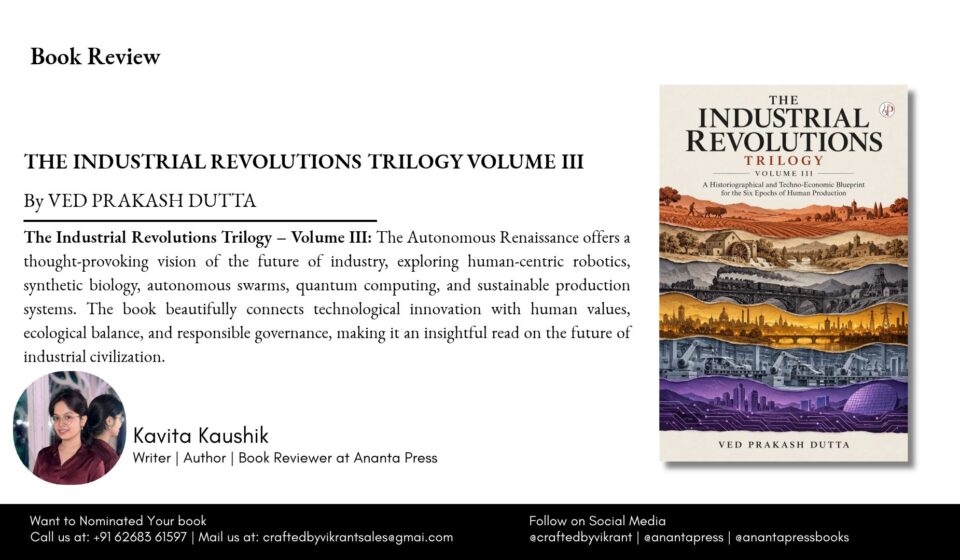

The Industrial Revolutions Trilogy – Volume III: The Autonomous Renaissance
From Human-Centric Cobotics and Biomimetic Manufacturing to Quantum Cyber-Physical Systems and Wise Anthropocentric Governance
By Ved Prakash Dutta
The Industrial Revolutions Trilogy – Volume III: The Autonomous Renaissance by Ved Prakash Dutta is an ambitious and forward-looking exploration of the Fifth and Sixth Industrial Revolutions. Building upon the historical and technological foundations established in the earlier volumes, this book examines a future in which human intelligence, collaborative robotics, synthetic biology, quantum computing, autonomous systems, and ecological thinking become deeply interconnected. Rather than presenting technological progress as an inevitable march toward greater automation, the book asks a much more fundamental question: how can humanity use advanced technologies while preserving human agency, ecological balance, and civilizational well-being?
The central idea of The Autonomous Renaissance is that the future of industrial production should not be defined simply by machines replacing humans. Instead, the author presents a transition toward systems in which technology works alongside human intelligence and operates within ecological boundaries. Industry 5.0 therefore represents a significant conceptual correction to the hyper-automated model of Industry 4.0. While Industry 4.0 focused heavily on connectivity, automation, efficiency, and cyber-physical integration, Industry 5.0 places human beings back at the centre of the industrial system.
One of the most important themes of the book is the emergence of human-machine cognitive alliances. The author argues that human intuition, creativity, judgement, and contextual understanding can complement the computational capabilities of machines. Collaborative robots, or cobots, become important in this model because they are designed to work directly with human operators rather than simply replacing them. This creates a production environment in which machines provide precision, endurance, and computational capability while humans contribute experience, creativity, ethical judgement, and strategic decision-making.
This human-centric approach is particularly significant because the book does not view efficiency as the only measure of industrial success. It introduces human-centricity, sustainability, and systemic resilience as important foundations of Industry 5.0. Such a perspective broadens the meaning of industrial progress. A highly efficient production system may still be vulnerable if it cannot respond to unexpected disruptions, social challenges, ecological pressures, or human needs. By placing resilience and human participation alongside technological efficiency, the book presents a more balanced vision of the future factory.
Another fascinating dimension of the book is its discussion of mass personalization. Traditional industrial production was built around standardisation and economies of scale. Digital manufacturing and advanced automation have already made it possible to produce increasingly customised products. The book takes this development further by imagining production systems capable of responding dynamically to individual needs while maintaining industrial-scale efficiency. Mass personalization therefore becomes an important bridge between technological capability and human individuality.
The book then moves into an even more transformative area: the biological turn in manufacturing. Synthetic biology is presented as a technology capable of changing the fundamental material basis of industrial production. Instead of relying exclusively on conventional petrochemical and extractive processes, future manufacturing could use living organisms, biological systems, enzymes, and engineered materials to produce useful products.
This concept of bio-cyber-physical production is one of the book’s most innovative themes. Living materials and bio-hybrid composites could potentially be grown rather than conventionally manufactured. Enzymatic catalysis and microbial fermentation can provide alternative approaches to chemical production, while enzymatic polymer upcycling offers a pathway toward more circular material systems. The book connects these biological processes with digital technologies such as multi-omics artificial intelligence, digital twins, and quantum-assisted modelling.
Importantly, the author does not ignore the risks associated with synthetic biology. Biological manufacturing requires strong containment and monitoring mechanisms. The discussion of auxotrophic kill switches, environmental DNA monitoring, digital biological watermarking, and controlled containment demonstrates that technological innovation must be accompanied by safety systems. This balance between innovation and responsibility is one of the strongest aspects of the book.
The idea of biomimicry further expands this ecological perspective. Inspired by the principles of nature, biomimetic manufacturing seeks to learn from biological systems that have evolved over enormous periods of time. Instead of treating nature merely as a source of raw materials, the book suggests that natural processes can become models for designing more sustainable industrial systems. This represents a fundamental shift from extractive production toward regenerative production.
Another major development explored in the book is autonomous swarm orchestration. Traditional factories have generally depended upon centralised control structures. Production schedules, machines, workers, and resources are coordinated through hierarchical systems. The book proposes an alternative model based on distributed autonomous agents.
In such systems, individual robots and autonomous units can coordinate with one another using decentralised algorithms and local information. The concept of stigmergy, inspired by biological systems such as ant colonies and bird flocks, provides a model for how simple local interactions can generate complex global behaviour. This could allow future production networks to respond dynamically to disruptions, redistribute workloads, and optimise resource flows without relying entirely on a central authority.
The implications of this concept are enormous. The factory of the future may no longer be a single physical location containing all stages of production. Instead, production could become a distributed network involving autonomous machines, biological production systems, robotic swarms, orbital infrastructure, and other specialised nodes. The book therefore expands the idea of industrial production from the factory to the planetary scale.
However, this expansion also creates new questions concerning control, accountability, and governance. If autonomous systems are increasingly capable of making decisions and reorganising production independently, humans must determine where authority should remain. The book repeatedly returns to the importance of human oversight and ethical governance, making it clear that autonomy should not mean the disappearance of responsibility.
The transition toward Industry 6.0 takes these ideas even further. The author describes a “Wise Anthropocentric Epoch” in which quantum computing, synthetic biology, nuclear fusion, green hydrogen, biomimetic manufacturing, and autonomous systems are brought together within a broader ecological framework. This is not simply an extension of Industry 5.0 but a conceptual transformation in the relationship between technology, humanity, and nature.
The book’s discussion of quantum cyber-physical systems is particularly ambitious. Quantum computing is presented as part of a future industrial architecture capable of handling highly complex computational and optimisation problems. When combined with autonomous systems, biological technologies, and advanced sensing, quantum technologies could potentially contribute to a new generation of industrial intelligence.
At the same time, the author recognises that advanced computation itself has physical and energetic requirements. This connects Volume III directly to the thermodynamic concerns raised in Volume II. The future cannot be considered sustainable merely because its technologies are digital or intelligent. Quantum systems, data infrastructure, robotics, and biological production will all require energy and physical resources. Therefore, technological development must remain connected to the realities of planetary limits.
The book’s treatment of post-industrial metamorphic ecosystems is especially thought-provoking. Traditional factories are relatively fixed structures designed for particular production processes. In contrast, future industrial ecosystems are imagined as dynamic systems capable of changing their physical configuration, material composition, and operating conditions according to environmental and economic circumstances.
Reconfigurable living composites, modular robotic structures, biological materials, and intelligent production systems could create manufacturing environments that adapt continuously. In this vision, the boundary between an industrial facility and a living ecosystem begins to disappear. Production becomes increasingly responsive to environmental signals and resource availability.
The idea of closed-loop industrial systems is central to this vision. Rather than following a linear model of extraction, production, consumption, and waste, future manufacturing should seek to reuse materials continuously. Biological processes can regenerate materials, robotic systems can reorganise production, and digital intelligence can monitor resource flows in real time. The ultimate objective is an industrial system that operates within planetary ecological boundaries rather than continually expanding its environmental footprint.
The final chapter of the book introduces the idea of cyber-physical sentience and bio-digital convergence. Here, industrial systems move beyond simple automation and adaptive control toward more sophisticated forms of self-monitoring, contextual awareness, and autonomous adaptation. The author carefully distinguishes this operational concept of “sentience” from biological consciousness, presenting it instead as the ability of industrial systems to maintain self-models, interpret complex environments, and adapt their behaviour.
This vision represents the culmination of the trilogy’s technological progression. The journey moves from mechanical power and industrial automation toward digital connectivity, human-machine collaboration, biological manufacturing, autonomous swarms, quantum systems, and integrated socio-technological ecosystems.
Yet the book’s most important contribution may not be technological at all. Its deepest message concerns governance and responsibility. The greater the capabilities of autonomous technologies become, the more important ethical and institutional frameworks will be. Advanced artificial intelligence, autonomous robotics, and synthetic biology can create enormous opportunities, but they can also introduce significant risks.
The author highlights several such risks, including the containment challenge associated with advanced autonomous intelligence, the biosecurity dangers of synthetic biology, and the energy and environmental implications of future computational infrastructure. These challenges cannot be addressed solely through engineering. They require global governance, algorithmic transparency, democratic oversight, institutional accountability, and ethical decision-making.
This emphasis makes the title The Autonomous Renaissance particularly meaningful. A renaissance traditionally represents renewal, transformation, and a rethinking of established ideas. In the author’s framework, the autonomous renaissance is not simply a period in which machines become more capable. It is an opportunity for civilisation to rethink what industrial progress should mean.
The book ultimately suggests that the future should not be measured only by productivity, economic growth, or technological sophistication. Human flourishing, ecological health, resilience, responsible innovation, and ethical governance must also become central measures of progress. This represents a significant philosophical shift from conventional industrial thinking.
The Industrial Revolutions Trilogy – Volume III: The Autonomous Renaissance is therefore more than a book about future technologies. It is an attempt to construct a broad intellectual framework for understanding where industrial civilisation may be heading. Its combination of robotics, artificial intelligence, synthetic biology, biomimicry, quantum computing, energy systems, ecological thinking, and governance gives it a wide-ranging character.
For readers interested in Industry 5.0, Industry 6.0, artificial intelligence, robotics, future manufacturing, synthetic biology, sustainability, quantum technologies, and the long-term evolution of industrial civilisation, the book offers a rich and thought-provoking perspective. Its greatest strength is its willingness to connect technological possibility with ethical responsibility and ecological reality.
In conclusion, The Autonomous Renaissance presents the future of industry as a choice rather than an inevitability. The technologies described in the book could contribute to greater productivity, sustainability, resilience, and human flourishing, but they could also generate new forms of systemic risk if developed without adequate oversight. The author’s central message is therefore both ambitious and cautionary: the future will not be determined by technology alone, but by the values, institutions, and choices through which humanity decides to use it.
As the concluding volume of The Industrial Revolutions Trilogy, the book successfully extends the narrative from the digital transformation of Industry 4.0 toward the human-centric, biological, autonomous, and ecologically conscious possibilities of Industry 5.0 and 6.0. Its vision of an “Autonomous Renaissance” ultimately challenges readers to imagine not merely a smarter industrial world, but a wiser one—one in which technological intelligence is balanced by human judgement, ecological responsibility, and a commitment to long-term civilizational well-being.