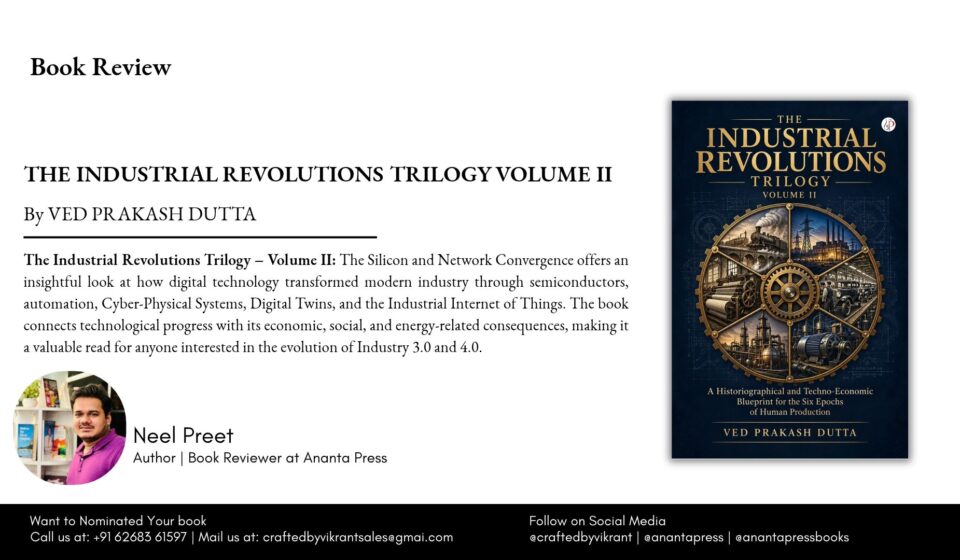

The Industrial Revolutions Trilogy – Volume II: The Silicon and Network Convergence
A Historiographical and Techno-Economic Blueprint for the Six Epochs of Human Production
By Ved Prakash Dutta
The Industrial Revolutions Trilogy – Volume II: The Silicon and Network Convergence by Ved Prakash Dutta is an ambitious and intellectually engaging examination of the technological, economic, social, and industrial transformations associated with Industrial Revolutions 3.0 and 4.0. Rather than presenting digitalisation simply as a story of technological progress, the book attempts to place the rise of semiconductors, microprocessors, automation, enterprise software, Cyber-Physical Systems, Digital Twins, and the Industrial Internet of Things within a broader historical and techno-economic framework.
The central strength of the book lies in its attempt to connect two apparently different worlds: the physical world of industrial production and the increasingly digital world of information processing. The author argues that the emergence of digital technologies did not eliminate the material foundations of industrial production. Instead, it created a new computational layer over those foundations. This perspective gives the book a distinctive character and makes it particularly relevant for readers interested in the deeper consequences of Industry 3.0 and Industry 4.0.
The book begins by examining the transition from the mechanical and thermodynamic foundations of earlier industrial revolutions toward an economy increasingly organised around information processing. According to the book, Industrial Revolution 3.0 represented a decisive shift in industrial organisation through solid-state electronics, semiconductors, microprocessors, programmable logic controllers, computer-aided design, enterprise computing, and increasingly sophisticated forms of industrial automation.
One of the book’s important contributions is its treatment of the semiconductor as more than a technological invention. The transistor, integrated circuit, and microprocessor are presented as foundational components of a new industrial architecture. The discussion of the Intel 4004 and Moore’s Law demonstrates how improvements in computational capability gradually transformed the possibilities of manufacturing, design, communication, and business operations.
The author then moves from semiconductor technology to industrial automation. Programmable Logic Controllers, Computer Numerical Control systems, and industrial robotics changed the relationship between workers and machines. Automation increasingly shifted production away from purely mechanical control toward software-driven systems. The discussion of industrial robotics, including the development of early systems such as Unimate, helps illustrate how computing became integrated directly into manufacturing processes.
Computer-Aided Design and Computer-Aided Manufacturing receive similar attention. These technologies transformed design from a primarily physical or manual activity into a digital process. Designs could be created, modified, stored, transferred, and integrated with manufacturing systems. In parallel, enterprise systems such as Material Requirements Planning and Enterprise Resource Planning created digital representations of organisational activities. The result was an increasingly interconnected industrial environment in which information could move across design, production, inventory, logistics, and management.
Another significant aspect of the book is its discussion of the economic and organisational consequences of digitalisation. The author connects the rise of computerized production with the emergence of flexible manufacturing and post-Fordist production systems. The emphasis on flexibility is important because industrial competitiveness increasingly depended not only on producing large quantities of standardised goods but also on responding rapidly to changing markets and consumer requirements.
The book also considers the development of the Toyota Production System and the broader movement toward flexible specialisation. Digital technologies supported this transformation by making it easier to coordinate increasingly complex production networks. At the same time, the digitalisation of industrial processes contributed to the fragmentation of global supply chains. Production could be distributed geographically while being coordinated through increasingly sophisticated information systems.
The discussion of East Asian industrial development adds another important dimension. The book highlights the rise of economies such as Taiwan and South Korea and their role in the global semiconductor and manufacturing ecosystem. Companies and industrial clusters associated with these economies became central to the production of advanced technological components. This development demonstrates that digitalisation was not simply a technological phenomenon; it also reshaped the geography of industrial power.
The second major part of the book moves into Industrial Revolution 4.0. Here, the focus changes from individual digital machines and systems to interconnected industrial ecosystems. The author describes Industry 4.0 as an environment characterised by Cyber-Physical Systems, Industrial Internet of Things technologies, Digital Twins, edge computing, cloud systems, advanced communication networks, and increasing levels of automation and autonomy.
The concept of Cyber-Physical Systems is particularly important in this discussion. These systems represent the convergence of computation, communication, sensing, and physical processes. The book draws on the 5C architecture associated with Jay Lee, moving from data acquisition and conversion toward deeper levels of cognition and configuration. This framework helps readers understand how industrial systems can progress from simply collecting information to analysing it and eventually using it for increasingly autonomous decision-making.
The treatment of Digital Twins is another strong feature of the book. A Digital Twin is not presented merely as a visual representation of a physical object. Instead, it becomes part of a broader industrial information system in which data from physical assets can be used to simulate, monitor, analyse, and optimise their behaviour. Applications such as virtual commissioning and dynamic engineering analysis demonstrate the potential of this approach to reduce uncertainty and improve industrial decision-making.
The Industrial Internet of Things further expands this interconnected environment. Sensors embedded within machines and production systems can generate continuous streams of information. Communication protocols such as OPC UA, MQTT, and DDS allow these systems to exchange data across different levels of industrial architecture. The book’s discussion of the edge-cloud continuum is particularly relevant because it shows that industrial intelligence does not necessarily reside in one location. Processing can increasingly be distributed between machines, edge devices, local systems, and cloud infrastructure.
The concept of vertical and horizontal integration also receives attention. Vertical integration connects different levels within an industrial organisation, while horizontal integration links processes and organisations across supply chains. Together, these approaches create a more interconnected production environment. One of the resulting possibilities is mass customisation and, potentially, production approaches approaching the ideal of “batch size one.”
However, the book does not treat technological integration as an uncomplicated success story. One of its most valuable contributions is its discussion of the changing nat
ure of labour. Digitalisation may reduce certain forms of repetitive work while increasing demand for new technical and analytical skills. This creates a skill gap and raises questions about training, employment, organisational restructuring, and the distribution of economic benefits.
The author also considers national strategies surrounding Industry 4.0, including initiatives associated with Germany, the United States, and China. This perspective reinforces the argument that advanced manufacturing is closely connected to national economic strategy and industrial competitiveness. Control over technological infrastructure, semiconductor capabilities, digital platforms, and industrial data can influence the distribution of economic power.
Perhaps the most distinctive intellectual contribution of Volume II is its challenge to the idea of a completely “dematerialized” or “weightless” digital economy. The book argues that although digital information may appear intangible, the systems required to create, transmit, process, and store that information depend upon substantial physical infrastructure.
Data centres require electricity and cooling. Digital networks require servers, fibre-optic infrastructure, communication equipment, and other physical systems. Semiconductor production requires complex manufacturing facilities and critical materials. Consequently, the apparent immateriality of digital services rests upon a considerable physical and energetic foundation.
This leads to what the author calls the “thermodynamic paradox of the dematerialized economy.” The more digital and virtual the economy appears, the easier it may be to overlook the energy, water, minerals, infrastructure, and physical labour required to sustain it. This argument provides an important counterpoint to narratives that describe digitalisation purely in terms of efficiency and dematerialisation.
The book’s historiographical dimension also adds depth to its technological discussion. Rather than treating Industry 3.0 and Industry 4.0 as isolated contemporary trends, the author connects them with earlier industrial transformations. This creates a longer historical narrative in which technological change, production systems, labour, energy, and economic organisation continually interact.
The use of thinkers and frameworks associated with Manuel Castells, David Harvey, Harry Braverman, David Noble, Jay Lee, Rolf Landauer, and Vaclav Smil further strengthens the intellectual foundation of the work. These references allow the discussion to move beyond engineering descriptions and into questions of labour, capital, information, energy, technological change, and economic geography.
Overall, The Industrial Revolutions Trilogy – Volume II: The Silicon and Network Convergence is a substantial examination of the forces that shaped modern digital industry. Its greatest achievement is that it refuses to separate technological progress from its economic, social, labour, and physical consequences. Semiconductors and software are not treated as isolated inventions; they are shown as components of a much larger transformation in how production is organised and coordinated.
The book will be especially valuable to readers interested in industrial history, manufacturing technology, Industry 4.0, digital transformation, automation, supply chains, economic geography, energy systems, and the future of work. It can also serve as a useful conceptual bridge between discussions of technological innovation and the physical realities that make such innovation possible.
In conclusion, Volume II presents Industrial Revolutions 3.0 and 4.0 as stages in a continuing transformation rather than as simple technological upgrades. From the transistor and microprocessor to Cyber-Physical Systems and Digital Twins, the book traces the growing role of computation in industrial production while reminding readers that the digital economy remains deeply connected to material resources and energy. Its combination of technological history, economic analysis, labour perspectives, and thermodynamic thinking makes it a thought-provoking contribution to the study of modern industrial civilisation.