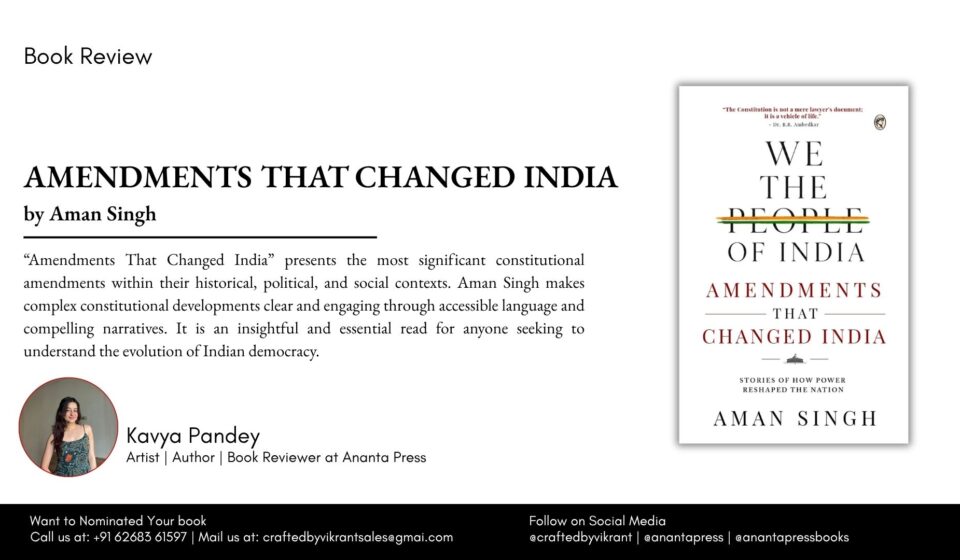

Constitutions are often viewed as static legal documents—collections of articles, clauses, and technical provisions that only lawyers and judges truly understand. Amendments That Changed India challenges that perception with remarkable clarity and intellectual depth. Instead of treating constitutional amendments as dry legal events, the author presents them as defining moments in India’s democratic journey, showing how each amendment reflects a larger struggle between power, justice, liberty, and social transformation. The result is a compelling work that is as engaging as it is educational.
From the opening chapters, the book establishes an important premise: the Indian Constitution was never intended to be an unchangeable document, nor was it designed to be so flexible that governments could alter its foundations at will. Through a thoughtful discussion of Article 368 and the philosophy behind constitutional amendments, the author explains how India’s framers created a system that balances continuity with change. This foundational explanation is delivered with exceptional clarity, making complex constitutional concepts understandable even for readers with no legal background.
One of the book’s greatest strengths lies in its storytelling. Rather than presenting amendments as isolated legal provisions, the author reconstructs the political, social, and historical circumstances that made each amendment necessary—or controversial. Every chapter reads almost like a historical narrative, populated by political leaders, judges, activists, and ordinary citizens whose decisions collectively shaped modern India. The constitutional debates become human stories, making the reader appreciate that every amendment represents real conflicts, real sacrifices, and real consequences.
The discussion of the First Constitutional Amendment is particularly impressive. Instead of reducing it to a technical amendment concerning free speech and property rights, the book carefully explains the enormous challenges facing newly independent India. The tension between protecting fundamental rights and implementing land reforms is presented with admirable balance. Jawaharlal Nehru’s perspective, the judiciary’s reasoning, and the concerns of critics are all examined fairly, allowing readers to appreciate the complexity of constitutional governance rather than viewing history through simplistic judgments. This balanced approach remains one of the defining characteristics of the book throughout.
Equally fascinating is the examination of linguistic reorganization and the creation of Andhra State following the sacrifice of Potti Sriramulu. The author demonstrates how constitutional amendments are not merely legal mechanisms but responses to powerful social movements and public aspirations. The narrative vividly illustrates how language, identity, and democracy intersected during one of India’s most transformative periods. These chapters remind readers that constitutions evolve because societies evolve, and democratic institutions must respond to changing realities without abandoning their core principles.
The author’s writing style deserves special appreciation. Legal and constitutional literature often suffers from excessive technical language, making it inaccessible to general readers. Amendments That Changed India avoids this pitfall entirely. The prose is elegant, conversational, and intellectually stimulating without ever becoming simplistic. Complex constitutional doctrines such as judicial review, separation of powers, constituent authority, federalism, and parliamentary sovereignty are explained with remarkable ease. The writing manages to maintain academic credibility while remaining highly readable—a balance that few books in this genre successfully achieve.
Another noteworthy strength is the book’s commitment to neutrality. Constitutional history is often interpreted through ideological or political lenses, but this work consistently resists partisan conclusions. The author neither glorifies governments nor demonizes them. Instead, each amendment is evaluated within its historical context, acknowledging both its necessity and its unintended consequences. Readers are encouraged to think critically rather than being directed toward predetermined conclusions. This objectivity greatly enhances the credibility of the work and makes it valuable for readers across political perspectives.
The treatment of the judiciary is equally insightful. The book demonstrates how the Supreme Court gradually emerged as the guardian of constitutional values while simultaneously recognizing Parliament’s democratic legitimacy. Rather than presenting constitutional institutions as adversaries, the author portrays them as participants in an ongoing constitutional dialogue. This nuanced understanding helps readers appreciate why constitutional conflicts are often essential for strengthening democratic institutions rather than weakening them.
One of the most impressive aspects of the book is its ability to connect historical amendments with contemporary India. Readers quickly realize that many constitutional debates from the 1950s and 1960s continue to influence present-day discussions on free speech, federalism, judicial independence, property rights, reservation policies, and the relationship between Parliament and the judiciary. The book demonstrates that constitutional history is not confined to the past; it continues to shape governance and public policy in modern India. This relevance makes the work particularly valuable for students, civil service aspirants, legal professionals, journalists, and politically aware citizens.
The research behind the book is both extensive and meticulous. Constitutional provisions, landmark judgments, parliamentary debates, and historical scholarship are woven together seamlessly into the narrative. Instead of overwhelming readers with citations or technical references, the author integrates legal history naturally into the storytelling. This careful balance between scholarship and accessibility reflects considerable research as well as a deep understanding of constitutional law.
Beyond its educational value, Amendments That Changed India also encourages readers to reflect on broader questions of democracy. How much power should elected governments possess? What limits should exist on constitutional amendments? How should courts protect fundamental rights without undermining democratic decision-making? Can social justice justify restrictions on individual liberty? These questions remain central to constitutional democracies worldwide, and the book invites readers to engage with them thoughtfully rather than offering simplistic answers.
The pacing of the book also deserves praise. Each chapter builds naturally upon the previous one, creating a continuous narrative rather than a disconnected collection of constitutional amendments. Early chapters establish the constitutional framework, while later chapters progressively deepen the discussion by introducing increasingly complex constitutional conflicts. This structure allows readers to gradually build their understanding without feeling overwhelmed.
Perhaps the greatest achievement of Amendments That Changed India is that it transforms constitutional history into an engaging intellectual journey. Instead of presenting amendments as mere legislative milestones, it reveals them as reflections of India’s evolving democratic conscience. The Constitution emerges not as an untouchable legal document, but as a living framework continually tested by political ambition, judicial wisdom, social change, and public aspiration. By placing legal developments within their historical and human contexts, the book demonstrates that constitutional amendments are ultimately stories about people—their rights, their struggles, and their vision for the nation’s future.
In conclusion, Amendments That Changed India is an outstanding contribution to constitutional literature. It combines rigorous research, balanced analysis, elegant writing, and compelling storytelling to create a work that is both intellectually enriching and highly accessible. Whether one approaches it as a student of law, a scholar of political science, a civil services aspirant, or simply a curious citizen interested in understanding India’s democratic evolution, the book offers valuable insights on every page. It is not merely a history of constitutional amendments; it is a thoughtful exploration of how a nation continually negotiates the delicate balance between continuity and change, liberty and reform, power and accountability. Informative, engaging, and profoundly relevant, this book deserves a place among the finest contemporary works on Indian constitutional history.