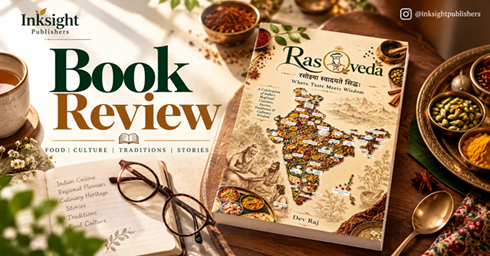
Book Review – Rasoveda by Dev Raj: Food, Memory and the Cultural Imagination of India

BOOK REVIEW | DEV RAJ
Some of the most enduring records of a society are not written on monuments or preserved in formal archives. They survive in the ordinary gestures of preparing a meal: the selection of an ingredient, the rhythm of a method, the way a table is arranged for others. Rasoveda, by Chef Dev Raj, approaches India’s regional cuisines with an appreciation for such forms of memory. Its subject is food, but its larger field is culture. Presented as a culinary journey through regional India, the book seeks to bring heritage recipes into conversation with traditions, stories, techniques and the wisdom that generations have attached to cooking.
There is something literary in the very idea of a culinary journey. Places become recognisable through detail, and food provides details that are at once intimate and communal. Rasoveda’s description moves among the rich kitchens of Punjab and Awadh, the delicate flavours of Bengal, the lively culinary cultures of Gujarat and Maharashtra, the royal traditions of Kashmir and the coconut-rich heritage of Kerala and southern India. This itinerary does not reduce the country to a single taste. Instead, it draws attention to multiplicity: different regions possess different ways of articulating hospitality, belonging and local identity through meals.
A dish, considered only as an object on a plate, is easy to detach from its origins. Considered as tradition, it becomes a meeting point between landscape and human choice. Ingredients imply questions of cultivation and availability; techniques suggest forms of practical inheritance; ceremonial and everyday preparations alike hint at the patterns of a community. Rasoveda’s stated interest in the stories behind regional cooking helps return these dimensions to view. That is the book’s most persuasive conceptual strength. It asks the reader to regard culinary knowledge as something interpreted and transmitted, not merely consumed.
The project also makes room for the voice of the practitioner. Chef Dev Raj is described as an Indian culinary professional, consultant, author and educator whose experience includes Indian cuisine, Sattvik and wellness-oriented food, culinary research and development, menus, training and kitchen operations. His professional trajectory connects the traditional subject matter of Rasoveda with the contemporary settings in which food is prepared and taught. It is a productive point of contact. Cultural knowledge can be romanticised from a distance; professional experience, at its best, keeps attention on the work, judgment and repeated practice that a cuisine demands.
The presence of regional thalis in the book’s stated scope is particularly evocative. A thali presents food as a relationship among parts, a way of thinking about the meal rather than the prestige of any single dish. As an editorial idea, this mirrors the book’s larger commitment to diversity. Individual flavours gain meaning through juxtaposition, and a region’s identity cannot be captured by a lone preparation. For the reader interested in social history or cultural writing, such a perspective may be as engaging as the recipes themselves. It draws attention to the structure of everyday life and to the customs that turn nourishment into shared experience.
The tension between preservation and change remains central to any account of heritage. Traditions are passed onward by people living in new circumstances, with different tools, preferences and resources. Rasoveda is described as rooted in tradition yet expressed through a professional culinary lens. That formulation resists a purely museum-like understanding of cuisine. It implies that the past must be understood with care while the present asks practical questions about communication and use. It also invites readers to distinguish respectful adaptation from casual simplification, a distinction that deserves attention whenever diverse regional identities are represented for a broad audience.
A book surveying cuisines across a country of such range cannot reasonably contain every local variation. The absence of an exhaustive claim is worth observing. Readers should resist expecting a definitive hierarchy of dishes or a single authoritative version of complex traditions. The book is better approached as an act of introduction and appreciation: a framework for noticing what regional cooking carries and why its knowledge merits continued study. That interpretive modesty does not diminish the scale of its aspiration. Indeed, it makes the culinary journey more meaningful by leaving room for further voices and discoveries.
Dev Raj’s guiding belief—that knowing the story of a dish helps us know the culture behind it—offers a lucid statement of purpose. It aligns the book with a tradition of cultural writing in which the smallest detail can disclose larger patterns of thought. A recipe may be useful to a cook, but its accompanying history can also speak to readers who are drawn to language, memory, place and the continuity of human habits. Rasoveda therefore has a possible audience beyond the kitchen. Its invitation extends to anyone interested in how a society expresses itself through ordinary practices.
What ultimately distinguishes the idea behind Rasoveda is its refusal to separate taste from knowledge. Pleasure and understanding need not compete. The distinctive flavours of India’s regions are reasons to explore; the stories, techniques and inherited judgments around those flavours are reasons to remain attentive. Home cooks, culinary students, hospitality professionals and readers of cultural nonfiction may all approach the book differently, yet its underlying question belongs to them equally: what do we learn about a place when we learn how its people cook? Rasoveda proposes that the answer is substantial, and that the search is worth making.
Amazon Link – https://www.amazon.in/RASOVEDA-Where-Taste-Meets-Wisdom/dp/9379000693/


