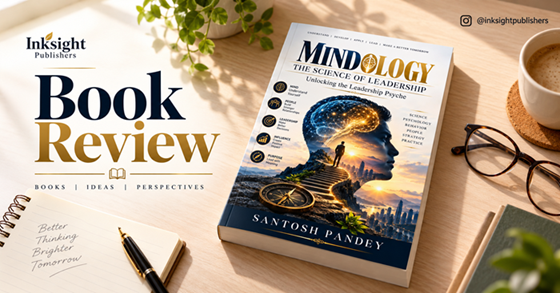
Book Review – Mindology: The Science of Leadership by Santosh Pandey: Understanding the Mind Behind Effective Leadership

Leadership is often discussed in the language of performance: targets achieved, teams managed, and decisions delivered under pressure. Yet those visible outcomes depend on less visible processes—how people understand themselves, interpret others, respond to uncertainty, and decide what deserves their commitment. Mindology: The Science of Leadership by Santosh Pandey approaches leadership through this more reflective lens. Its stated focus on leadership psychology, organizational behaviour, emotional intelligence, and strategy positions the book as an attempt to connect the human dimensions of leadership with the demands of contemporary organizations. Rather than treating leadership as a title or a fixed personality trait, the book’s guiding premise invites readers to consider it as a continuing practice of judgment, self-awareness, and responsibility.
That perspective matters because the conditions in which leadership takes place are rarely simple. A manager confronting team conflict must understand motivations as well as procedures; a professional responding to organizational change needs resilience alongside technical competence; and an executive shaping long-term direction must balance strategic ambition with ethical consequences. The book is presented as both a comprehensive reference and a practical guide, a combination that offers a useful way to think about such challenges. The reference dimension suggests a broad conceptual foundation, while the practical dimension emphasizes application. Together, they frame leadership not merely as something to know about, but as something that must be translated into behaviour and decisions.
One of the most relevant strands in this approach is the relationship between self-understanding and the ability to lead others. Emotional intelligence and leadership psychology belong in the same conversation because professional decisions are never made in an emotional vacuum. Perception, confidence, empathy, impatience, and fear can shape interactions even when an organization presents its choices as purely rational. A leadership book that gives these subjects serious attention encourages readers to examine how personal habits affect collective results. The value of this emphasis is not that self-awareness magically resolves every workplace difficulty; it is that better awareness can create the conditions for clearer conversations, more considered choices, and greater accountability.
The attention to organizational behaviour also broadens the book’s relevance beyond individual development. Leadership happens within relationships, incentives, cultures, and systems. Understanding why teams cooperate or resist, how trust is built, and what makes communication productive is essential for anyone whose work depends on other people. The book’s stated use cases include team development and conflict, suggesting an orientation toward situations readers may recognize in everyday professional life. These are especially important areas for emerging managers, who frequently discover that expertise in a functional role does not automatically translate into effectiveness when coordinating diverse personalities and expectations.
Strategy provides another important counterweight. Reflection without direction can become an end in itself; direction without reflection can create avoidable damage. By bringing psychological and strategic thinking into the same frame, Mindology addresses a tension that sits at the heart of effective leadership. Decisions about innovation, change, or resilience require more than selecting an attractive course of action. They require attention to how people will experience that course, how organizations will adapt, and which trade-offs are acceptable. The combination of behaviour and strategy therefore gives the book an intellectually coherent center, even for readers who approach it primarily for practical reasons.
The stated reading pathways are a noteworthy strength of the book’s design. Students are encouraged to read sequentially, building a foundation across leadership psychology, organizational behaviour, emotional intelligence, and strategy. Professionals and managers, by contrast, are invited to use individual chapters as points of reference for specific challenges, including decision-making, change, innovation, resilience, and team development. Executives are directed toward later material on executive psychology, ethics, transformation, and leadership legacy. Trainers and coaches are offered chapters as frameworks for workshops, coaching, and classroom discussion. This flexible positioning recognizes that readers come to leadership literature with different levels of experience and different questions in mind.
The author’s professional background gives useful context to this interdisciplinary orientation. Santosh Pandey works across finance transformation, corporate training, technology, and analytics, with experience spanning FP&A, strategic finance, artificial intelligence, business intelligence, and enterprise automation. His postgraduate studies in Finance, Mathematics, and Computer Applications, together with certifications in Data Science, AI, and Machine Learning, reflect an engagement with structured analysis and the changing technological workplace. He has also trained students and professionals in subjects ranging from financial modelling and Excel to Python, Power BI, and automation. These credentials do not, by themselves, establish the effectiveness of every argument in the book, but they help explain its interest in linking human judgment to organizational and strategic realities.
An additional aspect of Pandey’s stated authorial outlook is his interest in bringing modern research into conversation with selected insights from Indian philosophical traditions. This is a potentially valuable dimension of leadership writing, particularly when it is used to clarify questions of duty, conduct, and wise decision-making rather than to substitute tradition for evidence. Leadership ethics cannot be reduced to compliance or reputation management; it requires asking how power should be exercised and how choices affect others. The book’s emphasis on ethics and leadership legacy points toward these longer-term questions, which can be overlooked when professional advice focuses only on immediate results.
As an editorial proposition, Mindology appears most useful when understood as a broad learning and reference resource rather than a promise of quick leadership transformation. Its range is also the principal point readers should approach with realistic expectations. Psychology, behaviour, emotional intelligence, organizational change, strategy, and ethics are substantial disciplines in their own right. No single volume can be expected to replace specialist study or the difficult learning that comes from experience. Readers will gain the most by treating its frameworks as starting points for reflection, discussion, and testing in context, not as universal formulas. This is particularly true of complex interpersonal or organizational problems, where circumstances often matter as much as principles.
For students, the book offers a route into the vocabulary and interconnected concerns of leadership. For professionals and managers, its appeal lies in having relevant topics available for consultation when a practical problem arises. Executives may find the attention to transformation, responsibility, and legacy most pertinent, while educators, trainers, and coaches can use its thematic organization to structure further discussion. The book’s breadth makes it accessible to a varied audience without requiring every reader to have the same objective. Its usefulness ultimately rests on whether readers bring the ideas back to the situations in which they work, study, and influence others.
The strongest idea running through the book’s presentation is also the simplest: leadership is not adequately measured by authority alone. Character, wisdom, responsibility, continuous learning, and positive impact are presented as more durable standards. That is a timely reminder in workplaces increasingly shaped by rapid technological change and competing pressures. Mindology: The Science of Leadership offers an expansive framework for considering the psychology and practice of leading people, while encouraging readers to place judgment and ethical responsibility alongside capability. For those seeking a structured introduction or a multi-purpose reference on leadership’s human and strategic dimensions, it is a worthwhile title to consider.
Amazon Link – https://www.amazon.in/MINDOLOGY-SCIENCE-LEADERSHIP-SANTOSH-PANDEY/dp/9379001282/