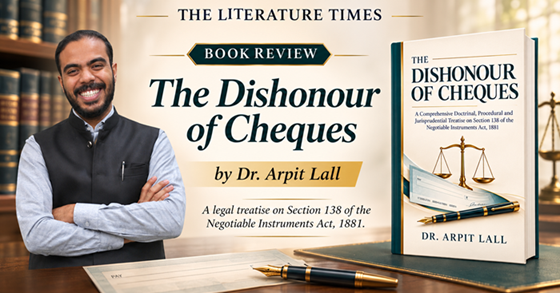
Book Review – The Dishonour of Cheques by Dr. Arpit Lall: Law, Procedure and the Demands of Justice

A comprehensive doctrinal, procedural and jurisprudential treatise on Section 138 of the Negotiable Instruments Act, 1881
Cheque dishonour litigation occupies an unusual position in Indian commercial law. A transaction that may begin as a straightforward promise of payment can develop into a dispute involving contractual liability, statutory compliance, evidentiary presumptions and criminal procedure. The Dishonour of Cheques by Dr. Arpit Lall addresses that complexity through a focused study of Section 138 of the Negotiable Instruments Act, 1881. Rather than treating the provision as a self-contained offence, the book positions it within the larger legal framework governing negotiable instruments, financial obligations and the administration of justice. Its declared ambition is comprehensive, and its most useful contribution lies in drawing doctrinal principles and procedural questions into one organised field of inquiry.
The book is structured in nine parts, an approach well suited to a subject that is frequently encountered in fragments during litigation. For a practitioner, the immediate question may be whether a notice complies with statutory requirements; for a researcher, it may be how judicial interpretation has developed the boundaries of liability. A systematic treatment allows these questions to be understood in relation to one another. By examining legislative history alongside contemporary developments, Lall makes room for both the purpose of the statutory framework and the practical consequences of its application. The result, judging from the described scope, is a reference-oriented work intended to be consulted as well as read sequentially.
An important starting point is the concept of a legally enforceable debt or liability. Questions about the underlying obligation matter because cheque dishonour is not simply an exercise in verifying that a bank returned an instrument unpaid. The character and enforceability of the transaction can become central to the dispute. By addressing that foundation together with the relevant statutory presumptions and the burden of proof, the book brings attention to the relationship between substantive rights and rules of evidence. These are especially significant in cases where the parties disagree about the purpose for which a cheque was issued, the existence of an obligation or the explanation offered in defence.
The discussion of statutory notices and procedural requirements is equally consequential. Section 138 litigation depends upon a sequence of legally significant acts, and errors in understanding that sequence can affect the outcome before the underlying commercial dispute has been fully examined. For advocates handling such matters, procedural precision is not a secondary concern: it is an essential part of legal strategy and case preparation. A work that treats notice requirements, jurisdiction and trial processes together can help readers see why apparently technical questions deserve careful attention. It can also remind non-litigation professionals that the legal effectiveness of a financial instrument depends on more than its form.
Lall also considers individual and corporate liability, a necessary distinction in commercial disputes involving organisations and persons acting on their behalf. These questions are particularly sensitive because identifying a financial obligation does not automatically resolve who may bear legal responsibility for it. The book’s inclusion of corporate liability broadens its utility beyond disputes between individual drawers and payees. It is relevant to legal teams, business advisers and professionals who must understand how organisational roles, financial conduct and statutory proceedings may intersect. Its consideration of jurisdiction complements this focus by addressing where proceedings may properly be brought and pursued.
One of the more practical strengths of the book’s stated design is its engagement with compensation, settlement and insolvency. A cheque dishonour case is not merely a contest over statutory interpretation; it often concerns the real prospect of recovery and the parties’ incentives to resolve a financial disagreement. Settlement raises questions distinct from those that arise at trial, while insolvency can complicate the relationship between individual claims and broader financial processes. By incorporating these topics, the study acknowledges that legal remedies must be understood within the economic circumstances in which disputes arise. This breadth should be useful to readers who need to think beyond a single filing or hearing.
The book draws on significant Supreme Court judgments and recent legal developments, according to its description. That case-law emphasis is important in a field where judicial interpretation shapes the practical understanding of statutory language. It also creates a demanding standard for the reader: legal propositions must be checked against the precise holdings and the current legal position. For that reason, the volume is best approached as a substantial research and practice reference rather than a substitute for verifying applicable legislation, procedural rules and later decisions. Its value rests in helping readers organise issues, identify doctrinal connections and approach the relevant authorities with better questions.
The examination of constitutional considerations and litigation challenges gives the project an additional dimension. The administration of cheque dishonour cases concerns not only the rights of complainants and accused persons but also procedural fairness and the effective functioning of courts. A study that recognises these tensions can encourage more careful thinking about the balance between commercial credibility, enforcement and justice. It is particularly relevant for students and researchers seeking to explore how a frequently litigated statutory provision interacts with wider principles of law. The subject rewards that broader treatment because procedural design and substantive outcomes are closely connected.
The intended readership is therefore appropriately varied. Advocates may turn to the work to frame arguments and anticipate procedural issues; judges and judicial aspirants may use its thematic organisation to revisit governing principles; law students can use it to connect the text of Section 138 with the questions generated by actual disputes. Legal researchers will find its combined doctrinal and jurisprudential orientation especially pertinent, while professionals dealing with financial transactions may gain a clearer sense of the legal considerations surrounding cheque-based obligations. Technical language is unavoidable in a treatise of this kind, but the systematic coverage described suggests an effort to make a dense area navigable.
The Dishonour of Cheques stands out in conception for refusing to reduce its subject to a checklist of offence ingredients or a compilation of isolated rulings. Its emphasis on history, liability, evidence, jurisdiction, trial procedure and resolution reflects the interdependence of the issues that shape cheque dishonour litigation. The book’s ultimate contribution is the coherent framework it offers for understanding a specialised but widely relevant area of Indian law. For readers prepared to engage seriously with its legal detail, Dr. Arpit Lall’s treatise promises a considered guide to the questions that arise when financial commitments become matters of judicial determination.
Amazon Link: https://www.amazon.in/DISHONOUR-CHEQUES-DR-ARPIT-LALL/dp/B0HQDLT1X8