
A psychological reading of fear, interpretation, and self-awareness
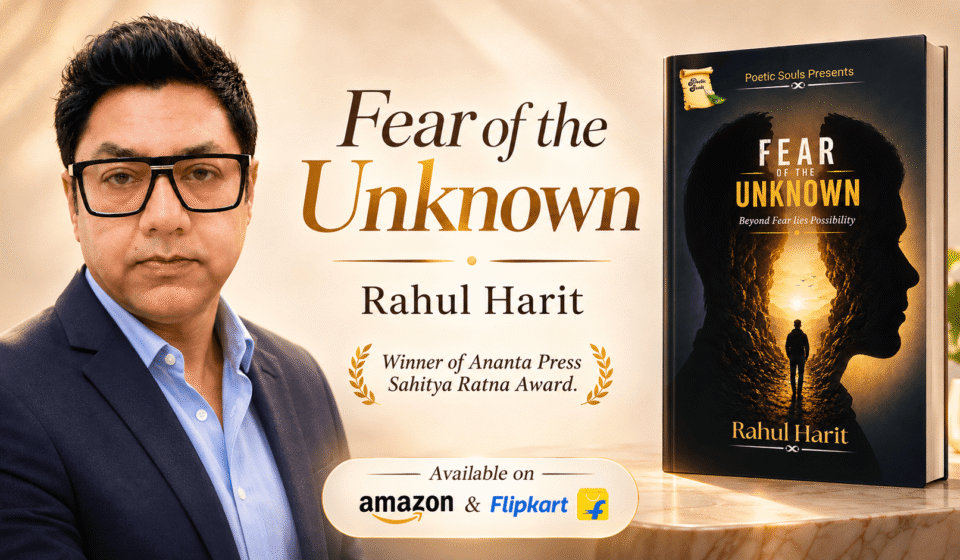
Fear rarely announces itself as an idea. More often, it arrives as a physical sensation, a hurried conclusion, or a story we tell ourselves before we have assembled the facts. A sound in an empty room becomes a presence. An unfamiliar event becomes a threat. A coincidence acquires an ominous meaning. The appeal of Rahul Harit’s Fear of the Unknown lies in its decision to look closely at this overlooked interval between an experience and our interpretation of it. Rather than treating fear only as an obstacle to be conquered, the book’s central inquiry asks how that obstacle was constructed in the first place. It is a compelling starting point for a work positioned between self-help, psychological reflection, and philosophical questioning.
According to the book’s overview, its subjects move from ghosts, black magic, and supernatural forces to God, spirituality, and the mysteries of existence. At first glance, these may appear to be unrelated concerns. Psychologically, however, they are connected by a fundamental human discomfort with incomplete information. We want an explanation, and we want it quickly. When evidence is absent, imagination is ready to supply an answer. That impulse can be useful in ordinary life, where anticipating possible danger sometimes protects us. It can also be costly, especially when the frightening possibility comes to feel more solid than what we actually know. Harit’s focus makes uncertainty itself the object of investigation.
One of the book’s most promising qualities is the distinction it encourages between fear as a feeling and fear as evidence. The fact that a person feels frightened tells us something important about their experience; it does not, by itself, establish that an external danger exists. Such a distinction is easy to express in a calm conversation and much harder to maintain when the mind is racing. The value of a reflective book on this subject is therefore not simply that it can offer reassurance. It can help readers develop a different relationship with their immediate conclusions. Feeling afraid and being correct about the source of danger are two separate questions, and recognizing that separation creates room for thought.
Harit also foregrounds conditioning: the accumulated influence of childhood stories, family conversations, social warnings, cultural assumptions, and repeated explanations. This is a particularly important dimension because no one begins life with a completely independent view of the world. We inherit vocabulary for danger long before we test all the ideas carried by that vocabulary. Consider, for example, the way an ordinary dark corridor can acquire emotional force when it has been associated with frightening stories. The corridor has not necessarily changed, but the person entering it has a mental history. A book that invites readers to examine these learned associations is not dismissing their emotions. It is asking where those emotions learned their language.
The book’s examination of superstition matters for the same reason. A fearful belief may survive not because a person has carefully verified it but because it has been repeated by trusted people. The authority of familiarity can easily be mistaken for the authority of evidence. Fear of the Unknown challenges that confusion without requiring readers to pretend that questions about the universe have all been settled. This is an important balance. Rational inquiry does not demand that every mystery be explained immediately; it asks that the absence of an explanation not be used as proof of the most alarming one. Harit’s emphasis on questioning inherited ideas makes intellectual humility a practical form of courage.
Another strength is the book’s interest in the relationship between thought and lived reality. Thoughts do not have to become supernatural forces to affect a life. They influence what we notice, what we avoid, whom we trust, and which opportunities we regard as safe enough to attempt. A person who consistently imagines humiliation may avoid speaking; one who associates uncertainty with catastrophe may find change exhausting. These examples are not presented as episodes from the book, but they illustrate why its subject reaches beyond the paranormal. The fear of not knowing is also the fear beneath ordinary indecision. Its reach extends into relationships, work, ambition, creativity, and self-esteem.
That breadth gives Fear of the Unknown its relevance within the self-help category. Many motivational books begin by urging the reader to act with confidence. Harit’s premise begins a stage earlier, with the questions that make confidence difficult. What is the feared outcome? Where did the expectation originate? Is it based on direct observation, another person’s warning, or a narrative repeated so often that it now feels unquestionable? These are less dramatic questions than a call to become fearless, yet they may be more sustainable. They replace a demand for instant bravery with the work of understanding. Readers do not need to perform certainty; they can learn to examine uncertainty.
The philosophical strand of the book strengthens the psychological one. Questions about God, spirituality, and the universe test the limits of human knowledge. They also reveal how tempting it can be to close an open question with a confident declaration. A thoughtful approach allows multiple possibilities to remain visible while asking what can reasonably be supported. This does not deprive life of wonder. On the contrary, it makes wonder less dependent on fear. The unknown can invite curiosity rather than obedience. Harit’s central message suggests that the mind becomes freer not when it has an answer for everything, but when it is no longer compelled to fear every unanswered question.
The author’s creative background adds an interesting context to this subject. Harit has worked in theatre, filmmaking, music production, and sound. Those fields rely on the difference between a stimulus and its emotional interpretation: a pause can build suspense, a sound can suggest danger, and framing can conceal information. It would be speculative to claim that specific cinematic techniques structure the book without seeing the full manuscript. Still, his professional experience makes his interest in perception especially understandable. A filmmaker and sound professional knows, in practical terms, that the same event can be experienced differently depending on how attention is guided. The book turns that insight toward everyday consciousness.
Its approach is also notable for what the supplied description does not promise. There is no claim that the reader will receive a scientific diagnosis, an exhaustive account of cognition, or a universal formula that banishes fear. Instead, the emphasis falls on self-inquiry, awareness, and rational thinking. That modesty is part of the work’s potential appeal. A subject as large as fear cannot be reduced to one reassuring slogan. The more useful aim is to help readers notice their mental habits and decide whether those habits deserve continued authority. This is an invitation to participate in the argument rather than accept another set of ready-made answers.
A reader approaching Fear of the Unknown should therefore expect reflection rather than a conventional thriller or a promise of paranormal revelation. The subjects of ghosts and black magic serve an examination of belief, not an excuse for sensationalism. The book’s value is likely to be greatest for readers willing to challenge ideas that feel natural precisely because they have never been questioned. It may be especially engaging for people curious about the psychology of superstition, the boundary between faith and knowledge, and the way personal assumptions can narrow a life. Its accessible premise also offers a starting point for conversations across generations, where inherited explanations often meet new questions.
What distinguishes the project is the direction of its central question. Instead of asking only, “How do I stop being afraid?” Harit asks, in effect, “How did this fear become convincing to me?” That change in emphasis is significant. One question searches for immediate relief; the other searches for understanding that may continue to help long after a particular fear has passed. The most meaningful possibility raised by Fear of the Unknown is not a life free from uncertainty, which no book can guarantee. It is a life in which uncertainty no longer receives automatic permission to control every conclusion. Awareness becomes the first movement toward freedom, and the unknown becomes something a person can investigate rather than merely dread.
Amazon purchase link: https://amzn.in/d/0aluc36w