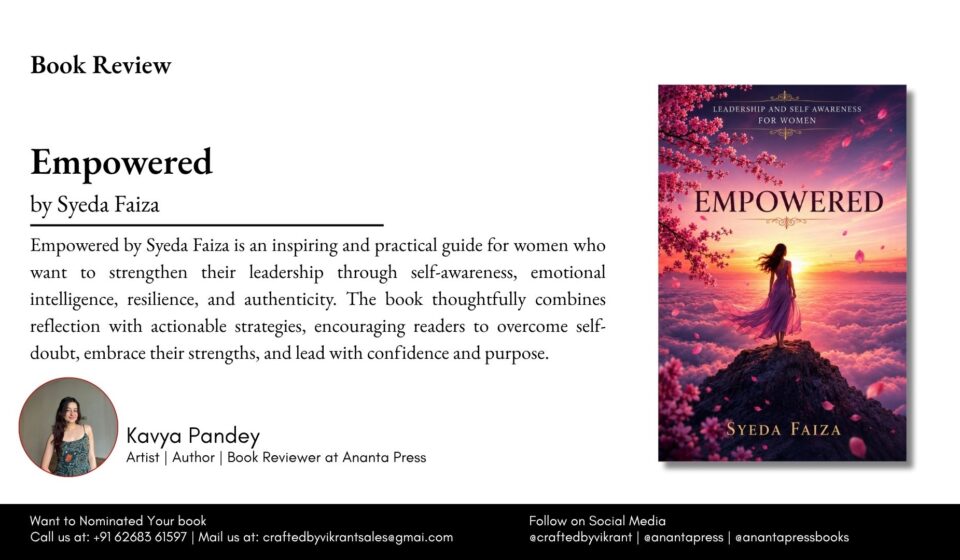

Empowered: Leadership and Self Awareness for Women by Syeda Faiza is an insightful and encouraging exploration of what it truly means for a woman to grow into leadership without losing her individuality in the process. Rather than presenting leadership as a position, designation, or exercise of authority, the book approaches it as a deeply personal journey shaped by self-awareness, emotional intelligence, confidence, resilience, communication, empathy, and continuous growth. From the very beginning, Faiza establishes that meaningful leadership begins internally. Before a person can effectively guide teams, influence organizations, or inspire communities, she must first understand her own values, emotions, strengths, vulnerabilities, and ambitions. This idea becomes the foundation on which the entire book is built.
One of the strongest qualities of Empowered is its thoughtful progression. The book does not rush readers toward conventional ideas of success. Instead, it begins with the fundamentals of leadership and self-awareness before gradually expanding into emotional intelligence, confidence, leadership styles, communication, decision-making, work-life integration, resilience, networking, authenticity, inclusion, and ultimately the creation of a lasting leadership legacy. This structure gives the book the feeling of a complete developmental journey rather than a collection of disconnected motivational ideas. The contents demonstrate a deliberate movement from understanding oneself toward influencing others and eventually preparing future leaders.
The emphasis on self-awareness is particularly valuable. Many leadership books focus first on external skills: speaking effectively, making decisions, managing employees, or setting goals. Faiza takes a different route by asking readers to understand who they are before deciding how they want to lead. This approach is especially relevant to women who may find themselves navigating expectations about how they should behave professionally and personally. Leadership, as presented here, is not about copying a predetermined model. It is about discovering a style that reflects one’s authentic personality, principles, and strengths.
That idea of authenticity gives Empowered much of its emotional depth. The book acknowledges that women can experience self-doubt, imposter syndrome, bias, conflicting expectations, pressure to prove themselves, and the difficulty of balancing ambition with personal responsibilities. Yet the tone does not position women merely as victims of these challenges. Instead, the discussion consistently moves toward awareness, agency, growth, and practical response. The reader is encouraged to recognize obstacles without allowing those obstacles to define her potential.
The sections on emotional intelligence strengthen this message considerably. Faiza explores self-awareness alongside empathy, active listening, and the management of emotions. These topics are important because leadership frequently takes place in emotionally complicated environments. A leader may have to respond to criticism, resolve disagreements, inspire discouraged colleagues, make difficult choices, or continue functioning effectively under considerable pressure. Technical knowledge alone is rarely sufficient in such situations. The ability to understand one’s reactions and recognize the emotions of others becomes equally important.
Another admirable quality of the book is that empathy is not treated as weakness. Instead, it becomes an important leadership capability. In many traditional concepts of leadership, strength can be associated with dominance or emotional distance. Empowered offers a more human model in which listening, understanding, collaboration, vulnerability, and compassion can coexist with decisiveness, ambition, and authority. This creates a much broader and more contemporary picture of what an effective leader can look like.
Confidence is another important thread throughout the book. The discussions around imposter syndrome, acknowledging achievements, identifying strengths, and aligning one’s leadership with personal values are particularly useful because confidence is not portrayed as simply “feeling fearless.” Instead, readers are encouraged to build a more grounded confidence based on self-knowledge. This distinction matters. Sustainable confidence is not created by pretending that uncertainty does not exist; it comes from developing enough clarity about one’s abilities and values to continue moving forward even when doubt appears.
The book also moves beyond internal development into essential professional abilities. Communication receives significant attention through verbal communication, non-verbal communication, and public speaking. Decision-making is similarly approached through models, critical analysis, and creative problem-solving. These subjects make Empowered useful not only as motivational reading but also as a broader leadership-development guide. Readers are encouraged to think about how they communicate ideas, respond to complex circumstances, analyze difficulties, and create solutions rather than merely react to problems.
The discussion of creative problem-solving is especially relevant in rapidly changing professional environments. The book connects creativity with emotional intelligence, resilience, reflection, curiosity, and collaboration. It emphasizes that innovation can require leaders to tolerate uncertainty and view setbacks as opportunities for learning. Reflective tools such as journaling, peer conversations, and coaching are also presented as ways of transforming experience into greater leadership wisdom.
Another area where Empowered distinguishes itself is its treatment of work-life integration, boundaries, self-care, resilience, stress management, and learning from failure. These topics recognize that leadership development cannot be separated entirely from personal well-being. Ambition without sustainable habits can easily become exhaustion. By including boundaries and self-care alongside decision-making and professional communication, Faiza presents leadership as something that must be sustainable rather than merely impressive. The goal is not simply to reach a leadership position but to develop the emotional and personal strength necessary to remain effective within it.
The sections devoted to mentorship and networking are equally meaningful. Faiza reframes mentorship as much more than simply asking an experienced person for advice. Effective mentorship, according to the book, requires listening, thoughtful questions, honest feedback, encouragement, trust, and support for individual self-discovery. Mentors are encouraged to help mentees strengthen confidence and resilience rather than simply instructing them what to do. The book also recognizes mentorship as mutually valuable: mentors themselves can develop fresh perspectives and sharpen their own leadership understanding through the relationship.
This philosophy extends naturally into networking. Empowered rejects the shallow idea that networking means accumulating contacts. Instead, it emphasizes genuine relationships, shared learning, support, and reciprocity. Such an approach is particularly valuable because it transforms professional connection from a transactional activity into community building. Leadership does not need to be a solitary climb. Strong networks can provide perspective during difficult decisions, encouragement during periods of doubt, and opportunities for collaboration and growth. The book describes meaningful networks as relationships rooted in authenticity and mutual support rather than simply professional advantage.
One of the most mature aspects of the book appears in its later discussions of diversity and inclusion. Empowered encourages leaders to create environments where different voices are not merely present but genuinely heard. It discusses inclusive communication, opportunities for quieter participants to contribute, awareness of bias, accessible forms of communication, mentorship, sponsorship, and organizational practices that support belonging. This moves the book beyond individual empowerment. Personal success becomes connected with the responsibility to create opportunities for others.
That transition is important because the strongest leadership philosophy in Empowered is ultimately not about individual status. It is about influence that continues to benefit people beyond the leader herself. This becomes especially clear when the book reaches continuous learning, succession planning, and legacy.
The discussion of continuous learning argues that leadership development never truly ends. Titles and previous accomplishments are not substitutes for curiosity, feedback, reflection, or adaptation. Leaders need to remain willing to examine their communication habits, decision-making patterns, blind spots, and assumptions. The book therefore presents growth as an ongoing practice rather than a stage completed once a person has reached a particular professional level.
Succession planning takes this philosophy even further. Rather than viewing leadership only in terms of what one person accomplishes while holding authority, Faiza asks readers to consider what remains after they leave. Preparing others to lead, transferring wisdom, developing potential, and creating cultures capable of continuing meaningful work become signs of mature leadership. The book describes succession as an act of stewardship and connects it with mentorship, organizational values, and the development of future leaders.
This makes the final emphasis on legacy especially effective. By the later chapters, the journey has expanded considerably: the reader began by examining herself, but she is eventually challenged to think about the people, teams, workplaces, and communities she may influence. Leadership becomes less about occupying a powerful position and more about creating circumstances in which other people can also grow.
For this reason, Empowered can speak to readers at several different stages of their journeys. A young professional beginning to imagine herself as a leader can gain language for understanding confidence, communication, and self-awareness. A woman already managing teams can reflect on emotional intelligence, decision-making, resilience, inclusion, and mentorship. An experienced leader can find value in the book’s discussions of continuous learning, succession, and legacy. The breadth of topics allows readers to return to different sections depending on the challenge they are currently facing.
Perhaps the book’s greatest strength is its consistent reminder that leadership does not require women to become someone else. Growth is necessary, skills can be strengthened, habits can change, and weaknesses can be addressed, but authentic leadership begins with understanding and accepting one’s own identity. Strength and empathy are not opposites. Confidence and vulnerability can coexist. Ambition does not eliminate the need for self-care. Individual advancement can exist alongside mentorship and inclusion. Authority can be exercised while still listening deeply to others.
Overall, Empowered by Syeda Faiza is a substantial and encouraging guide to leadership that places self-awareness at the heart of professional and personal transformation. Its journey from internal reflection to communication, resilience, mentorship, inclusion, continuous learning, and legacy gives the book a clear sense of purpose. Rather than offering only short-term motivation, it invites readers to examine how they think, communicate, respond to challenges, build relationships, support others, and define the kind of influence they ultimately want to leave behind.
For women seeking to develop a leadership style rooted in confidence without arrogance, empathy without weakness, ambition without losing authenticity, and success that extends beyond individual achievement, Empowered offers a thoughtful roadmap. Its central message is compelling: genuine leadership is not simply about reaching the front of the room. It is about knowing yourself well enough to stand there with purpose, understanding others well enough to lead them with empathy, and creating a path wide enough for others to rise after you.