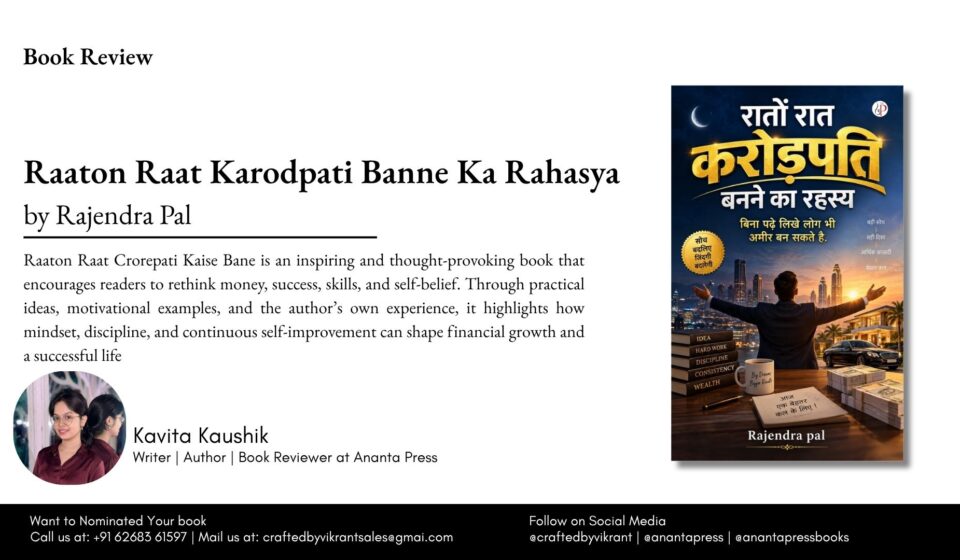

Raaton Raat Karodpati Kaise Bane by Rajendra Pal is a motivational and self-development book that approaches wealth not simply as a matter of income, but as a result of mindset, skill, discipline, courage, and better financial choices. The title may initially suggest a promise of instant riches, yet the deeper message of the book is quite different. Rather than presenting wealth as a miracle that happens overnight, the author repeatedly emphasizes changing one’s habits, learning continuously, building useful skills, saving money, investing wisely, and developing the confidence to take action. This makes the book less about a shortcut to becoming a crorepati and more about transforming the way a person thinks about success and money.
One of the strongest ideas running through the book is the author’s challenge to the conventional belief that formal education alone guarantees success. Rajendra Pal does not dismiss education completely; instead, he argues that a degree has limited value if it is not supported by practical knowledge, useful skills, ideas, initiative, and the courage to take risks. The book repeatedly contrasts academic qualifications with real-world ability and encourages readers to become highly competent in at least one field. This message will connect with readers who feel that their future has been defined too narrowly by marks, degrees, or traditional career expectations. The author’s emphasis on mastery is simple but powerful: learn something you enjoy, become extremely good at it, and make yourself valuable enough that opportunities begin to find you. The book itself prominently presents the idea that becoming wealthy does not necessarily depend on having a degree.
The book also gives considerable importance to self-belief. Several chapters explore the idea that many people are stopped not by a lack of potential but by doubt, fear, comparison, and hesitation. The author presents confidence not as empty positive thinking but as the willingness to continue even when circumstances are difficult. His examples encourage readers to trust their abilities, accept mistakes as part of growth, and keep moving despite uncertainty. This creates an emotional dimension that goes beyond financial advice. The author is essentially saying that money management and career growth cannot be separated from a person’s inner life. Someone who constantly doubts himself, fears failure, or depends entirely on other people’s approval will struggle to act decisively. The book describes self-belief as a deeper inner state rather than merely a motivational slogan.
Another important strength of the book is its focus on persistence. Rajendra Pal describes how enthusiasm is often strongest at the beginning of any journey, but real progress depends on staying committed after the excitement fades. He explains persistence as the ability to stand up again after setbacks rather than the unrealistic belief that a successful person never breaks down. Many people start new businesses, savings plans, skill-building routines, or personal goals with energy, but stop when results are not immediate. The book reminds readers that meaningful success often develops invisibly before it becomes visible. Persistence, in the author’s view, means finding the strength to rise again even after one has been discouraged or exhausted.
This lesson becomes even more effective when the author compares growth with a seed that needs time before it becomes a tree. The image communicates an important truth about success: effort does not always produce visible results immediately. Sometimes preparation, learning, and personal development are taking place beneath the surface. Instead of interpreting tiredness or delayed results as proof that the path is wrong, the book asks readers to develop patience. This approach gives the motivational content more emotional weight because it recognizes that discouragement is a normal part of any meaningful journey.
The author also pays close attention to environment and company. The book suggests that the people around us influence the size of our ambitions, the quality of our decisions, and even our attitude toward learning. Readers are encouraged to stay close to people who push them upward, think bigger, and continue learning. This fits naturally with the book’s larger message: becoming financially stronger is not just about earning more; it is about creating a lifestyle in which growth becomes normal. The author views learning as a form of earning in itself, arguing that people who stop learning gradually fall behind in a changing world.
Where the book becomes more practical is in its treatment of saving and investment. Rajendra Pal clearly communicates that becoming wealthy is not only about how much money a person earns but also about how intelligently that money is used. The financial message toward the conclusion emphasizes saving and investment as essential habits for moving toward greater financial independence. The author even connects these habits with creating income that can continue without depending entirely on daily labour.
This is an important correction to the common belief that a higher salary automatically creates wealth. A person can earn a large amount and still remain financially unstable if spending rises at the same speed. The book therefore encourages readers to examine their financial behaviour rather than simply wishing for more income. That distinction gives the book practical relevance. Wealth, according to its broader philosophy, is not only created by earning; it must also be protected and developed through wiser financial decisions.
A related theme is the difference between being rich and merely looking rich. The author criticizes the tendency to spend money on appearance, status, and outward display simply to impress other people. He presents genuine wealth as quieter, more secure, and less dependent on social approval. The book specifically contrasts the desire to appear wealthy with the behaviour of someone who is genuinely secure in his success.
This observation gives the book an interesting social dimension because it addresses a pressure that many modern readers understand well. In an age of social media, luxury imagery, comparison, and constant public display, it is easy to confuse financial success with the appearance of financial success. Rajendra Pal encourages readers to move away from that trap. In his framework, true prosperity requires self-control, patience, and enough confidence to stop living primarily for other people’s approval.
Entrepreneurship and leadership are also recurring concerns. The book encourages readers not only to work hard themselves but to understand how successful people organize work, collaborate with specialists, and build systems. One of its arguments is that a leader does not have to be the greatest technical expert in every task. A strong leader should instead know how to identify capable people, bring them together, and direct their expertise toward a larger objective. The book uses accessible examples to explain the difference between doing everything personally and learning how to get work accomplished through an effective team.
For readers interested in entrepreneurship, this is a valuable distinction. Many first-time business owners believe that success means personally controlling every small operation. The book instead introduces the idea of leverage and delegation. Even though the discussion is motivational rather than technical, it encourages readers to think like builders of systems rather than only individual workers.
Stylistically, the book is direct, conversational, and energetic. Rajendra Pal often writes as though he is speaking face-to-face with the reader. He asks questions, challenges common assumptions, presents stories, and quickly extracts lessons from those stories. The language is intentionally accessible rather than academic. The aim is not to construct a complex theory of economics or finance but to encourage readers to reconsider familiar beliefs.
Stories, comparisons, motivational statements, and everyday observations keep the discussion moving. Readers who enjoy a personal and spoken style of self-help writing are likely to appreciate this approach because the author rarely creates distance between himself and his audience. He communicates with urgency, as though encouraging a friend to change direction before wasting more valuable years.
At the same time, the book is best understood as a work of motivational financial self-development rather than as a detailed investment manual. Its strongest contribution is encouraging readers to reconsider their relationship with money, education, fear, work, learning, and personal value. Some statements are intentionally bold and provocative. A careful reader may not agree with every generalization, particularly when extraordinary examples of success are used to challenge conventional education or employment. Yet the broader lesson remains meaningful: a qualification by itself is not enough. Practical competence, continuous learning, adaptability, discipline, and action are equally important.
What makes the book memorable is the way it connects external prosperity with internal development. The author repeatedly returns to self-belief, courage, awareness, usefulness, patience, and personal value. Money, in this framework, becomes more than currency. It is connected with the value a person creates and the discipline with which that value is managed.
The book therefore encourages readers to stop chasing money blindly and instead concentrate on becoming more capable, useful, emotionally strong, and financially aware. This makes the message broader than the title suggests. The question is not merely, “How can I become a crorepati?” A deeper question runs through the book: “What kind of person must I become to create and sustain prosperity?”
Another notable quality is the author’s insistence on action. Positive thinking has limited value if it is never followed by decisions. Fear may never disappear completely, and the perfect opportunity may never arrive. Therefore, the reader is encouraged to move forward despite uncertainty. The book repeatedly pushes the audience toward practical change: learn something valuable, improve your environment, save money, invest, control unnecessary spending, take responsibility, and continue when results are slow.
For readers from ordinary or modest backgrounds, this message may have particular emotional appeal. Rajendra Pal presents the starting point of a person’s life as something that does not necessarily determine the final destination. The book challenges the idea that wealth belongs only to people with elite education, exceptional circumstances, or privileged families. Instead, success is presented as a combination of learning, courage, disciplined habits, financial awareness, and sustained effort.
Ultimately, Raaton Raat Karodpati Kaise Bane is an energetic, accessible, and thought-provoking motivational guide for readers who want to reconsider their approach to money and personal progress. Its real value lies less in offering a magical formula for becoming wealthy overnight and more in questioning the behaviours and assumptions that can keep people financially stuck.
Rajendra Pal encourages readers to develop skills instead of depending only on qualifications, to save and invest rather than simply earn and spend, to choose their environment carefully, to keep learning, to persist beyond early excitement, and to build enough confidence to survive criticism and failure. The result is a book that combines financial motivation with personal development in a language designed for ordinary readers.
For anyone beginning a journey toward financial awareness, entrepreneurship, or self-improvement, this book can serve as an encouraging starting point. Its central message is simple but important: lasting prosperity begins long before money appears in a bank account. It begins with the way a person thinks, learns, works, saves, chooses, and continues despite difficulty. That is perhaps the most meaningful “secret” behind the book’s striking title, and it is what gives the book the potential to leave readers with more than temporary motivation.