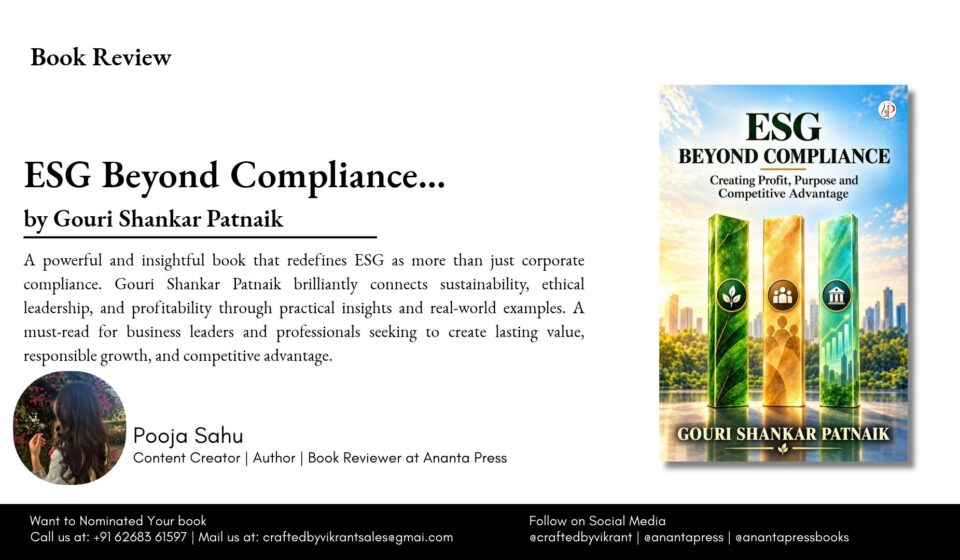
ESG Beyond Compliance… — Creating Profit, Purpose and Competitive Advantage

Author: Gouri Shankar Patnaik Genre: Business Management | Sustainability | Corporate Leadership Review Title: Redefining Business Success Through Sustainability, Responsibility, and Purpose
A Transformative Perspective on the Future of Responsible Business
In an era when businesses are increasingly judged not only by their financial achievements but also by their environmental responsibility, social impact, and ethical conduct, ESG Beyond Compliance…: Creating Profit, Purpose and Competitive Advantage by Gouri Shankar Patnaik emerges as a timely, insightful, and thought-provoking contribution to modern business literature. The book challenges conventional corporate thinking and presents a compelling argument that Environmental, Social, and Governance (ESG) principles should not be treated merely as regulatory obligations but embraced as powerful instruments for innovation, sustainable profitability, organizational excellence, and lasting competitive advantage.
What makes this work particularly valuable is its practical orientation. Rather than discussing sustainability exclusively through theoretical concepts, Patnaik draws upon four decades of professional experience in quality assurance, technology, organizational development, and industrial leadership. His perspective offers readers a meaningful understanding of how responsible business practices can strengthen both organizational performance and broader societal well-being.
The central message is clear: genuine business success is achieved when profitability, purpose, and responsibility work together rather than compete against one another.
Moving Beyond the Traditional Compliance Mindset
One of the book’s greatest strengths is its examination of the difference between regulatory compliance and genuine organizational commitment.
Many companies approach ESG primarily as a reporting requirement, concentrating on documentation, sustainability disclosures, ratings, and regulatory expectations. While these activities remain important, Patnaik argues that they represent only the beginning of meaningful transformation.
The book encourages organizations to move beyond simply meeting minimum requirements and instead integrate sustainability into their everyday decisions, operational processes, leadership philosophy, and long-term strategies.
This distinction becomes particularly powerful because it changes the fundamental questions business leaders ask. Rather than focusing exclusively on regulatory obligations, organizations are encouraged to examine how they can reduce environmental impact, strengthen stakeholder relationships, improve operational efficiency, and create sustainable economic value.
The author effectively communicates that compliance may protect an organization from immediate regulatory risks, but authentic commitment can contribute to innovation, resilience, and sustained market relevance.
This perspective makes the book especially meaningful for executives seeking to transform sustainability from an administrative responsibility into a strategic opportunity.
Building a Strong Business Case for ESG
Patnaik successfully addresses a common misconception: that sustainability necessarily creates additional expenses and reduces profitability.
Through thoughtful explanations and business-oriented discussions, he demonstrates how responsible environmental and social practices can contribute to financial performance.
Initiatives involving energy conservation, waste reduction, resource optimization, improved employee engagement, and ethical governance are presented as opportunities to improve efficiency and reduce long-term business risks.
The book also emphasizes the growing importance of customer trust, investor confidence, corporate reputation, and stakeholder loyalty.
A particularly engaging aspect is its inclusion of corporate case studies involving Unilever, Microsoft, ITC, and Tata Group. These examples illustrate different approaches to integrating sustainability into business strategy, responsible innovation, environmental stewardship, and organizational culture.
By connecting established business practices with ESG principles, the author makes an important subject more accessible to readers who may otherwise perceive sustainability as an abstract or highly specialized discipline.
The discussion reinforces the idea that responsible practices can contribute to stronger organizations while generating positive outcomes for society and the environment.
Environmental Excellence as a Competitive Advantage
The environmental dimension of ESG receives substantial attention throughout the book.
Patnaik explores important topics including energy efficiency, water stewardship, carbon emissions reduction, circular economy principles, and responsible resource utilization.
Instead of presenting these concerns solely as environmental obligations, he examines their connections with productivity, operational performance, and cost management.
This approach is particularly relevant for manufacturing and process industries, where efficient resource utilization can significantly influence both financial and environmental outcomes.
The discussions surrounding waste reduction, sustainable sourcing, greenhouse gas monitoring, and industrial efficiency demonstrate how environmental objectives can be incorporated into existing business improvement systems.
One of the book’s most convincing arguments is that sustainability becomes more effective when organizations recognize its relationship with operational excellence.
Reducing waste, conserving energy, and improving resource efficiency are not merely ecological achievements; they can also represent meaningful improvements in business performance.
Through this practical perspective, Patnaik makes environmental responsibility relevant to managers, industrial professionals, and decision-makers responsible for everyday organizational operations.
Recognizing People as Essential Business Assets
Beyond environmental sustainability, the book provides valuable insights into the social responsibilities of modern organizations.
Patnaik examines employee well-being, occupational safety, diversity, inclusion, community development, and stakeholder engagement as essential contributors to sustainable business performance.
His discussion highlights an important truth: an organization’s long-term success depends heavily on the people who contribute to its operations and the communities affected by its activities.
Businesses that prioritize employee safety, create supportive workplaces, encourage inclusion, and establish meaningful relationships with stakeholders can strengthen organizational trust and commitment.
The author also explores how social responsibility influences employee engagement, talent retention, customer relationships, and corporate reputation.
Rather than presenting these considerations as separate charitable initiatives, the book demonstrates how they can become integral components of business strategy.
This section offers a valuable reminder that sustainable growth cannot be measured exclusively through financial statements. The well-being of employees, communities, customers, and other stakeholders is equally important when evaluating an organization’s broader impact.
Ethical Governance and the Importance of Trust
Another compelling element of the book is its emphasis on governance.
Patnaik convincingly explains that environmental and social initiatives cannot achieve their full potential without responsible leadership, transparency, accountability, and ethical decision-making.
Governance forms the foundation upon which meaningful ESG performance can be established.
The book discusses how strong governance practices help organizations improve credibility, manage risks, strengthen stakeholder confidence, and develop resilient institutional cultures.
Its emphasis on leadership accountability is especially relevant because sustainability cannot be achieved through policies and declarations alone.
Meaningful change requires leaders who demonstrate commitment through their decisions, organizational priorities, performance expectations, and everyday conduct.
The author’s treatment of governance reinforces the understanding that trust is not simply a desirable corporate characteristic. It is a valuable strategic asset that must be developed through consistency, responsibility, and transparency.
Connecting ESG With Quality Management and Industrial Excellence
Perhaps one of the book’s most distinctive contributions is its integration of ESG with established quality management principles.
Drawing upon his professional background, Patnaik explores the relationships between sustainability and Total Quality Management, Lean Management, Six Sigma, continuous improvement, and operational excellence.
This connection provides readers with a practical framework for understanding how ESG initiatives can complement existing organizational systems.
The discussion also introduces relevant international standards, including ISO 9001, ISO 14001, ISO 45001, ISO 50001, and ISO 14064.
By connecting sustainability with familiar management approaches, the author demonstrates that organizations do not necessarily need to treat ESG as an entirely separate operational discipline.
Instead, environmental and social objectives can be incorporated into performance improvement, risk management, production efficiency, and organizational development.
This is especially useful for manufacturing executives, quality professionals, plant managers, and industrial leaders who want to translate sustainability commitments into measurable operational improvements.
The book’s emphasis on practical application helps distinguish it from purely conceptual discussions of responsible business.
From Sustainability Reporting to Meaningful Performance
Another important theme is the difference between measuring ESG activities and delivering genuine results.
Patnaik argues that sustainability reports, although necessary, cannot replace actual organizational progress.
The book explores performance indicators, impact measurement, data integrity, and accountability as essential elements of effective ESG implementation.
This discussion encourages organizations to evaluate tangible improvements rather than relying exclusively on the number of initiatives undertaken or the quantity of information disclosed.
For example, measuring actual reductions in energy consumption, waste generation, or workplace risks can provide a more meaningful indication of performance than simply documenting awareness campaigns.
The author successfully communicates that sustainability should be reflected in organizational outcomes, not merely in presentation materials.
This emphasis on measurable progress adds considerable practical value to the book and strengthens its usefulness as a resource for managers responsible for ESG implementation.
Leadership, Global Standards, and the Future of Sustainability
The book also examines the evolving international ESG landscape, introducing frameworks and reporting systems such as GRI, ISSB, SASB, TCFD, and India’s Business Responsibility and Sustainability Reporting framework.
Patnaik discusses the complexities created by multiple reporting requirements and explores the movement toward greater international harmonization.
Importantly, the book recognizes that different countries and industries have distinct economic, regulatory, and social circumstances. This makes its discussion of global standards more nuanced than a simple call for identical reporting requirements everywhere.
Looking ahead, the author explores the increasing role of artificial intelligence, digital technologies, climate resilience, and data-driven decision-making in sustainability management.
Potential applications involving energy optimization, emissions monitoring, workplace safety, predictive risk assessment, and organizational accountability demonstrate how technology may support future ESG progress.
The book also emphasizes the skills future leaders will require, including ethical judgment, systems thinking, adaptability, digital literacy, and stakeholder engagement.
These forward-looking discussions broaden the book’s relevance beyond present-day corporate challenges.
An Insightful and Practical Contribution to Business Literature
What ultimately distinguishes ESG Beyond Compliance… is its combination of professional experience, strategic thinking, and practical business relevance.
The writing follows a structured progression, beginning with the evolution of ESG and moving through its economic, environmental, social, governance, operational, and leadership dimensions.
The corporate examples, management frameworks, and industry-oriented discussions provide readers with opportunities to connect sustainability principles with real organizational challenges.
The book is particularly strong when explaining how quality management and responsible business practices can reinforce one another.
Although readers seeking a purely academic critique of ESG may desire more extensive examination of competing perspectives and implementation limitations, the book’s principal strength lies in offering a constructive, action-oriented management perspective.
It is therefore well suited to corporate executives, entrepreneurs, sustainability practitioners, quality professionals, manufacturing leaders, management students, and policymakers.
The author succeeds in making ESG understandable not simply as a reporting framework, but as a broader philosophy of organizational responsibility and excellence.
Final Verdict
ESG Beyond Compliance…: Creating Profit, Purpose and Competitive Advantage by Gouri Shankar Patnaik is a valuable and inspiring exploration of what responsible business leadership can mean in the modern world.
The book presents a persuasive vision in which environmental stewardship, employee well-being, ethical governance, customer trust, technological innovation, and profitability are interconnected elements of sustainable organizational success.
Its greatest achievement is encouraging readers to reconsider the relationship between business performance and societal responsibility.
Rather than asking organizations to choose between profitability and purpose, Patnaik presents a framework for understanding how the two can support each other.
With its accessible explanations, practical insights, corporate examples, and emphasis on continuous improvement, the book offers meaningful guidance for professionals seeking to build more responsible and resilient organizations.
More than an introduction to ESG, it is an invitation to rethink the definition of business excellence.
A highly recommended read for leaders, entrepreneurs, and professionals who believe that the future of business belongs to organizations capable of creating profit with purpose, growth with responsibility, and success with lasting positive impact.