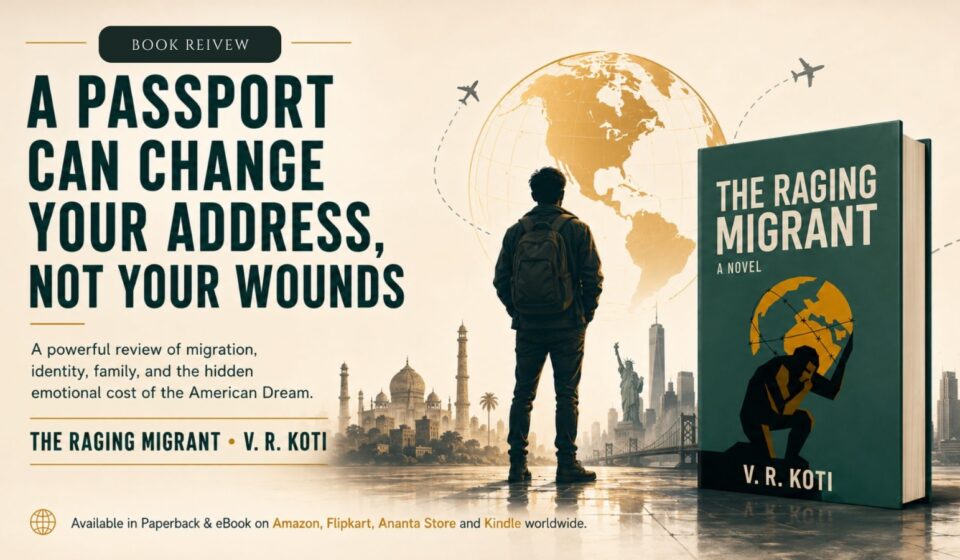

The real migration in this novel is not from India to America; it is from pain to awareness.
The Raging Migrant by V. R. Koti is a literary novel that uses migration as its visible storyline and self-understanding as its deeper destination. It tells the story of Krishna Kant Sharma, known as KK, who moves through family crisis, love, ambition, violence, trauma, and cultural displacement. But the true power of the book lies in the way it turns outward movement into inward questioning. KK travels from one place to another, but every new place forces him to look more closely at what he has carried from the old one.
The novel is structured like an emotional journey. Its chapter titles are not only labels; they are signals of the protagonist’s inner state. Onward or Away? begins with uncertainty. Cities of Contradiction places KK in a world where opportunity and struggle exist together. Where to Now? expresses the confusion of ambition. Borrowed Strength suggests the support systems that help him move forward. Follow Heart or Mind? introduces the conflict between love and practical future. Arrival Without Anchors captures the immigrant’s disorientation. Line Crossed, The Body Never Forgets, Conditional Love, The Cost of Silence, Mediated Meetings, and Holding the Center all point toward a story concerned not just with events, but with meaning.
This structure is one reason the novel deserves attention. Koti is not simply arranging incidents. He is mapping psychological development. Each chapter pushes KK into a new form of awareness. He begins as a young man trying to escape crisis and become useful. He gradually becomes someone who must ask deeper questions about family, love, identity, and moral responsibility. By the end, “holding the center” is not only about managing outer conflict. It is about not falling apart internally.
The first part of the book, Survival, establishes the emotional foundation. KK’s home is marked by his father’s drinking, his mother’s endurance, his grandmother’s blunt wisdom, and a serious family debt. The household is full of love, but also dysfunction. This is a crucial combination. If the family were only cruel, leaving would be easy. If the family were only loving, staying would be easy. The truth is more complicated. KK loves his family and suffers because of it. He wants distance and connection at the same time. That contradiction gives the novel its emotional realism.
The debt owed to Aunt Lakshmi is an effective narrative device because it makes invisible pressure visible. Money becomes a symbol of dependency, shame, and power. KK’s promise to repay the loan and buy back his mother’s jewelry is not just financial ambition. It is a desire to repair dignity. This is why readers can understand his hunger for progress. He is not chasing success only for personal pride. He wants to restore something broken.
The Delhi chapters expand the world of the novel. Delhi is presented as a city of contradictions: crowded, ambitious, harsh, lively, and full of possibility. KK’s friendship with Piyush is especially important. Piyush is well-read, vulnerable, witty, and wounded by his own romantic and social conflict. Through Piyush, KK encounters friendship that is intellectual and emotional. The attack on Piyush becomes one of the book’s major traumatic moments. It exposes violence, helplessness, guilt, and the painful question of what one should do when danger arrives faster than courage.
This question returns throughout the novel. KK repeatedly faces situations where action and restraint both carry consequences. When Mira is harassed, he acts. When violence erupts in America, he must again decide how to respond. In each case, the book does not offer a simple heroic answer. Instead, it examines the moral and physical cost of intervention. This makes the novel thoughtful. Courage is not romanticised. It is tested.
The love story with Mira adds warmth and emotional danger. Their relationship begins with unexpected grace and grows into something deeply meaningful for KK. Mira gives him a sense of being seen. But the relationship also brings conditions, family expectations, secrecy, and a hurried marriage. The novel understands that love can be both healing and destabilising. For KK, loving Mira becomes connected to becoming worthy: more educated, more fit, more successful, more acceptable. This is emotionally powerful because many readers will recognise the pain of feeling loved but not fully accepted as one is.
The sudden marriage at the temple is one of the most memorable developments because it contains devotion and doubt in the same moment. It feels sacred, urgent, romantic, and unstable. The photograph of the wedding becomes a recurring emotional object. It is proof, but not peace. It represents commitment, but also secrecy and unresolved consent from the wider family world. Koti uses this object well. It shows how a single image can carry an entire relationship’s tension.
When KK leaves for America, the novel enters a new phase. Arrival Without Anchors captures the immigrant experience with sensitivity. The new country offers structure, modernity, and opportunity, but KK arrives emotionally unsettled. He carries a secret marriage, family pressure, limited money, memories of violence, and the responsibility of making his journey meaningful. The airport scenes, the customs questions, the food packed by his mother, and the transition into shared student life all create a believable immigrant texture.
The novel’s portrayal of America is balanced. It is not a fantasy land, and it is not only hostile. It contains kindness, systems, danger, loneliness, bureaucracy, education, and cultural difference. KK meets people who help him, but he also faces suspicion and violence. This balance is important because it prevents the novel from becoming propaganda for or against migration. Instead, it becomes a serious exploration of what it means to be displaced and hopeful at the same time.
The post-9/11 atmosphere gives the American section historical weight. The fear and suspicion around identity affect KK directly. A question about religion during a visa process, the anniversary of 9/11, media narratives after violent events, and the general atmosphere of uncertainty all show how global politics enters immigrant life. KK is not only an individual student. He is also read by others through the lens of nationality, race, paperwork, and fear. This is one of the novel’s important social insights.
The chapter The Body Never Forgets deepens the literary quality of the book. Trauma is not treated as a plot device that appears and disappears. It becomes part of KK’s body. Pain, injuries, dreams, anxiety, and physical reactions show that the past continues to act inside the present. This is a mature portrayal. The novel understands that human beings do not move forward in straight lines. They carry imprints. They repeat patterns. They are surprised by memories that return through the body rather than through conscious thought.
Therapy and reflection are important in the later sections because they turn the novel from survival narrative into self-understanding narrative. KK is not merely recovering from events. He is learning to interpret himself. He begins to examine love, anger, family patterns, emotional safety, and negotiation. This gives the book its philosophical dimension. It asks readers not only what happened to KK, but what those events mean.
The phrase Conditional Love is central to the book’s emotional argument. KK has experienced love tied to sacrifice, expectation, family pressure, and performance. His relationship with Mira also becomes shaped by conditions. The novel does not say that all conditions are wrong. Relationships do need boundaries, growth, and mutual responsibility. But it asks when conditions become tests of worth. This question is relevant for families, lovers, and migrants alike.
The Cost of Silence is another key idea. Silence appears in the family, in the marriage, in trauma, in unspoken expectations, and in cultural pressure. Silence protects people temporarily, but it also delays truth. The novel shows that what remains unspoken does not vanish. It returns as misunderstanding, distance, guilt, legal conflict, and emotional pain. This lesson gives the book lasting value. Many readers will see their own lives in it.
Holding the Center, the final movement, suggests maturity. KK cannot control every system or every person. He cannot rewrite his childhood. He cannot fully erase pain. He cannot make love simple by force. But he can learn to stand more clearly inside himself. That is the real achievement of the novel. It is not only about reaching America, finishing education, or resolving a relationship. It is about becoming able to face life without being ruled entirely by fear, guilt, or the need for approval.
The writing style of The Raging Migrant is accessible, direct, and rich in emotional detail. Koti has a talent for using ordinary scenes to reveal larger truths. A family argument, a market encounter, a first aid kit, a train journey, a visa interview, an airport exchange, a hospital recovery, a legal consultation, and a phone call all become meaningful. The book’s realism comes from attention to such details.
The novel’s importance lies in its refusal to give a simple success story. It does not say that migration is wrong. It does not say that ambition is selfish. It does not say that family is only a burden. Instead, it shows how all these forces can be true at once. Migration can be opportunity and escape. Family can be love and wound. Love can be devotion and pressure. Courage can be protection and risk. Healing can require distance and confrontation.
This complexity makes The Raging Migrant a strong work of literary fiction. It speaks to readers who want emotional depth rather than quick entertainment. It is especially meaningful for migrants, students, parents, and young professionals who have felt torn between duty and desire. It will also appeal to readers interested in Indian family dynamics, global mobility, masculinity, trauma, and the personal cost of ambition.
The book is available in paperback and e-book formats, with availability shared through Amazon, Flipkart, Ananta Store, and international channels in 150 plus countries. Its reach matters because the story itself is global. It begins in an Indian home, moves through Delhi, travels to America, and finally rests in the universal human question of how to become whole.
As a final assessment, The Raging Migrant is important because it gives readers a protagonist who is neither a flawless hero nor a passive victim. KK is a person in formation. He makes choices, suffers consequences, learns, fails, loves, protects, doubts, and continues. His journey reminds us that self-understanding is not a sudden revelation. It is a long migration. V. R. Koti has written a novel that asks us to look beyond the visible journey and pay attention to the inner one. That is why this book deserves to be read, discussed, and remembered.