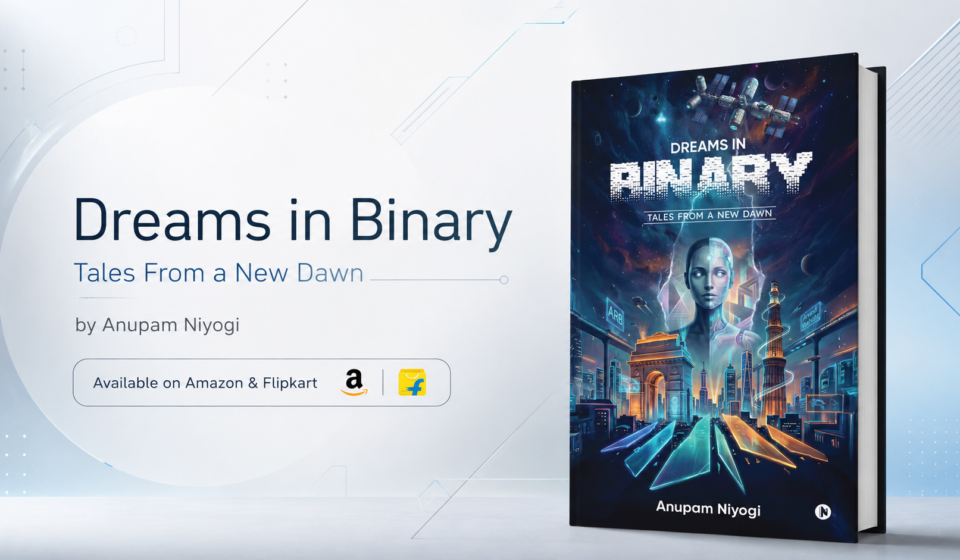

The future has always fascinated us. We imagine intelligent machines, cities illuminated by impossible technologies, colonies beyond Earth and new forms of communication that could overcome distance itself. Yet every vision of the future carries an uncomfortable possibility: humanity may change its surroundings without changing its behaviour.
That tension lies at the heart of meaningful science fiction, and it gives Anupam Niyogi’s Dreams in Binary: Tales From a New Dawn its strongest reason to be read.
The book brings together seven stories that move through time, space and sharply contrasting environments. Its journey begins in places associated with ancient civilisation and travels towards advanced speculative worlds and outer space. Despite that enormous geographical and imaginative range, the stories remain grounded in recognisable social and emotional conflicts.
Not Just Stories About Tomorrow
The title Dreams in Binary creates an immediate contrast.
“Dreams” suggest imagination, longing, memory and emotion. “Binary” suggests systems, calculation, code and technological order. Placing these ideas together raises a compelling question: Can human dreams survive when existence is increasingly interpreted through data, machines and programmed decisions?
The title may also be read as a reflection of how society divides complex realities into simplified opposites: right or wrong, normal or abnormal, loyal or disloyal, human or machine. Yet identity and morality rarely fit comfortably into two fixed categories.
This is where the collection’s engagement with subjects such as homophobia and identity becomes important. Prejudice often depends on binary thinking. It asks people to conform to one accepted definition while treating every variation as a threat. Science fiction can challenge this thinking by creating worlds in which the familiar categories themselves no longer apply. The reader must then decide whether humanity will expand its moral imagination as quickly as it expands its technology.
From Varanasi to the Emptiness of Space
The range of settings described in the book is one of its most distinctive attractions. Few images could be more different than the crowded, ancient ghats of Varanasi and the silent emptiness of outer space. One is filled with ritual, history, mortality and generations of human memory. The other evokes isolation, uncertainty and the possibility of beginning again.
According to published descriptions, the stories move between these environments while combining imaginative futures with hard-hitting social realities.
That movement gives the collection a strong conceptual foundation. The future is not portrayed as something disconnected from history. It emerges from history. Every invention, political structure and social rule carries the influence of what came before it.
A futuristic civilisation may possess extraordinary scientific knowledge while remaining trapped by ancient prejudices. A journey into space may expand physical boundaries while revealing emotional emptiness. A technologically advanced society may claim to be rational while repeating the hypocrisy and violence of earlier generations.
The book therefore appears to ask not whether humanity can reach the future, but whether it deserves the future it is creating.
The Value of Seven Different Perspectives
A collection of seven stories gives the author room to explore an idea from multiple directions. One narrative may focus on personal identity, while another examines collective violence. One may use technology as a source of hope; another may present it as a tool that exposes human weakness.
This variety prevents the book’s central concerns from becoming a lecture. Social issues can easily feel predictable when they are explained only through argument. Fiction works differently. It allows readers to experience the consequences of an idea through characters, decisions and conflict.
Instead of simply declaring that war is futile, a story can show what remains after victory has lost its meaning. Instead of defining moral hypocrisy, it can place a character in a situation where public virtue and private behaviour collide. Instead of discussing identity in abstract language, it can make readers feel the cost of being misunderstood or rejected.
That emotional dimension is essential. Readers rarely remember a message merely because it was correct. They remember it because a character made the message personal.
Entertainment With a Moral Pulse
A socially aware book does not have to sacrifice entertainment. In fact, imaginative storytelling can make difficult themes more engaging. The official overview describes the stories as gripping, grounded and thought-provoking while also presenting them as accessible to a broad readership.
The promise of a “roller-coaster ride through time and space” suggests shifts in pace, setting and emotional tone. Readers are not being invited into seven versions of the same narrative. They are being offered multiple journeys united by a common concern for the direction of humanity.
This makes the collection suitable for several types of readers. Science-fiction enthusiasts may be drawn to the speculative environments and advanced technologies. Literary readers may respond to the social questions and moral conflicts. Younger readers may appreciate the shorter format, while book-club members may find considerable material for discussion.
Questions naturally emerge from the premise:
Can technology solve a problem created by prejudice?
Does progress have meaning without empathy?
Is war still presented as honourable when viewed from the perspective of its victims?
Can an individual preserve identity in a society demanding conformity?
What happens when machines behave logically but human beings behave cruelly?
A book that encourages such questions continues working in the reader’s mind after the final page.
Why Indian Speculative Fiction Needs Greater Visibility
The book’s Indian geographical and cultural grounding also matters. Global popular culture frequently presents the future through a limited set of cities and societies. New York, London, Los Angeles and other Western urban centres repeatedly become the default locations of imagined technological change.
But India offers its own powerful landscape for speculative fiction. It contains ancient traditions, rapidly changing cities, scientific ambition, economic contrast, spiritual inquiry and complex debates about identity and social belonging. A story that connects Varanasi with futuristic technology does more than create visual contrast. It suggests that the future can be imagined from an Indian cultural position rather than imported from somewhere else.
This perspective deserves greater visibility. The future will not be experienced in the same way by every society. Technology will interact differently with local histories, beliefs, inequalities and relationships. Indian speculative fiction can explore these tensions with an intimacy that externally constructed narratives may lack.
Dreams in Binary contributes to that broader imaginative space by refusing to choose between cultural history and futuristic possibility.
Why It Deserves a Place on Your Reading List
The book is especially worth considering for readers who believe science fiction is only about complicated scientific explanations. Its central concerns are distinctly human. The machines, imagined worlds and distant locations operate as lenses through which familiar problems can be examined more clearly.
It is also a practical choice for readers rebuilding their reading habit. At 208 pages and divided into seven stories, it can be approached gradually. Each narrative provides a fresh beginning, making the collection easier to enter than an extremely long speculative novel.
Above all, it deserves to be read because it appears willing to disturb comfortable assumptions. It recognises that innovation alone cannot rescue humanity. The future will only become better when our ethics develop alongside our inventions.
The true meaning of a “new dawn” is therefore not merely the arrival of new technology. It is the possibility of greater understanding. It is the hope that people might finally examine the prejudices, wars and hypocrisies that have followed civilisation across centuries.
Seven stories may not resolve those problems. They can, however, make readers look at them differently. That is one of fiction’s most valuable achievements.
Dreams in Binary: Tales From a New Dawn invites readers to travel across worlds, but its ultimate destination may be much closer: the uncomfortable territory of the human conscience.
Book details: Written by Anupam Niyogi and published by Notion Press, the paperback edition is listed as a 208-page English work of fiction with ISBN 9798902077381. It was published on February 10, 2026.
Buy the book: Dreams in Binary: Tales From a New Dawn on Amazon