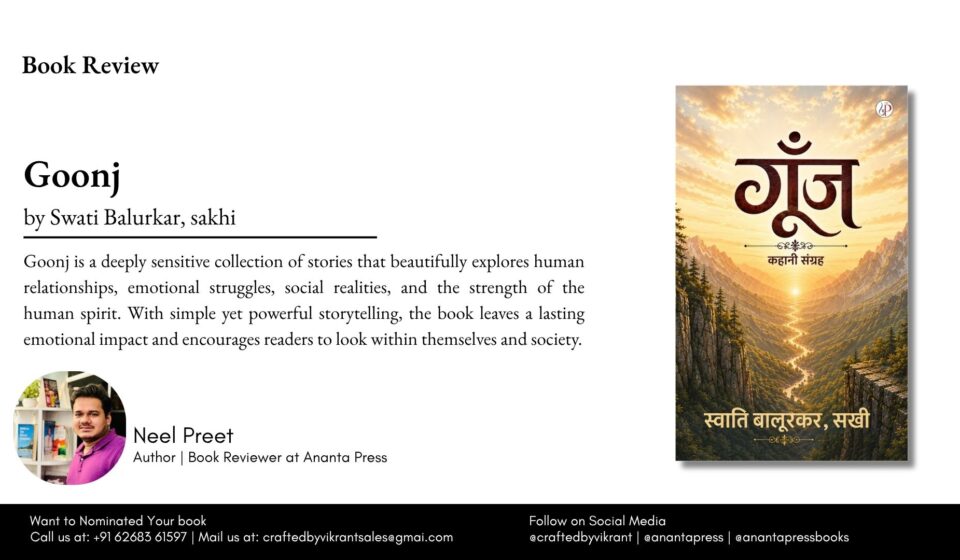

Goonj is a sensitive and thought-provoking collection of Hindi stories that explores the many shades of human life, emotions, relationships, struggles, and social realities. The book brings together stories that are not merely meant to entertain the reader but also encourage reflection on the circumstances, choices, and emotions that shape human lives. Through simple yet expressive storytelling, the author succeeds in creating situations that feel familiar, believable, and emotionally engaging.
One of the most striking qualities of Goonj is its strong connection with ordinary human experiences. The stories touch upon issues that exist around us but often remain unnoticed. The characters come from different walks of life, and their experiences reveal the complexities of relationships, responsibilities, hopes, disappointments, and survival. The author observes these realities with sensitivity and presents them through narratives that are accessible and engaging.
The emotional depth of the collection is particularly noteworthy. Many of the stories revolve around individuals who are facing difficult circumstances, yet their struggles are presented with humanity rather than judgment. The reader is encouraged to understand the emotions behind their actions and circumstances. In this way, Goonj becomes more than a collection of fictional narratives—it becomes a reflection of the emotional realities that exist within society.
The book also demonstrates considerable variety in its storytelling. The author does not rely on a single narrative technique. Some stories use a straightforward style, while others experiment with devices such as diary entries and flashbacks. The story Kabhi Kisi Ko Mukammal Jahan Nahin Milta, for example, makes effective use of diary and flashback techniques, adding depth to its narrative structure. Stories such as Facebook Friend and Sauda are notable for their unexpected conclusions and surprising climaxes, which keep the reader engaged until the end.
Another strength of Goonj is the author’s ability to combine emotional storytelling with social observation. The book does not present society as something distant or abstract. Instead, social problems emerge naturally through the lives of the characters. Their personal difficulties often reveal larger issues concerning family, financial hardship, social expectations, human vulnerability, and the struggle for dignity.
One particularly moving aspect of the collection is its portrayal of economic hardship and family responsibilities. In one story, a young woman is confronted with the painful reality of having to protect her hard-earned money from her father’s addiction. Her emotional outburst reflects not only anger but also helplessness, responsibility, and the pain of seeing one’s family suffer despite one’s efforts. Such moments give the stories a strong emotional authenticity.
The author’s understanding of human relationships is another important feature of the book. Relationships in Goonj are not shown as perfect or uncomplicated. They contain affection, misunderstandings, sacrifice, disappointment, dependence, and unexpected support. This realistic portrayal makes the characters relatable. Readers may recognize fragments of their own experiences, or those of people they have encountered, in these stories.
The book also pays attention to the idea of hope. Even when characters face difficult situations, the narratives often leave room for compassion and human goodness. One of the stories presents a deeply moving idea in which a character begins to see divine presence through the people who come forward to help during difficult times. The emotional conclusion connects faith with human kindness, suggesting that goodness can sometimes appear through ordinary people.
This element of compassion gives Goonj an especially warm dimension. The book recognizes that life can be harsh, but it also reminds readers that human beings can become sources of strength for one another. Help, empathy, friendship, family bonds, and unexpected acts of kindness become important emotional threads within the stories.
The author’s journey toward Hindi storytelling also adds an interesting dimension to the collection. The author’s earlier writing was largely in Marathi, while Hindi poetry was also part of the creative journey. The decision to write a Hindi story and eventually develop a Hindi collection reflects a meaningful literary transition. This background helps explain the sincerity with which the stories are presented and the author’s evident interest in communicating with readers through Hindi literature.
From a literary perspective, Goonj benefits from its diversity of subjects and narrative forms. The stories do not follow a repetitive pattern. Some depend heavily on emotional situations, while others build curiosity and suspense. The use of unexpected endings gives several narratives an additional layer of interest. This variety ensures that the collection remains dynamic and prevents the reading experience from becoming monotonous.
The language and presentation are also among the strengths of the book. The writing remains approachable, allowing readers to connect with the characters without being overwhelmed by unnecessarily complicated expression. At the same time, the author creates emotionally powerful situations through dialogue and characterization. The conversations often reveal the inner condition of the characters more effectively than lengthy descriptions could.
A particularly effective feature is the way ordinary situations are transformed into meaningful literary moments. A financial difficulty, a family disagreement, a personal disappointment, an unexpected friendship, or a moment of assistance can become the central point of a story. This ability to find significance in everyday experiences is one of the qualities that makes the collection engaging.
The stories also invite readers to think about the difference between appearances and reality. People are often more complicated than they seem, and circumstances can influence their choices in ways that are not immediately visible. By allowing readers to experience situations from the characters’ perspectives, the book encourages empathy rather than quick judgment.
The title Goonj itself can be understood beautifully in relation to the collection. The stories seem to create an emotional resonance that continues even after a particular narrative has ended. Their situations, questions, and emotions remain in the reader’s mind. In this sense, the stories create their own kind of “echo”—an emotional Goonj that continues within the reader.
Another important aspect is the balance between realism and imagination. While many stories are grounded in recognizable social situations, the collection also explores psychological and supernatural dimensions. One of the narratives, for instance, creates a psychological/supernatural mystery connected with unfulfilled physical desires and their tragic consequences. This demonstrates the author’s willingness to experiment with different genres and emotional registers.
The book therefore offers something to different kinds of readers. Those who enjoy emotional fiction may appreciate its sensitive treatment of relationships. Readers interested in social themes will find plenty to reflect upon in its depiction of everyday struggles. Those who enjoy suspense may be drawn to stories with unexpected climaxes, while readers interested in literary experimentation may appreciate the variety of narrative techniques.
Perhaps the greatest achievement of Goonj is that it does not attempt to provide easy answers to complicated human problems. Instead, it presents situations and allows readers to experience them emotionally. The stories encourage us to pause and consider the people around us—their struggles, their hidden pain, their choices, and their hopes. This approach gives the book a humane and reflective quality.
The collection also highlights the strength of women and families in difficult circumstances. Characters are often required to make difficult decisions while carrying emotional and practical responsibilities. Their struggles are not presented merely as obstacles but as experiences that reveal courage, resilience, and emotional strength.
At the same time, Goonj does not reduce its characters to symbols of social problems. They remain individuals with their own personalities, emotions, weaknesses, and desires. This makes the narratives more convincing. The reader can sympathize with them because they feel like people rather than constructed literary figures.
Overall, Goonj is a meaningful and emotionally engaging collection of stories. Its greatest strength lies in its sensitivity toward human emotions and its ability to discover powerful stories within ordinary life. The combination of social realism, emotional depth, varied storytelling techniques, psychological elements, and unexpected endings makes the collection distinctive.
The book is especially successful when it allows a small personal experience to reveal a larger truth about life. Whether it is the pain of financial hardship, the complexity of relationships, the disappointment of unmet expectations, the mystery of human psychology, or the comfort found in unexpected kindness, each narrative contributes to the larger emotional landscape of the collection.
Goonj is therefore a book that can be read not only for its stories but also for the feelings and questions that remain after the stories are finished. It reminds us that behind every person is a story that may not always be visible on the surface. It encourages compassion, reflection, and a deeper understanding of human experiences.
In conclusion, Goonj is a thoughtful collection that successfully combines entertainment with emotional and social reflection. Its diverse narrative styles, memorable situations, relatable characters, and surprising conclusions make it an engaging read. Most importantly, the stories leave behind an emotional resonance that stays with the reader long after turning the final page. For readers who appreciate sensitive storytelling, human emotions, social realities, and meaningful narratives, Goonj is a collection worth reading.