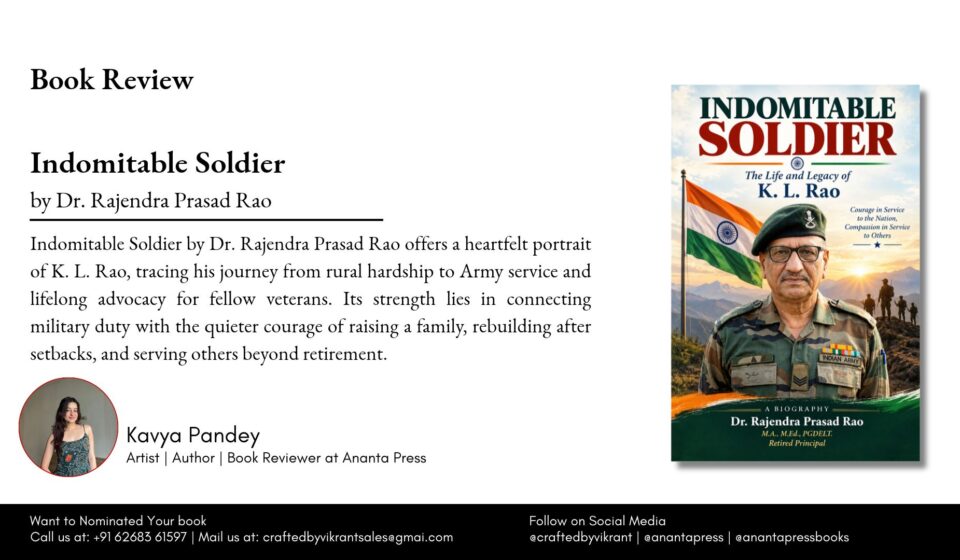

by Dr. Rajendra Prasad Rao
Indomitable Soldier: The Life and Legacy of K. L. Rao by Dr. Rajendra Prasad Rao is an affectionate and inspiring biography that explores the many forms courage can take across a lifetime. Following Kadam Linga Rao from his rural childhood through military service, family responsibilities, civilian employment, and veterans’ welfare work, the book presents perseverance as a daily practice. Its central strength is the attention it gives to the responsibilities that continue after a soldier leaves the Army. Through this wider perspective, the biography becomes a meaningful account of service, sacrifice, and the determination to remain useful to others despite personal hardship.
The narrative begins in Yedapally, in the Nizamabad district of Telangana, where Rao grows up in a farming household with limited resources and considerable family responsibilities. These early chapters establish the practical circumstances behind his later decisions. His father’s agricultural work and employment at the Bodhan Sugar Factory illustrate the effort required to sustain a large family. His mother’s care and endurance contribute another important influence. The author places Rao within this network of relationships, showing how responsibility, cooperation, and respect for work develop through everyday experience. This grounding gives the biography an emotional foundation that extends beyond its military subject.
One of the most relatable aspects of Rao’s early life is the interruption of his education because of financial difficulties. Having completed his Pre-University Course, he wishes to study further, but his family cannot support that ambition. The disappointment becomes an important turning point. His subsequent search for employment reflects both necessity and initiative, making his entry into the Army understandable in personal and economic terms. The biography is effective here because it connects aspiration with circumstance. Readers can recognise the experience of having to revise a cherished plan while continuing to search for a worthwhile future.
Rao’s recruitment into the Indian Army in September 1969 begins the next major stage of his development. His appointment as a clerk in the Signals Department introduces him to an institution demanding accuracy, discipline, adaptability, and collective responsibility. The account of his training and early assignments emphasises learning through experience. Although his formal education has ended earlier than intended, his professional growth continues. This theme gives the book particular value for younger readers facing uncertainty about their own opportunities. Rao’s progress suggests that an interrupted educational journey can still lead to meaningful learning, useful skills, and a strong sense of purpose.
The chapters concerning his service during the 1971 Indo-Pakistani War provide some of the biography’s most affecting material. The account describes Rao helping carry wounded soldiers to ambulances and donating blood for the injured. These actions give the book’s discussion of courage a concrete human focus. Rather than depending entirely on declarations of patriotism, these passages show service through physical effort and concern for suffering comrades. The wounded men become the immediate reason for action. This emphasis on assistance and compassion makes the wartime narrative moving and reinforces the idea that military duty includes a profound responsibility towards fellow human beings.
The biography also gives attention to the experience of Rao’s wife, Susheela Devi. Their marriage begins shortly before the war, and the separation that follows introduces uncertainty into their early life together. Her presence broadens the emotional scope of the narrative. Military service affects the people waiting at home as well as those carrying out assignments, and the book repeatedly acknowledges that shared burden. The account of their relationship contributes warmth to a story otherwise shaped by demanding responsibilities. It also helps readers appreciate the patience and emotional endurance required to build a family around the changing conditions of Army life.
Fatherhood gradually becomes one of the strongest forces guiding Rao’s choices. His concern for his children’s education carries particular weight because his own studies were restricted by financial hardship. The biography establishes a clear connection between that earlier disappointment and his determination to create better opportunities for the next generation. His eventual decision to leave the Army brings this commitment into sharp focus. The choice involves uncertainty about income and employment, yet he gives considerable importance to educational continuity. These passages are compelling because they reveal how deeply personal ambitions can be transformed into hopes for one’s children.
The account becomes especially engaging when it follows Rao into civilian life. His departure from military service does not produce an immediate period of security. Instead, he encounters financial pressure, disappointing employment prospects, and the difficulty of establishing a dependable livelihood. This part of the biography gives substance to its title: his determination must survive repeated practical setbacks. The narrative recognises that military experience, however valuable, does not automatically remove the challenges of civilian adjustment. By including these struggles, the author presents a fuller picture of the person behind the uniform and draws attention to experiences that can receive less public recognition.
Rao’s efforts to earn a living through a general store, cinema management, physical education teaching, and later work at Bharat Petroleum Corporation Limited demonstrate his willingness to adapt. These occupations differ considerably, but the responsibilities behind them remain consistent. He needs to support his household and keep his children’s future within reach. The sequence gives the book an accessible sense of persistence: when one possibility fails, he looks for another. His dignity emerges through that readiness to work. Readers may find these chapters particularly encouraging because the progress they describe depends on repeated effort, patience, and acceptance of unfamiliar responsibilities.
The discussion of his serious illness adds vulnerability to this portrait of endurance. Having spent years supporting others, Rao himself requires treatment, assistance, and reassurance. The change reveals how quickly an apparently stable life can become uncertain. His recovery brings relief, but the episode also gives greater significance to the family relationships developed throughout the narrative. Strength becomes something shared among people who depend on one another. The biography benefits from including this difficult period because it allows its subject to appear as a person whose resilience includes needing help and receiving care, alongside his capacity to provide for others.
The later chapters on veterans’ welfare are among the book’s most meaningful contributions. Rao’s involvement with the Zilla Sainik Welfare Association in Nizamabad shows his administrative experience finding a continuing social purpose. Helping former servicemen pursue benefits, approach officials, and navigate procedures gives his commitment a practical expression. The proposed canteen, association building, and residential plots represent concerns closely connected to everyday dignity and security. Through these efforts, the biography expands its understanding of service. Rao’s concern for fellow veterans continues into the years when his own military career has already become part of the past.
Particularly affecting is the account of his continuing efforts over problems involving residential plots allotted to ex-servicemen. The book presents an unresolved concern that still requires attention, patience, and repeated approaches to authorities. This unfinished element lends the conclusion emotional force. Rao’s legacy is shown through work that remains demanding, without the reassurance of a complete resolution. His persistence in old age encourages readers to consider what recognition for veterans should mean in practical terms. Respect acquires substance when people can access their entitlements, receive assistance with grievances, and live with the security their service was intended to help provide.
The author’s prose is straightforward, accessible, and openly appreciative of its subject. Short sections and explanatory passages make the sequence of events easy to follow. The tone reflects the book’s purpose as both a biography and a record of family memory. Its closeness to Rao gives the narrative warmth, particularly when describing educational hopes, marriage, employment, and recovery. The author also states that the account relies primarily on Rao’s recollections, with assistance from family members. That acknowledgement helps readers understand the perspective from which the story is told and the personal nature of the material being preserved.
There are limitations to this admiring approach. Ideas about courage, discipline, responsibility, and perseverance recur frequently, sometimes repeating lessons that the events have already made clear. A tighter treatment could have allowed certain incidents to carry more of their own meaning. Readers seeking a detached assessment or extensive historical documentation may also wish for a broader range of perspectives. Nevertheless, the book’s emotional purpose remains consistent. It aims to preserve an individual life and communicate the values the author finds within it. Its strongest passages achieve that purpose through specific decisions and experiences, where Rao’s character becomes visible in action.
Ultimately, Indomitable Soldier succeeds as a sincere portrait of a man whose commitment to responsibility continues across changing circumstances. Its appeal rests on the connection between public service and private sacrifice: helping wounded soldiers, supporting children, rebuilding a livelihood, recovering from illness, and standing beside fellow veterans. These experiences give the biography a human relevance beyond military history alone. Readers interested in personal resilience, family legacies, and the lives of former servicemen will find much to appreciate. The book leaves a lasting impression of courage sustained through ordinary duties, difficult choices, and an enduring willingness to help others.