
A literary review of learning through story
An alphabet can be presented to a child as a sequence to memorize, or it can be presented as a collection of doors waiting to be opened. Ojas Bansal’s Ojas Alphabet Tales belongs to the second approach. The supplied description presents a 34-page illustrated book in which letters are connected with imaginative storytelling, lively characters, vocabulary challenges, and interactive quizzes. That combination is significant because it shifts the purpose of an alphabet book from recognition alone toward curiosity. The child is not simply asked to identify a symbol; the child is invited to wonder what that symbol might lead to. As a concept for readers aged five and above, it offers an appealing answer to a familiar educational question: how can early literacy feel more like discovery than duty?
The strongest promise of the book is its effort to connect learning and narrative. Letters are abstract marks until children begin to associate them with words, situations, characters, and feelings. A story provides those associations with a sense of movement. Instead of learning vocabulary as unrelated items, young readers can meet words as part of an imaginative experience. This matters because a word encountered in a meaningful context can be easier to talk about, remember, and use. The approach is especially suitable for children who enjoy being read to but hesitate when an activity is presented as a formal lesson. The storytelling framework gives their interest somewhere natural to begin.
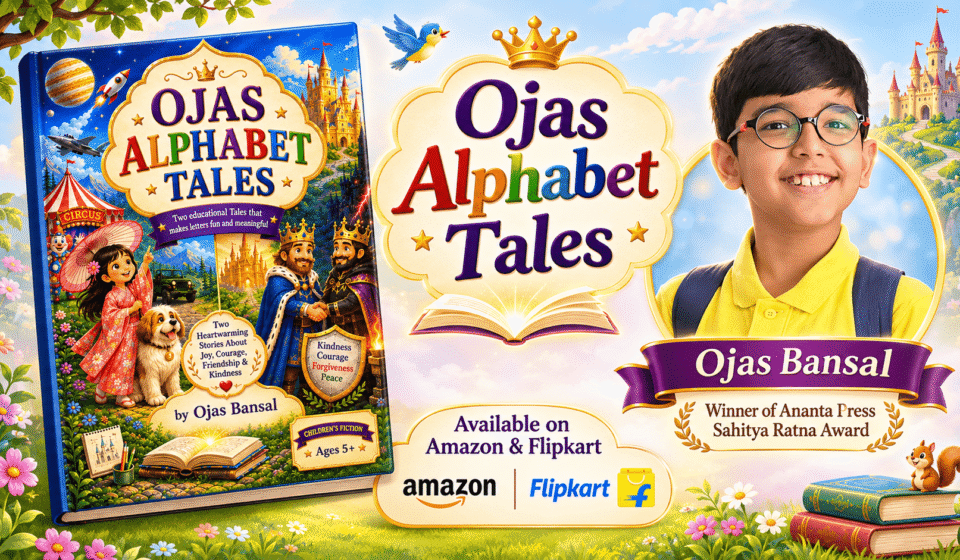
The cover makes this intention visible before the first page is turned. Its world is crowded with the ingredients of childhood wonder: a faraway planet, a rocket, a castle, a circus, bright crowns, a friendly dog, and a glowing open book. These are cover motifs, not evidence of particular episodes inside the story, yet they communicate the range of possibilities the title promises. Science-fiction imagery sits comfortably beside fairy-tale fantasy. The letters themselves appear grand, colorful, and theatrical. For a child discovering the book on a shelf, that visual language says that reading is not confined to one kind of adventure. It can travel from the ordinary to the extraordinary in a single imaginative leap.
The educational design, as described, also has a useful rhythm. Storytelling supplies enjoyment; vocabulary challenges invite attention to language; quizzes invite the child to respond. These components create a progression from listening to noticing and then to participating. The last step is particularly important. Children often need opportunities to test their understanding without feeling that they are sitting an examination. A short question asked in a playful atmosphere can turn into conversation: What happened? Why might a character act that way? Which new word was especially interesting? What might happen next? When activities remain light and age-appropriate, participation becomes a continuation of the reading experience rather than a break from it.
The title also draws attention to a valuable connection between language and imagination. Early reading is often assessed through visible milestones: naming letters, recalling sounds, recognizing familiar words, or answering questions correctly. These milestones matter, but the internal experience of a reader matters too. A child who expects books to offer surprise, warmth, and enjoyment is building a relationship with language that can outlast an individual lesson. Ojas Alphabet Tales appears designed with that relationship in mind. Its ambition is not merely to explain an alphabet, but to make the alphabet feel worth exploring.
Its compact length deserves a measured appreciation. At 34 illustrated pages, the book is positioned for manageable reading sessions rather than prolonged concentration. For many five-year-olds, short sessions offer opportunities to revisit material without fatigue. The real test of such a format is not how much information can be squeezed into each page, but how carefully each idea is presented. A brief story can make a vivid impression if it allows room for pictures, questions, and emotional connection. Likewise, a vocabulary challenge can be effective when it encourages a child to think rather than forcing a long list of definitions. The described blend of formats suggests an awareness that young readers benefit from variety.
There is also a thoughtful social dimension in the values highlighted by the summary. Curiosity, courage, kindness, friendship, and family are not separate from literacy; they can become the reasons a child wants to discuss what has been read. Stories about bravery invite questions about fear. Stories about friendship can help children name what loyalty or consideration means. Family-centered moments can connect a fictional adventure to familiar relationships. In this way, the book’s proposed educational value extends beyond the mechanics of reading. Language becomes a tool for speaking about choices and emotions, and that is one of the most rewarding uses of stories for young children.
A distinctive part of this project is the young author behind it. Ojas Bansal is described in the supplied biography as an eight-year-old writer who has published fifteen books. That fact should not be used as a substitute for evaluating the book itself, yet it gives the project an unusual context. A young storyteller is creating material for readers who are close to his own imaginative world. His experience demonstrates that children can be creators of stories as well as audiences for them. For parents and educators, that example may open a conversation about the difference between reading a story and thinking of one to write. It may encourage a child to illustrate a new alphabet adventure or invent a character of their own.
An effective review must also distinguish an attractive premise from details that require direct examination. The description establishes the presence of illustrated storytelling, vocabulary work, and quizzes, but it does not provide the complete interior of Ojas Alphabet Tales. It would therefore be inaccurate to claim that every exercise has been tested, that particular stories have a specific plot, or that the difficulty level has been verified page by page. Those are questions parents and teachers can consider when they use the book. Are the words appropriate for the child’s current level? Do the questions prompt genuine thinking? Is there enough visual space to follow the story? The concept provides strong reasons to look closely, without making those unseen details up.
What the available material does support is a clear and appealing educational philosophy. Reading becomes more inviting when discovery, play, and meaning are joined. Rather than separating vocabulary from storytelling or treating character values as a separate lecture, the book aims to let these experiences support one another. The result is a format that could work well as a shared reading activity, a playful supplementary resource, or a starting point for classroom discussion. Its colorful fantasy presentation may particularly attract readers who respond to visual storytelling and energetic worlds.
The most memorable quality of Ojas Alphabet Tales is thus its underlying invitation. It asks children to see letters not simply as objects to be correctly named, but as beginnings: beginnings of words, questions, conversations, and invented worlds. In a culture where learning can sometimes be reduced to quick answers, that is a generous ambition. A child who leaves a reading session wanting to ask one more question or imagine one more scene has gained something valuable, even before every new word is mastered. On the strength of its stated design and energetic cover, this is a promising example of how an introductory literacy book can present education as an adventure shaped by joy.
Buy the book on Amazon: https://www.amazon.in/Ojas-Alphabet-Tales-Bansal/dp/B0HLXNHBXV/